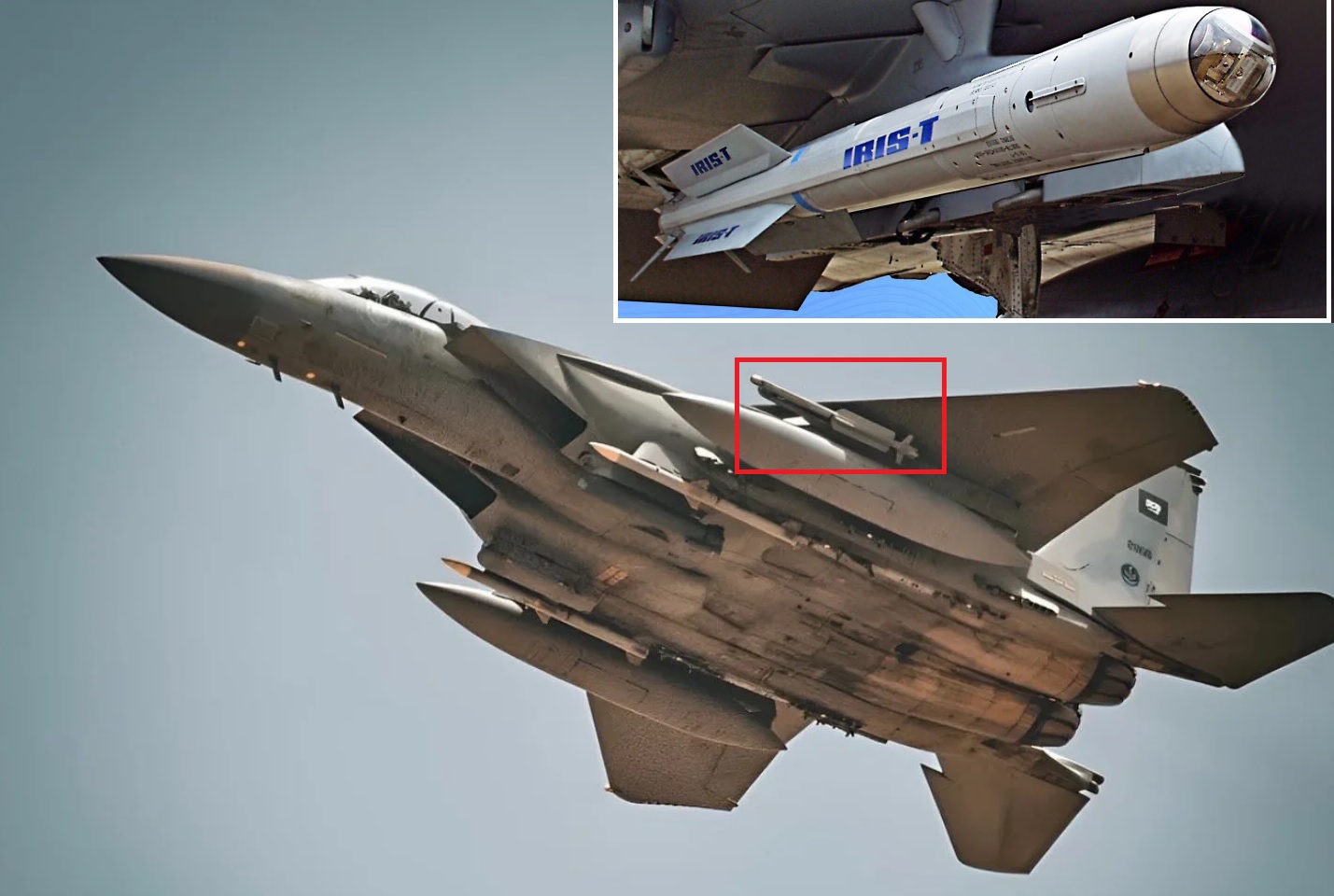
RIYADH, — May 24, 2026 : A Royal Saudi Air Force (RSAF) F-15SA fighter jet has been publicly observed carrying the European-developed IRIS-T short-range air-to-air missile, marking the first known appearance of the advanced missile integrated onto a Boeing F-15 platform. The development, first reported by Arab Defense through published imagery, signals an expansion of Saudi Arabia’s aerial weapons integration strategy and highlights efforts to increase compatibility across its mixed fighter fleet.
The RSAF’s F-15SA fleet has traditionally relied on the U.S.-manufactured AIM-9X Sidewinder for short-range air-to-air combat. However, defense analysts note that the integration of the IRIS-T does not indicate a replacement of the AIM-9X. Instead, it reflects an effort to broaden available weapon options, enabling Saudi Arabia to utilize different missile characteristics depending on operational requirements, threat environments, and electronic warfare conditions.
Strategic Interoperability Across Fighter Fleets
The integration of the IRIS-T on the F-15SA also improves interoperability between Saudi Arabia’s U.S.- and European-origin combat aircraft. The RSAF operates the Eurofighter Typhoon, which already employs the IRIS-T as part of its standard air combat loadout. Standardizing missile access across both fleets may provide benefits in pilot training, mission planning, logistical coordination, and ammunition management.
Defense observers suggest that using a common short-range missile across multiple fighter platforms can simplify maintenance and supply procedures while increasing operational flexibility during joint missions involving different aircraft types.
Technical Profile of the IRIS-T Missile
The Infra Red Imaging System Tail/Thrust Vector-Controlled (IRIS-T) was developed by a European consortium led by Germany’s Diehl Defence, with participation from Italy, Sweden, Greece, Norway, and Spain. The missile entered service in 2005 and has since become the standard short-range air-to-air weapon used by most European fighter aircraft.
A defining feature of the missile is its Imaging Infrared (IIR) seeker, which generates a high-resolution image of a target rather than relying solely on thermal signatures. This capability improves target discrimination and increases resistance to infrared countermeasures such as flares and advanced decoys, enhancing performance in contested air combat environments.
The missile is designed for high maneuverability through a combination of thrust-vectoring propulsion and gas-dynamic control surfaces, enabling it to withstand maneuvers of up to 60 g. This allows the system to engage highly maneuverable and supersonic aerial targets during close-range engagements.
Another notable capability is its high off-boresight targeting envelope, allowing engagement of threats at angles exceeding 90 degrees relative to the aircraft’s forward direction. This permits pilots to target aircraft positioned beside or behind their own platform without requiring significant changes in flight path. The missile has an effective operational range of approximately 25 kilometers.
Wider Platform Integration and Air Defense Role
Beyond the Eurofighter Typhoon and Saudi Arabia’s F-15SA, the IRIS-T has been integrated into several fighter aircraft platforms, including the JAS 39 Gripen, F-16 Fighting Falcon, and modified F/A-18 Hornet fleets operated by multiple air forces.
The missile family has also been adapted into ground-based air defense systems through the IRIS-T SLS (Short-Range) and IRIS-T SLM (Medium-Range) variants. These systems have seen operational deployment in several countries and have been used extensively in Ukraine’s active air defense network, further demonstrating the flexibility of the platform.
Procurement History and Policy Context
Saudi Arabia has maintained a long-term procurement relationship with the IRIS-T program. According to data from the Stockholm International Peace Research Institute (SIPRI), Riyadh ordered approximately 1,400 IRIS-T missiles in 2009, with deliveries completed between 2010 and 2014 to support Eurofighter Typhoon and Tornado aircraft operations.
In 2024, the German government approved the export of an additional 150 IRIS-T air-to-air missiles to Saudi Arabia. The decision marked the end of a five-year restriction period imposed by Berlin following Saudi Arabia’s involvement in the Yemen conflict and the 2018 killing of journalist Jamal Khashoggi. The approval enabled replenishment of Saudi missile stocks and supported broader integration across combat platforms.
F-15SA Capability Expansion
The F-15SA represents the most advanced F-15 variant in RSAF service and incorporates several modern combat systems, including the APG-63(V)3 Active Electronically Scanned Array (AESA) radar, digital fly-by-wire flight controls, advanced electronic warfare systems, a digital cockpit architecture, and an Infrared Search and Track (IRST) capability.
The aircraft can carry a wide range of air-to-air and air-to-surface weapons across 11 external hardpoints, giving it significant operational flexibility for air superiority, strike, and multirole missions.
Operational Significance
The appearance of the IRIS-T missile on the F-15SA aligns with Saudi Arabia’s broader efforts to diversify combat aircraft armament while improving compatibility between U.S.- and European-origin defense systems already in service. Although no official statement has been released by the Royal Saudi Air Force, Boeing, or Diehl Defence regarding the timeline or operational certification of the integration, the public sighting suggests the capability is progressing within Saudi operational planning.
——— End of Article ———