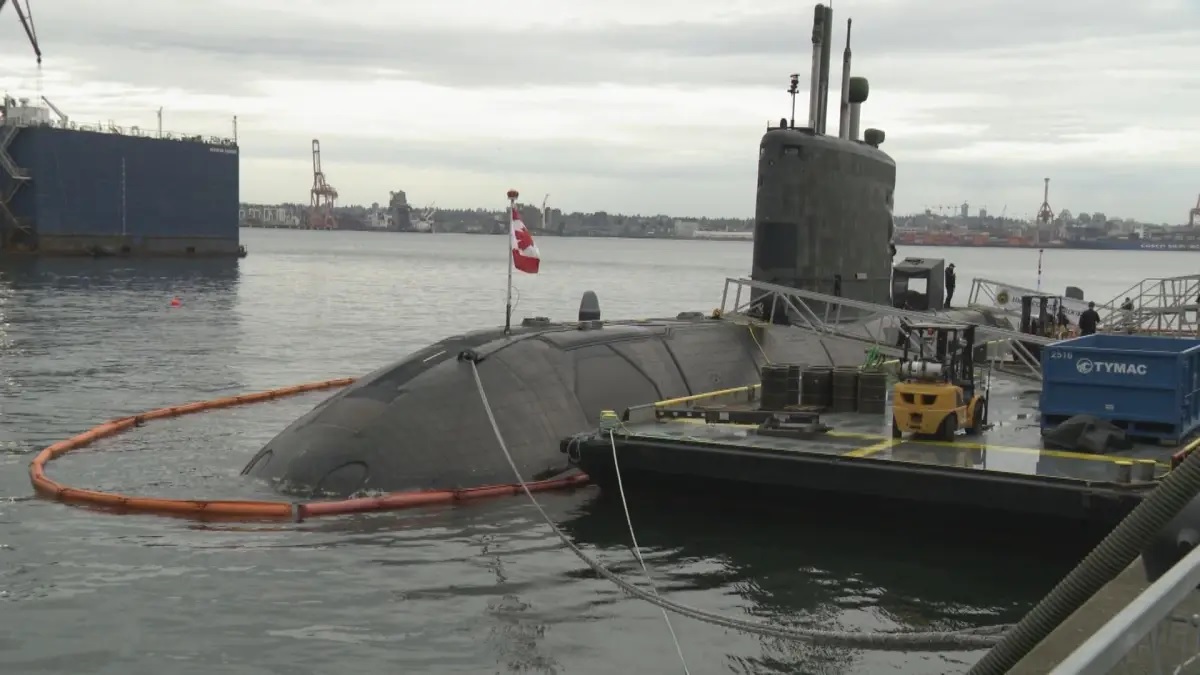
ESQUIMALT, British Columbia, — June 14, 2026 : Canada will deploy the Victoria-class submarine HMCS Corner Brook to the Rim of the Pacific (RIMPAC) 2026 exercise off the coast of Hawaii, marking the Royal Canadian Navy’s first submarine participation in the multinational naval drills in more than a decade.
The submarine is scheduled to depart from Canadian Forces Base Esquimalt in the coming days and will join a large Canadian task group participating in the 30th edition of RIMPAC, which will be held from June 24 to July 31, 2026. Hosted by the U.S. Pacific Fleet, the exercise is regarded as the world's largest international maritime training event, bringing together approximately 25,000 to 30,000 military personnel, around 40 surface ships, five submarines, and 140 aircraft from 31 partner nations.
The deployment ends a 12-year absence of Canadian submarine participation in the biennial exercise. Canada last sent a submarine to RIMPAC in 2014, when HMCS Victoria took part. A planned return in 2020 was canceled due to the COVID-19 pandemic.
HMCS Corner Brook Returns to International Operations
HMCS Corner Brook is currently the only operational submarine among Canada’s four-vessel Victoria-class fleet. The vessel recently completed an extensive maintenance and modernization program at Esquimalt, involving approximately 90,000 hours of work aimed at extending its operational life and improving combat capabilities.
The submarine returned to active service in 2025 after more than 14 years of repairs and upgrades following a grounding incident off Vancouver Island in 2011 that caused significant damage to its bow. Immediate repairs following the accident cost approximately $20 million, while a broader refit and life-extension program required an additional $695 million in investment.
The modernization effort included upgrades designed to improve the submarine’s effectiveness in contemporary naval operations. Enhancements include a modernized electronic warfare system capable of improving detection and identification of nearby vessels and potential threats, a new battery system with advanced remote-monitoring capabilities, the installation of the BQQ-10 sonar suite, and integration of the Mk 48 Mod 7AT heavyweight torpedo.
According to Lt.-Cmdr. Linda Coleman, spokesperson for Maritime Forces Pacific, the Victoria-class submarines may be older platforms, but they have been equipped with modern systems necessary to address evolving operational requirements and emerging threats.
Earlier this month, HMCS Corner Brook participated in combat training exercises off Vancouver Island alongside the Republic of Korea Navy’s KSS-III submarine Dosan Ahn Chang-ho, a modern submarine platform built by Hanwha Ocean. The South Korean vessel is among the designs being promoted as a potential replacement for Canada’s aging submarine fleet.
Canadian Forces to Demonstrate New Naval Capabilities
During RIMPAC 2026, Canadian naval forces will participate in a range of operational scenarios, including anti-submarine warfare training, torpedo and missile firings, maritime interdiction operations, and ship-boarding exercises.
Canada is also using the exercise as an opportunity to demonstrate recently introduced capabilities aboard its surface fleet.
The Halifax-class frigate HMCS Regina is expected to conduct a live firing of the Evolved Sea Sparrow Missile (ESSM) Block II, a next-generation air-defense missile equipped with its own onboard radar seeker. The missile is designed to engage high-speed aircraft and anti-ship cruise missiles and represents a significant enhancement to the Royal Canadian Navy’s layered air-defense capabilities.
Meanwhile, HMCS Ottawa will showcase the navy’s new Underwater Warfare Suite Upgrade, which combines active intercept sensors with a towed low-frequency sonar array to improve the detection and tracking of modern submarines at greater ranges. The system is expected to be installed across the entire Halifax-class fleet by 2034.
Broad Canadian Contribution to RIMPAC
Canada’s participation extends beyond its naval vessels and includes approximately 800 personnel drawn from the Royal Canadian Navy, Royal Canadian Air Force, and other military organizations.
The Canadian contingent will include the replenishment ship MV Asterix, a CP-140 Aurora long-range maritime patrol aircraft, and two CH-148 Cyclone helicopters operating from deployed frigates. The aircraft and helicopters will provide surveillance, reconnaissance, and anti-submarine warfare support throughout the exercise.
Additional specialized teams include clearance divers, a fleet cyber-protection group, and medical emergency response personnel, reflecting the broad scope of Canadian involvement.
Canada will also play a key leadership role by commanding the multinational air component during RIMPAC 2026, overseeing coordinated air operations involving participating nations.
Supporting Canada's Indo-Pacific Strategy
Canada has participated in every RIMPAC exercise since 1971, when the event was established by Canada, the United States, and Australia. The country's continued involvement aligns with the objectives outlined in its 2022 Indo-Pacific Strategy, which committed $2.3 billion over five years to strengthen Canada's military presence and security partnerships throughout the region.
As regional maritime activity and security challenges continue to evolve, RIMPAC provides participating nations with an opportunity to enhance interoperability, test advanced military systems, and strengthen cooperation across the Indo-Pacific.
The deployment of HMCS Corner Brook represents a significant milestone for Canada’s submarine force and highlights ongoing efforts to modernize naval capabilities while maintaining an active role in multinational maritime security operations.
——— End of Article ———