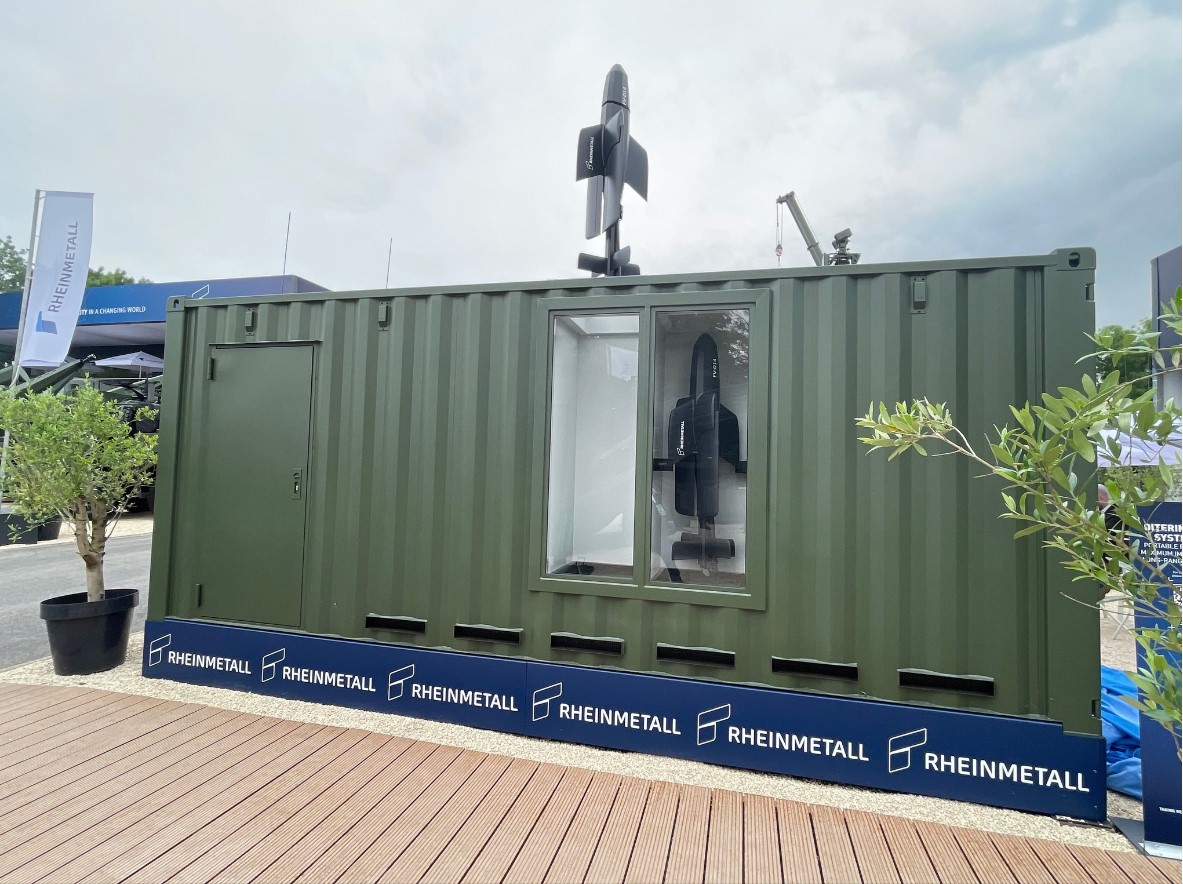
Paris, France, — June 16, 2026 : German defense manufacturer Rheinmetall has officially unveiled its new Containerized Missile Launcher (CML) for the FV-014 Loitering Munition System at the Eurosatory 2026 defense exhibition in Paris. Designed around a standard 20-foot shipping container, the new launcher combines reconnaissance and precision-strike capabilities while offering a flexible deployment solution for modern military operations.
Container-Based Launch System Designed for Flexible Deployment
The Containerized Missile Launcher (CML) is built to provide mobility, rapid deployment, and operational flexibility. By utilizing a standard 20-foot container format, the system can be transported and deployed using a wide range of military and civilian platforms, including trucks, rail cars, and ships.
The launcher can carry up to 18 FV-014 loitering munitions in a ready-to-launch configuration. Rheinmetall said the CML is a fully autonomous and networked system equipped with its own power supply, battery system, and communication modules. A built-in sleep mode enables extended standby operations, while an optional generator can further increase operational endurance.
The system can transition from standby to active mode on command, allowing remote launch operations with minimal personnel requirements. Its modular design also enables integration with different platforms and command structures.
FV-014 Combines Reconnaissance and Precision Strike Capabilities
The FV-014 loitering munition serves as the core weapon of the new launcher system. Weighing approximately 20 kilograms, the unmanned aerial vehicle combines intelligence gathering, target tracking, and precision-strike functions within a single platform.
The munition is equipped with a 5-kilogram High-Explosive Dual Purpose (HEDP) warhead capable of penetrating more than 600 millimeters of rolled homogeneous armor (RHA). This capability allows it to engage armored vehicles, artillery systems, fortified positions, and infrastructure targets.
Key Specifications of the FV-014
- Maximum range: Up to 100 kilometers
- Data link range: Up to 60 kilometers
- Flight endurance: Up to 70 minutes
- Warhead: 5 kg High-Explosive Dual Purpose (HEDP)
- Armor penetration: More than 600 mm RHA
- Propulsion: Quiet electric motor
- Sensor suite: 360-degree swiveling nose-mounted gimbal
- Navigation: Capable of operating in GNSS-denied environments
- Control: Human-in-the-loop operation with swarm capability
A 360-degree swiveling gimbal located at the front of the aircraft enables continuous target observation and surveillance. The FV-014 uses a quiet electric propulsion system and an aerodynamic wing design with faceted surfaces intended to reduce acoustic, thermal, and radar signatures.
Rheinmetall stated that the munition is designed to maintain operational effectiveness in electronically contested environments where Global Navigation Satellite System (GNSS) signals may be disrupted or jammed.
Swarm Operations Enable Simultaneous Target Engagement
One of the key features of the FV-014 is its ability to conduct swarm operations. The system's software architecture allows a single operator to launch and control multiple loitering munitions simultaneously.
This capability enables coordinated attacks against several targets at once or concentrated strikes against a single objective. The swarm functionality can also support wider-area reconnaissance and target tracking missions while reducing operator workload.
Integration Through Rheinmetall Battlesuite
The CML and FV-014 are integrated into Rheinmetall's Battlesuite digital architecture, which connects sensors, platforms, command systems, and weapon systems across the battlefield.
The launcher uses the Battlesuite Interface Collection, a set of open interfaces based on NATO STANAG standards as well as internationally recognized civilian standards such as ROS2 and MAVLink. This approach enables integration with existing national command-and-control networks and third-party systems.
According to Rheinmetall, the architecture supports a range of digital battlefield applications, including:
- Tactical mission planning
- AI-assisted target classification
- Multi-mode target tracking
- Autonomous unmanned system control
- Battlefield management and command functions
- Counter-UAS operations
The company said the open architecture is intended to simplify integration efforts while improving information sharing and operational coordination across different military platforms.
Production and Procurement
The FV-014 is developed and manufactured entirely within the European Union and has been designed for large-scale industrial production. Rheinmetall said the system uses modular components and established manufacturing processes to support high-volume output.
The program gained momentum following a successful live-fire demonstration conducted for a NATO customer at the German Aerospace Center in February 2026. Subsequently, in April 2026, the German Armed Forces (Bundeswehr) signed a multi-billion-euro framework agreement for the procurement of tens of thousands of FV-014 loitering munitions. Initial deliveries are expected to begin in 2027.
Eurosatory 2026 Debut
The Containerized Missile Launcher (CML) and FV-014 made their public debut at Rheinmetall's stand during Eurosatory 2026, held in Paris from June 15 to 19.
With the introduction of the CML, FV-014, and Battlesuite architecture, Rheinmetall is expanding its portfolio of networked reconnaissance and strike systems. The company positions the integrated solution as a platform designed to support reconnaissance, target engagement, force protection, and command connectivity across modern operational environments.
——— End of Article ———