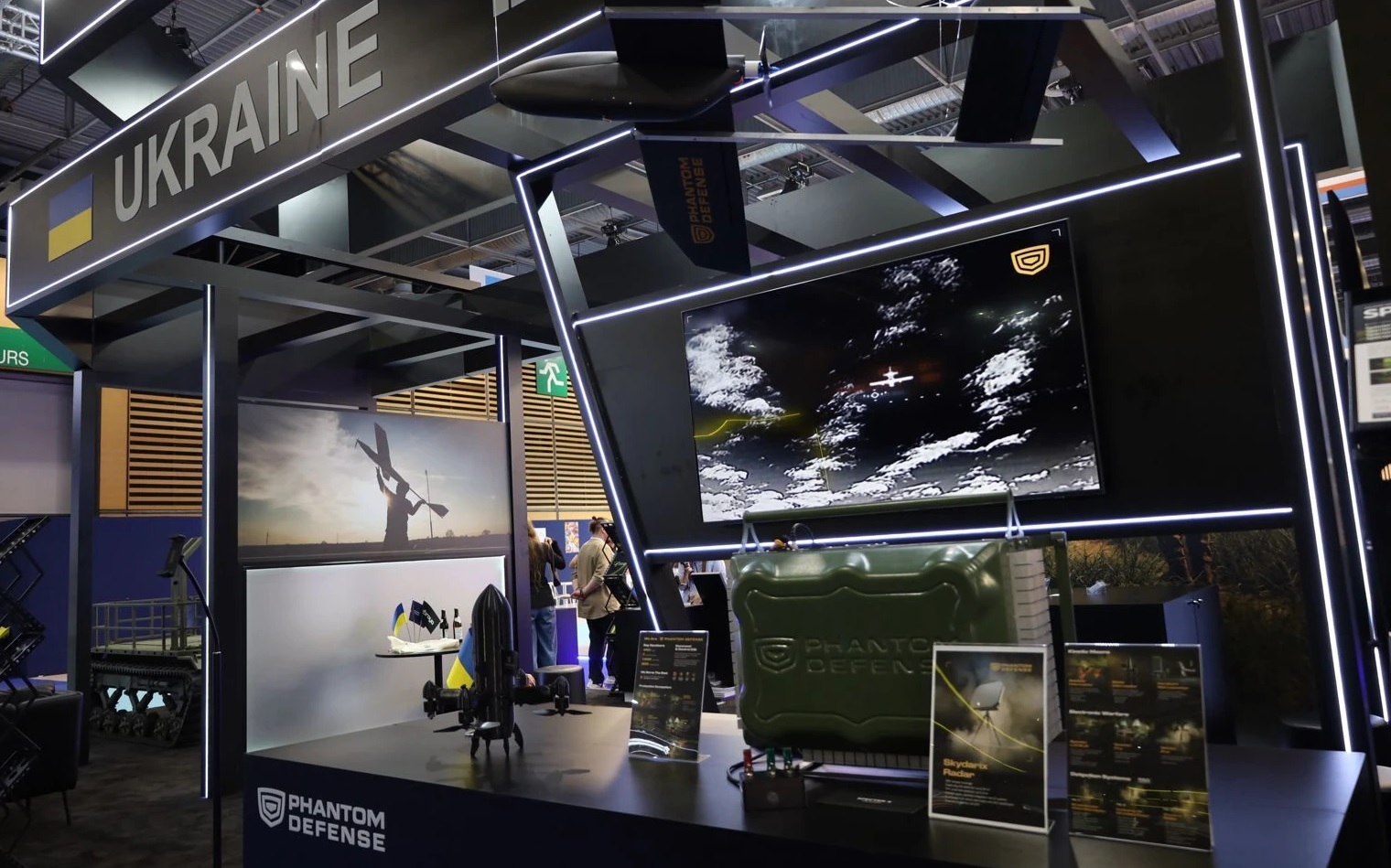
KYIV, Ukraine — Ukrainian defense technology company Phantom Defense has unveiled an integrated counter-unmanned aerial system (C-UAS) ecosystem that combines electronic warfare systems, interceptor drones, detection sensors and a centralized command-and-control (C2) platform into a single operational network.
The system was presented during the Brave1 Advantage defense technology event in Kyiv after it was previously showcased at the Eurosatory 2026 exhibition in Paris. Rather than offering individual products, Phantom Defense displayed a "Detect-to-Defeat" architecture that detects, tracks, identifies and neutralizes different types of aerial threats through one integrated network.
At the center of the ecosystem is a centralized C2 platform that combines data from radars, radio-electronic intelligence sensors and video interceptors to create a single operational picture. The software automatically identifies targets, gives operators real-time engagement recommendations and records the results of every engagement for later operational analysis.
The company also introduced several electronic warfare systems under its Specter family. The Specter L, XL and A variants are built to protect both fixed and mobile assets while providing 360-degree coverage. Depending on the configuration, they operate across the 300-900 MHz frequency range and support active jamming at 1.4 GHz, 2.4 GHz and 5.8 GHz.
The Specter Pro system provides omnidirectional narrowband signal suppression across frequencies from 250 MHz to 6 GHz. It is supported by the Vector Pro directional jammer, which covers the same 250 MHz to 6 GHz frequency range for targeted electronic suppression.
Phantom Defense also displayed several kinetic interception systems. The Balaban fixed-wing interceptor drone has an endurance of up to 2.5 hours, a maximum speed of 260 km/h and can carry a 1.2 kg payload.
The Blade Interceptor multirotor drone is intended to engage Shahed-type attack drones. It has a top speed of 310 km/h, an operational range of 15 km and a 0.5 kg payload. The company also presented the Karakurt net-launching module, which can be integrated with different drone platforms to disable aerial targets by deploying nets.
Several detection systems were also introduced as part of the ecosystem. The Streamhunter video interceptor is already available and detects signals at ranges of up to 30 km across frequencies from 800 MHz to 8 GHz. It can receive five channels simultaneously and has a detection time of less than one second.
The Skydarix all-round radar, planned for release in the fourth quarter of 2026, can detect aircraft-type drones at distances of up to 20 km and FPV drones at up to 5 km. It also supports ASTERIX protocol integration.
The Radiotrex direction finder, expected in the second quarter of 2027, has a detection range of 30 km, operates across 300 MHz to 8 GHz, provides directional accuracy of up to 3 degrees, and features a 250 MHz bandwidth.
Phantom Defense said the ecosystem has already been tested under operational conditions in Ukraine during a project protecting urban infrastructure in one regional center. The company said the deployment provided more than 90% of a dome protection system covering an area of more than 100 square kilometers.
Between June 1, 2025, and June 24, 2026, the company said the system detected 10,821 hostile drones and actively suppressed 7,397 of them.
"There is no single answer for all types of threats from drones; each type of UAV requires a special approach," a Phantom Defense representative said. "That is why we do not sell individual devices—we offer an ecosystem of solutions that have already proven their effectiveness in combat conditions."
Phantom Defense employs more than 600 personnel and said its production capacity exceeds 100 interceptor drones and 200 electronic warfare units per day to support ongoing operational requirements.
——— End of Article ———