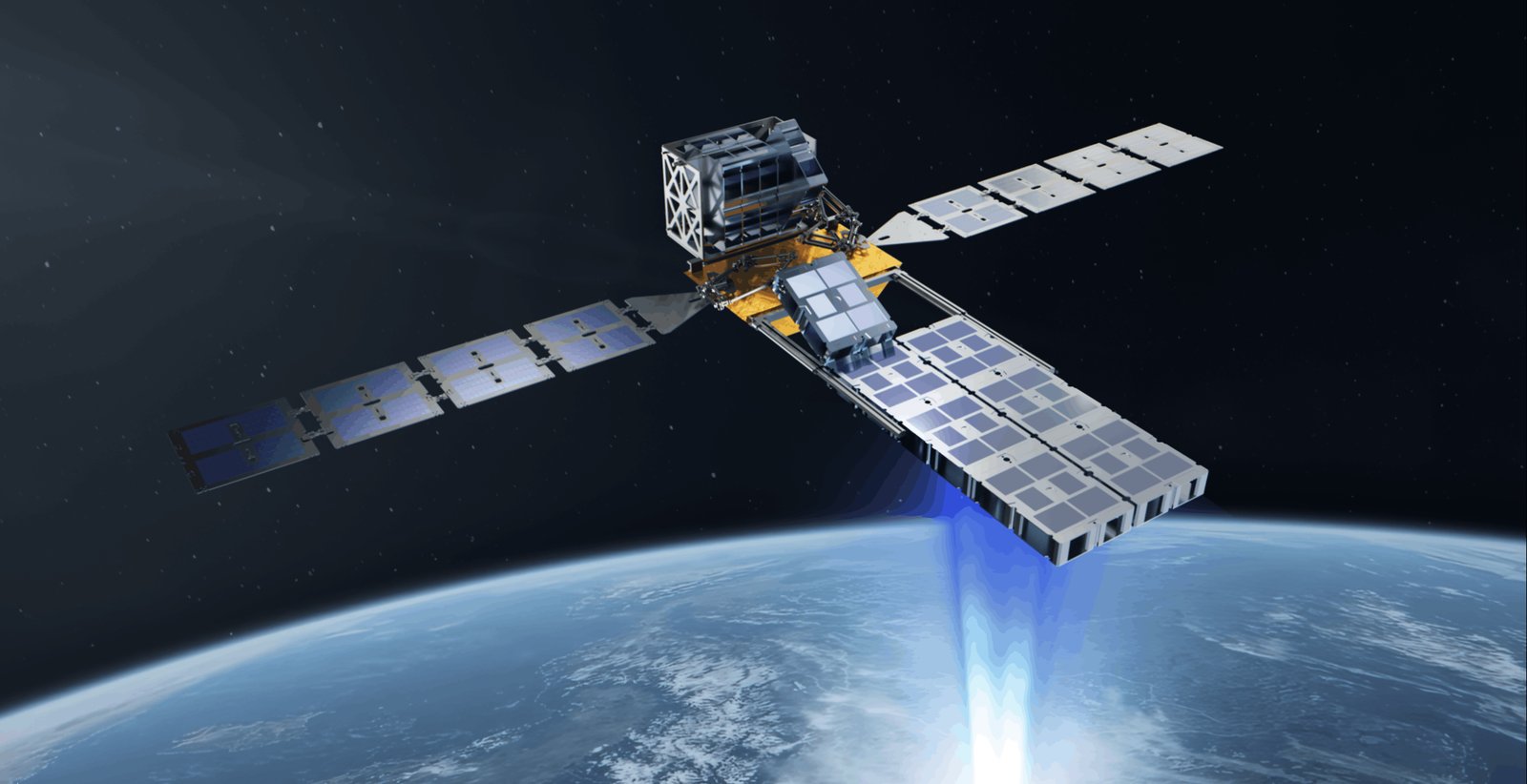
BROOMFIELD, Colo. — The Pentagon has selected Katalyst Space to develop and launch a robotic spacecraft that will assemble a large-format space-based solar power system in low Earth orbit and transmit electricity back to Earth.
The project is being carried out under the Advanced Scalable Growth Architecture for Robotic Deployment (ASGARD) program and is funded through the Operational Energy Capability Improvement Fund (OECIF). Katalyst announced the selection on September 21.
NEXUS to Assemble Solar Power System in Orbit
Katalyst will use its NEXUS multi-mission robotic spacecraft for the mission. The spacecraft is designed for mobility, manipulation and autonomous operations in space.
NEXUS will carry modular power-generation and power-beaming tiles being developed by the U.S. Naval Research Laboratory (NRL). After reaching low Earth orbit, NEXUS will use its robotic arms to assemble the tiles into a large-format power-beaming system.
The assembled system will collect solar energy, convert it into radio-frequency microwave energy and transmit the energy to a receiving station on Earth.
The orbital assembly approach is intended to overcome the volume limitations of individual launch vehicles. Large power-beaming structures can exceed the space available inside a single launch vehicle, so separate components can instead be launched and assembled after reaching orbit.
Katalyst said the system is designed to be resupplied, expanded and scaled over time. The company's longer-term vision is to increase the capability from kilowatts toward megawatts of power.
Intended Operational Applications
OECIF focuses on developing energy technologies for future military operations. According to Katalyst, space-based power generation could provide electricity to remote operational locations and areas where electrical grids are constrained or disrupted, without depending on fuel supplies or conventional terrestrial infrastructure.
The technology is also intended to provide resilient power for on-orbit missions and could have applications in disaster areas or other locations where terrestrial power infrastructure is unavailable or damaged.
NRL Power-Beaming Research
The ASGARD effort builds on NRL's previous work on solar-to-microwave power conversion.
NRL previously flew a Photovoltaic Radio-frequency Antenna Module (PRAM) experiment aboard the U.S. Air Force's X-37B spaceplane to study solar-to-microwave conversion in orbit. NRL has also conducted a ground demonstration in which 1.6 kilowatts of power was transmitted across approximately one kilometer using microwaves.
ASGARD will combine this power-conversion work with robotic assembly capabilities to demonstrate the construction and operation of a larger power-beaming system in orbit.
Katalyst's Expanding Robotic Spacecraft Work
Katalyst Space was founded in 2020 and is developing autonomous robotic spacecraft for operations in orbit. Its NEXUS platform is intended for tasks involving spacecraft mobility, manipulation, docking and servicing.
The company is also developing the LINK robotic spacecraft. LINK launched on July 3, 2026, aboard a Northrop Grumman Pegasus XL rocket and is being used for a mission involving NASA's Neil Gehrels Swift Observatory.
A program kickoff event for ASGARD was held at Katalyst's Broomfield, Colorado, facility on September 2, 2026.
Katalyst and the Pentagon have not disclosed the contract value or launch date for the ASGARD mission. The next major work will involve development of the NEXUS spacecraft and the NRL power-beaming tiles.
——— End of Article ———