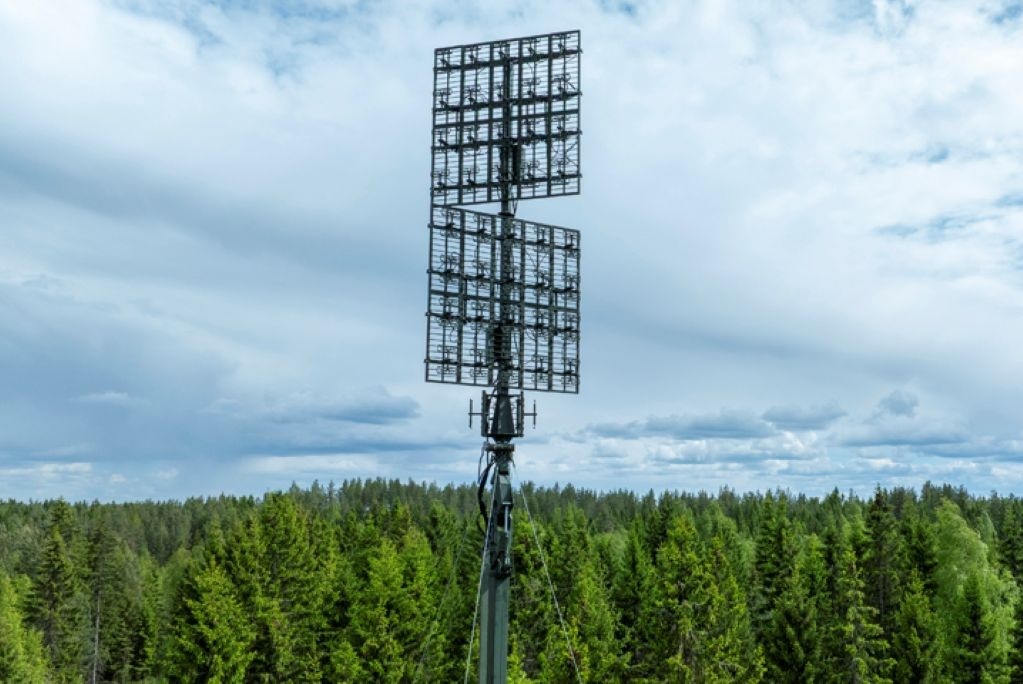
PARIS, — June 16, 2026 : Nordic defense and technology company Patria has officially launched the Patria WISPR (Weapon Indication and Sensing Passive Radar) at the Eurosatory 2026 defense exhibition in Paris. The new system is designed to detect and locate incoming artillery, mortar, and rocket fire without emitting detectable radio frequency signals, offering a passive approach to counter-battery operations.
The launch expands Patria’s portfolio of passive sensing technologies and addresses a growing challenge on modern battlefields, where active radar systems can become vulnerable to detection, electronic warfare measures, and precision strikes due to their own emissions.
Passive Detection Technology
Patria WISPR is based on Passive Coherent Location (PCL) technology, which allows the system to operate without transmitting radio signals. Instead, it utilizes existing commercial broadcasts in the environment, primarily digital television transmitters, as sources of illumination.
By analyzing how projectiles reflect these signals, the system can detect, locate, and track artillery shells, mortar rounds, and rockets at operationally relevant ranges. Because the radar does not emit its own signals, it remains difficult to detect through conventional electronic warfare systems.
The system uses antenna arrays and advanced passive signal-processing technology to maintain continuous surveillance while minimizing its electromagnetic signature.
Addressing Modern Battlefield Requirements
The introduction of WISPR comes as military forces increasingly operate in contested environments where the time between target detection and enemy response is rapidly decreasing. Active counter-battery radars provide critical battlefield awareness but can expose their positions once they begin transmitting.
According to Patria, WISPR is designed to provide persistent projectile detection while reducing the risk associated with active radar emissions.
“Patria WISPR will be critical in enabling a new level of resilience and survivability in counter-battery operations. In today’s operational environment, where the time from detection to strike is short, active radars risk exposure due to their emissions. Patria WISPR responds to this challenge by providing a silent projectile detection,” said Mikko Leino, Executive Vice President of Patria’s Defence and Weapon Systems business area.
Flexible Deployment Options
Patria stated that WISPR can be deployed in two primary operational roles.
As a standalone system, it can serve as the main projectile-tracking sensor near frontline positions, providing continuous surveillance without revealing its location through emissions.
The system can also function as a cueing sensor alongside conventional active counter-battery radars. In this role, WISPR can monitor the battlefield while active radars remain switched off, activating them only when additional tracking information is required. This approach can help extend the operational availability and survivability of active radar assets.
Coverage and Networked Operations
The WISPR system provides more than 100 degrees of azimuth coverage and features a high update rate for target tracking. Its modular design allows deployment as a single remote-controlled station or as a network of multiple interconnected stations covering larger operational areas.
Both deployment configurations support remote operation and management, enabling flexible integration into existing surveillance and command networks.
Additional Air Surveillance Capability
Beyond its counter-battery role, WISPR is also capable of performing air surveillance missions. Patria said the system can detect and track aerial targets, including low-observable and highly maneuverable unmanned aerial vehicles (UAVs) operating in radio silence.
The dual-use capability allows the system to contribute to both ground-force protection and wider airspace monitoring requirements.
Built on Existing Passive Radar Technology
WISPR builds upon the technological foundation of Patria’s MUSCL passive air surveillance radar, which was developed to provide covert target detection using external radio-frequency sources. Both systems share the same principle of detecting targets without transmitting signals, reducing exposure to enemy electronic surveillance and countermeasures.
Displayed at Eurosatory 2026
Patria is presenting the WISPR system at its stand in Hall 6 (F126 and F146) during Eurosatory 2026, taking place in Paris from June 15 to June 19.
The introduction of WISPR reflects the growing focus on passive sensing technologies within the defense sector, as armed forces seek surveillance and target-location systems capable of operating effectively in increasingly contested electromagnetic environments.
——— End of Article ———