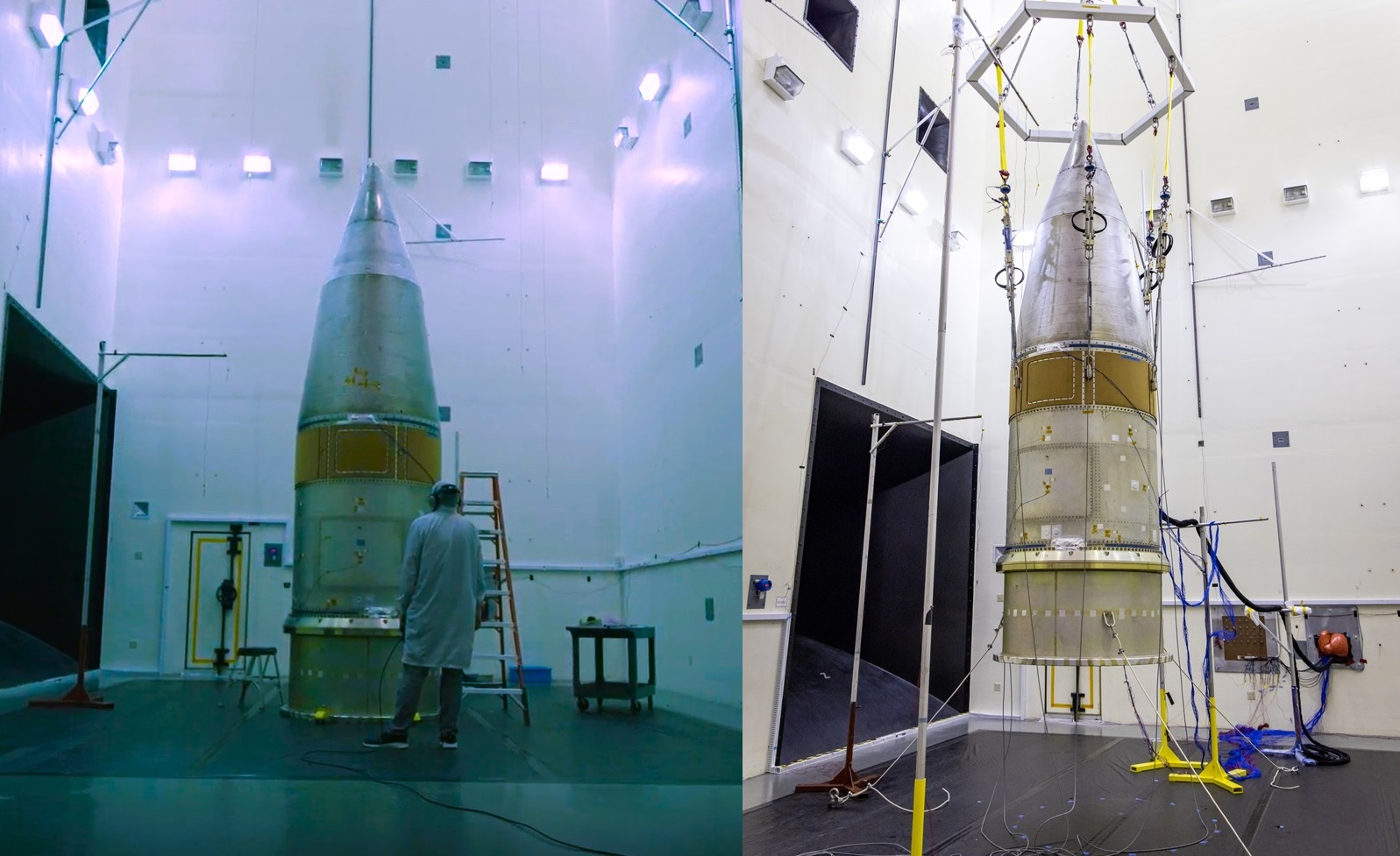
REDONDO BEACH, California, June 30, 2026 — Northrop Grumman has released the first public photographs of hardware for the LGM-35A Sentinel intercontinental ballistic missile (ICBM), marking a significant milestone in the U.S. Air Force's next-generation strategic missile program. The images show the missile's nose section, known as the integrated front end, inside the company's Large Acoustic Test Facility in Redondo Beach, California, following the successful completion of structural validation testing.
According to Northrop Grumman, the acoustic testing campaign remains on schedule and represents one of the final major engineering milestones before the Sentinel's planned first flight test in 2027. The release of physical hardware images also indicates that the program is moving from digital design and engineering into full-scale manufacturing and hardware qualification.
The published photographs show a large cone-shaped metallic structure positioned inside a high-bay test chamber, with an engineer in protective clean-room clothing standing nearby to illustrate the scale of the assembly.
Integrated Front End Undergoes Acoustic Qualification
The hardware tested is designated as the integrated front end, a critical section of the missile that combines two major components:
- The Payload Reentry System, which houses the nuclear reentry vehicle.
- The Post-Boost Attitude Control Module, containing the missile's guidance, navigation, and control systems.
After the Sentinel's three-stage solid rocket boosters complete their burn and separate during flight, the integrated front end assumes control of the missile's trajectory. Using onboard computers, sensors, and maneuvering thrusters, it performs precise flight corrections before the reentry vehicle separates for its terminal descent.
Because the guidance package contains highly sensitive electronic and mechanical systems, it must withstand the severe acoustic environment generated during missile launch from underground silos. When an ICBM launches, the rocket motor produces extremely high sound pressure levels inside the launch tube, creating powerful vibrations that could damage internal systems if they are not properly protected.
To verify the design, engineers subjected the integrated front end to simulated launch conditions inside Northrop Grumman's Large Acoustic Test Facility. The component was surrounded by an array of specialized microphones and acoustic equipment capable of reproducing the intense sound environment expected during an operational silo launch.
Lawrence Livermore Supported Test Qualification
The acoustic testing was conducted in collaboration with Lawrence Livermore National Laboratory (LLNL), which helped establish the qualification requirements for the reentry vehicle and its internal payload package.
LLNL is one of the two U.S. national laboratories responsible for certifying the safety and effectiveness of the nation's nuclear warheads. Its role in the Sentinel program includes supporting qualification of the reentry vehicle to ensure it meets stringent nuclear weapon certification standards.
Facility Modernized for Advanced Testing
Northrop Grumman's Large Acoustic Test Facility has previously supported qualification testing for several major aerospace programs, including the James Webb Space Telescope, commercial satellites, and national security spacecraft.
To improve testing capability, the company recently invested more than $1 million to upgrade the facility's control systems from analog to digital technology. The modernization enables higher measurement accuracy, improved data collection, and more precise generation of high-decibel acoustic environments.
Replacing the Minuteman III
The Sentinel program is intended to replace the LGM-30G Minuteman III, which has served as the land-based component of the U.S. nuclear triad since 1970. After more than five decades of service and multiple life-extension efforts, the U.S. Air Force determined that the Minuteman III had reached the practical limits of modernization.
Unlike previous upgrade programs, Sentinel represents a complete replacement of the ground-based strategic missile system. The program includes new missiles, rebuilt launch silos, modernized launch control centers, upgraded command-and-control systems, and new communication infrastructure.
Approximately 400 Sentinel missiles are planned to replace the existing Minuteman III force deployed across Montana, North Dakota, Wyoming, Colorado, and Nebraska. Because current silos were designed specifically for the dimensions and interfaces of the Minuteman III, the U.S. Air Force is rebuilding hundreds of hardened launch facilities while maintaining continuous nuclear alert operations.
As part of this effort, construction has begun on a full-scale modular launch silo prototype at Promontory, Utah, to validate more efficient construction methods for future deployment.
Program Continues Despite Cost and Schedule Challenges
The Sentinel program has faced significant financial and administrative challenges in recent years. Rising infrastructure costs triggered a Nunn-McCurdy breach after program expenses exceeded the original baseline by more than 25 percent, requiring a mandatory review by the U.S. Department of Defense and Congress.
Following the review, the U.S. Air Force concluded that no affordable alternative could replace the aging Minuteman III fleet and directed the program to continue under a government-mandated restructuring process. The restructuring is expected to conclude with a new Milestone B certification later in 2026 under the leadership of Gen. Dale White.
The Congressional Budget Office (CBO) has estimated that the Sentinel program's total lifecycle cost, including reconstruction of the missile infrastructure across five states, could exceed $140 billion, although both the U.S. Air Force and Northrop Grumman have disputed that projection.
Progress Toward First Flight
Alongside the successful acoustic qualification, the Sentinel program has continued to complete major propulsion milestones. Full-scale qualification static-fire tests of the missile's first-stage and second-stage solid rocket motors were successfully completed during 2024 and 2025.
With structural validation, propulsion testing, and hardware manufacturing continuing to advance, the Sentinel program remains on schedule for its first pad launch test in 2027, with operational deployment planned for the early 2030s as the United States modernizes the land-based leg of its nuclear deterrent.
——— End of Article ———