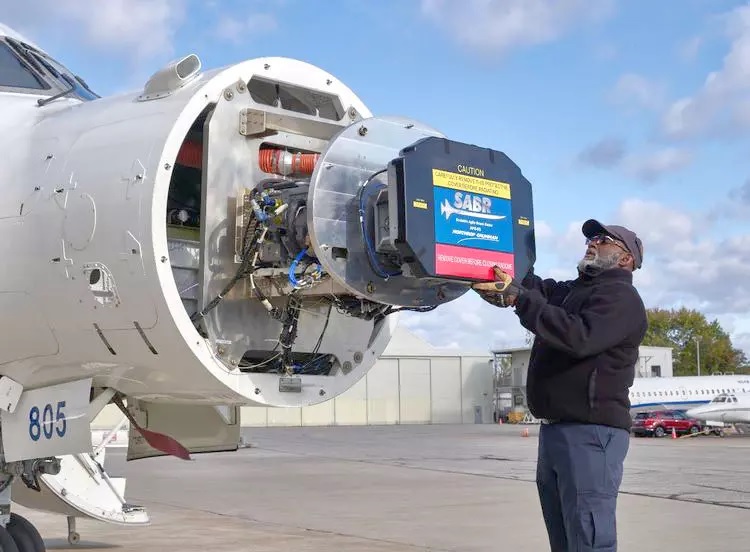
BALTIMORE, — May 20, 2026 : Northrop Grumman has delivered its 1,000th AN/APG-83 Scalable Agile Beam Radar (SABR) system, marking a significant production milestone in the modernization of fourth-generation fighter aircraft operated by the United States and allied nations.
The milestone was announced on May 19 at the company’s radar manufacturing facility in Baltimore, Maryland, where SABR systems are assembled for both domestic and international operators. The AN/APG-83 is an Active Electronically Scanned Array (AESA) fire control radar designed primarily for the F-16 Fighting Falcon, replacing older mechanically scanned radar systems that have remained in service for decades.
AESA Radar Technology
Unlike conventional mechanically scanned radars that rely on physically rotating antenna assemblies, the APG-83 uses hundreds of electronically controlled transmit-receive modules to direct the radar beam almost instantly without moving parts. This architecture enables faster target acquisition, simultaneous tracking of multiple targets, improved reliability, and enhanced resistance to electronic jamming and spoofing.
The radar also provides high-resolution synthetic aperture radar (SAR) ground mapping, moving target indication capability, and improved detection performance in contested electromagnetic environments. Publicly available information associated with the program indicates detection ranges of up to approximately 370 kilometers, depending on operational conditions and target profiles.
Fifth-Generation Technology Integration
Northrop Grumman developed the APG-83 using technology derived from the AN/APG-77 radar used on the F-22 Raptor and the AN/APG-81 radar integrated into the F-35 Lightning II.
The company adapted those technologies into a configuration compatible with existing F-16 airframes while remaining within the aircraft’s original size, power, and cooling limitations. This allows operators to install the radar without requiring major structural modifications to the aircraft.
F-16 Modernization Program
The APG-83 serves as the standard radar for the U.S. Air Force F-16V modernization program and is installed as baseline equipment on all newly built F-16 Block 70 and Block 72 aircraft produced by Lockheed Martin.
The U.S. Air Force is currently upgrading 608 F-16C/D Block 40/42 and 50/52 aircraft with the system as part of a broader fleet sustainment effort intended to keep the aircraft operational through the mid-2040s. Separate modernization work is also underway for Air National Guard F-16 units.
More than 3,000 F-16 aircraft remain operational across approximately 25 countries, making the fighter one of the most widely used combat aircraft in the world. Many operators are pursuing modernization programs to maintain operational effectiveness against advanced air defense and electronic warfare threats.
Operational Feedback
Operational users have reported substantial improvements following the installation of the APG-83. In 2022, Lt. Col. Shaun Loomis of the 480th Fighter Squadron described the transition to SABR-equipped aircraft as a “night and day” improvement after nearly two decades with largely unchanged radar hardware.
During Exercise Ramstein Flag in April 2025, a Greek F-16V pilot stated that the radar significantly improved long-range target tracking and overall situational awareness during multinational air operations.
International Operators
Taiwan became the first international customer for the APG-83 after receiving its first export systems in late 2016. Additional operators selecting F-16 variants equipped with the radar include Greece, Bulgaria, Slovakia, Bahrain, Jordan, and Singapore.
Singapore previously signed a $2.43 billion modernization agreement for its F-16 Block 52 fleet, including the installation of 70 APG-83 radar systems.
Northrop Grumman stated that the radar is currently deployed in nine countries.
Integration With Electronic Warfare Systems
The APG-83 integrates with Northrop Grumman’s Integrated Viper Electronic Warfare Suite (IVEWS), allowing simultaneous operation of radar and electronic warfare functions without mutual signal interference.
According to the company, the radar’s software-defined architecture also enables future capability upgrades through software updates rather than extensive hardware modifications, reducing maintenance requirements and minimizing aircraft downtime.
The system is powered by domestically produced American microelectronics intended to strengthen supply chain reliability and long-term sustainment.
Expansion to Other Aircraft Platforms
Although primarily associated with the F-16 program, Northrop Grumman has also explored integration of the SABR architecture on additional military aircraft platforms.
The company previously conducted fit checks for U.S. Marine Corps F/A-18C/D Hornet aircraft and developed the SABR-GS variant for modernization of the Rockwell B-1 Lancer bomber fleet.
Northrop Grumman stated that the 1,000-unit production milestone reflects continued global demand for AESA radar modernization programs as air forces seek to extend the operational relevance of legacy fighter fleets while incorporating capabilities associated with fifth-generation combat aircraft.
——— End of Article ———