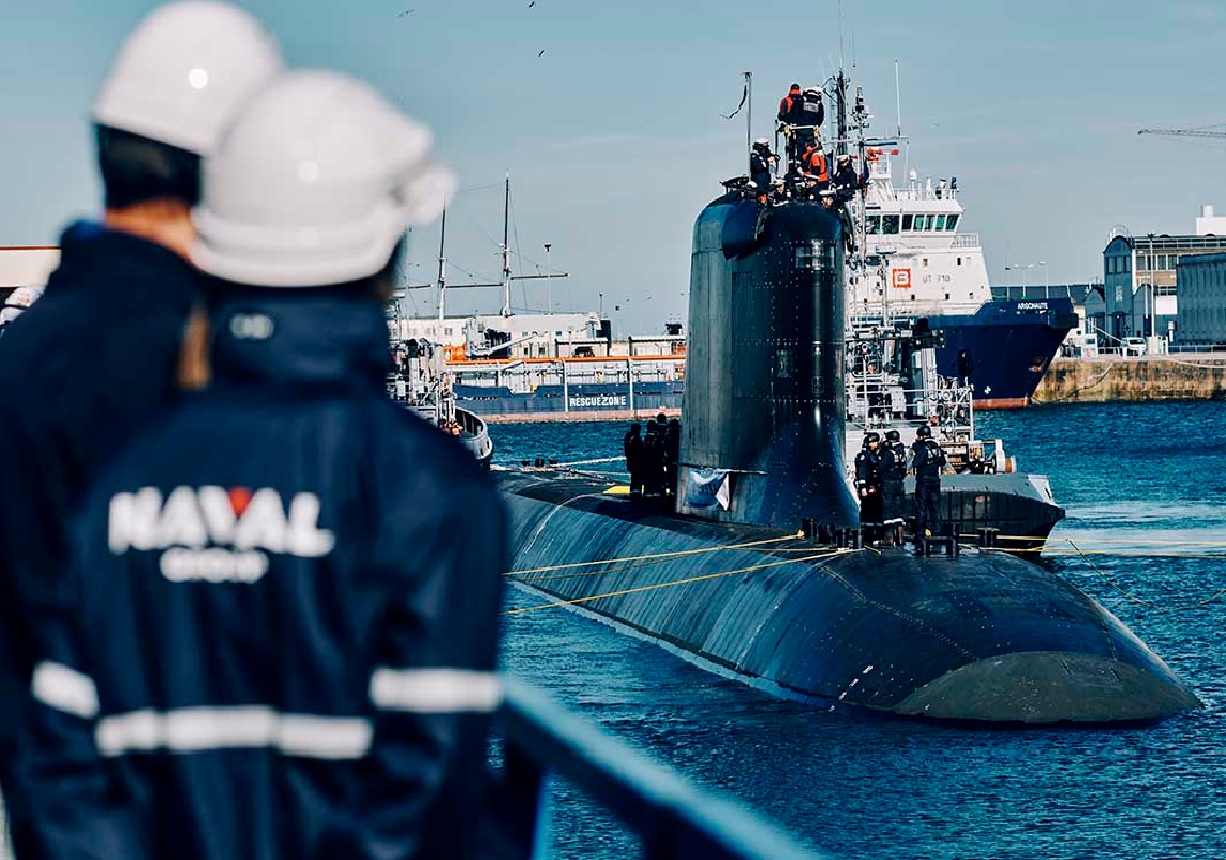
CHERBOURG, France, June 26, 2026 — Naval Group has officially delivered the De Grasse (S636), the fourth Barracuda-class (Suffren-class) nuclear-powered attack submarine (SSN), to the French Defense Procurement Agency (DGA) and the French Navy (Marine Nationale). The handover took place on June 24, 2026, marking another major milestone in France's effort to modernize its submarine fleet through the six-vessel Barracuda program.
The delivery brings the program beyond its halfway point, with four submarines now completed. The Barracuda program is replacing the French Navy's aging Rubis-class nuclear-powered attack submarines with a new generation of more capable and stealthier vessels.
Accelerated Development and Testing
The De Grasse completed its development and acceptance process at an accelerated pace. Naval Group delivered the submarine exactly four months after it began sea trials on February 24, 2026, reflecting experience gained during the construction and testing of the first three submarines in the class.
After rolling out from the Cherbourg construction hall in May 2025, the submarine completed dockside testing before its nuclear reactor achieved divergence in December 2025. This enabled an extensive sea trials campaign in the English Channel and the Atlantic Ocean, leading to final delivery.
Named After a Historic Naval Commander
The submarine is named after Lieutenant Général des Armées Navales François Joseph Paul, Comte de Grasse, Marquis de Grasse-Tilly, who commanded the French fleet during the Battle of the Chesapeake in 1781. His victory over the British Royal Navy played a decisive role in the American Revolutionary War.
Enhanced Combat Systems
Although built on the same core design as the earlier Suffren-class submarines, De Grasse incorporates several technological improvements.
According to Admiral Xavier Petit, Commander of the French Submarine Forces (ALFOST), the submarine features an upgraded version of the SYCOBS combat management system, providing new operational capabilities. It is also equipped with a new-generation electronic warfare suite and sensor technology estimated to be 10 to 15 times more capable than that of the Rubis-class submarines it is replacing.
These improvements enhance the submarine's effectiveness in anti-submarine warfare, anti-surface warfare, intelligence gathering, special operations support, and long-range precision strike missions.
Barracuda Program Progress
The first three Barracuda-class submarines have already entered service:
-
Suffren – June 2022
-
Duguay-Trouin – April 2024
-
Tourville – July 2025
The remaining two submarines, Rubis and Casabianca, are currently under construction and are scheduled for delivery before the end of the decade.
Naval Group serves as the prime contractor for the Barracuda program, overseeing design, construction, testing, and lifecycle support. TechnicAtome co-develops and manufactures the main components of the submarines' nuclear reactors, while Naval Group also provides long-term maintenance and logistical support from the French naval base at Toulon.
Technical Characteristics
The Barracuda-class submarines are designed for stealth, endurance, and multi-mission operations. Each submarine is equipped with a dry deck shelter for the discreet deployment of naval commandos and underwater vehicles, while pump-jet propulsion and advanced acoustic quieting technologies improve underwater stealth.
Specifications
-
Surface displacement: 4,700 tonnes
-
Submerged displacement: 5,200 tonnes
-
Length: 99 metres
-
Diameter: 8.8 metres
-
Crew: 65 personnel, plus capacity for naval commandos
-
Endurance: Approximately 70 days at sea
-
Operational availability: More than 270 days per year
Armament
-
Naval Cruise Missiles (NCM)
-
F21 heavyweight torpedoes
-
Modernised Exocet SM39 anti-ship missiles
-
Provisions for future integration of naval mines, unmanned aerial vehicles (UAVs), and unmanned underwater vehicles (UUVs)
Propulsion
The submarine uses a hybrid propulsion system consisting of a pressurised water reactor derived from those used aboard the Triomphant-class ballistic missile submarines and the Charles de Gaulle aircraft carrier, one propulsion turbine, two turbo generators, and two electric motors driving a low-noise pump-jet propulsor.
The delivery of De Grasse marks another significant step in the modernization of the French Navy's nuclear-powered attack submarine fleet. With four submarines now delivered and the remaining two under construction, the Barracuda program continues to strengthen France's underwater warfare capabilities for the coming decades.
——— End of Article ———