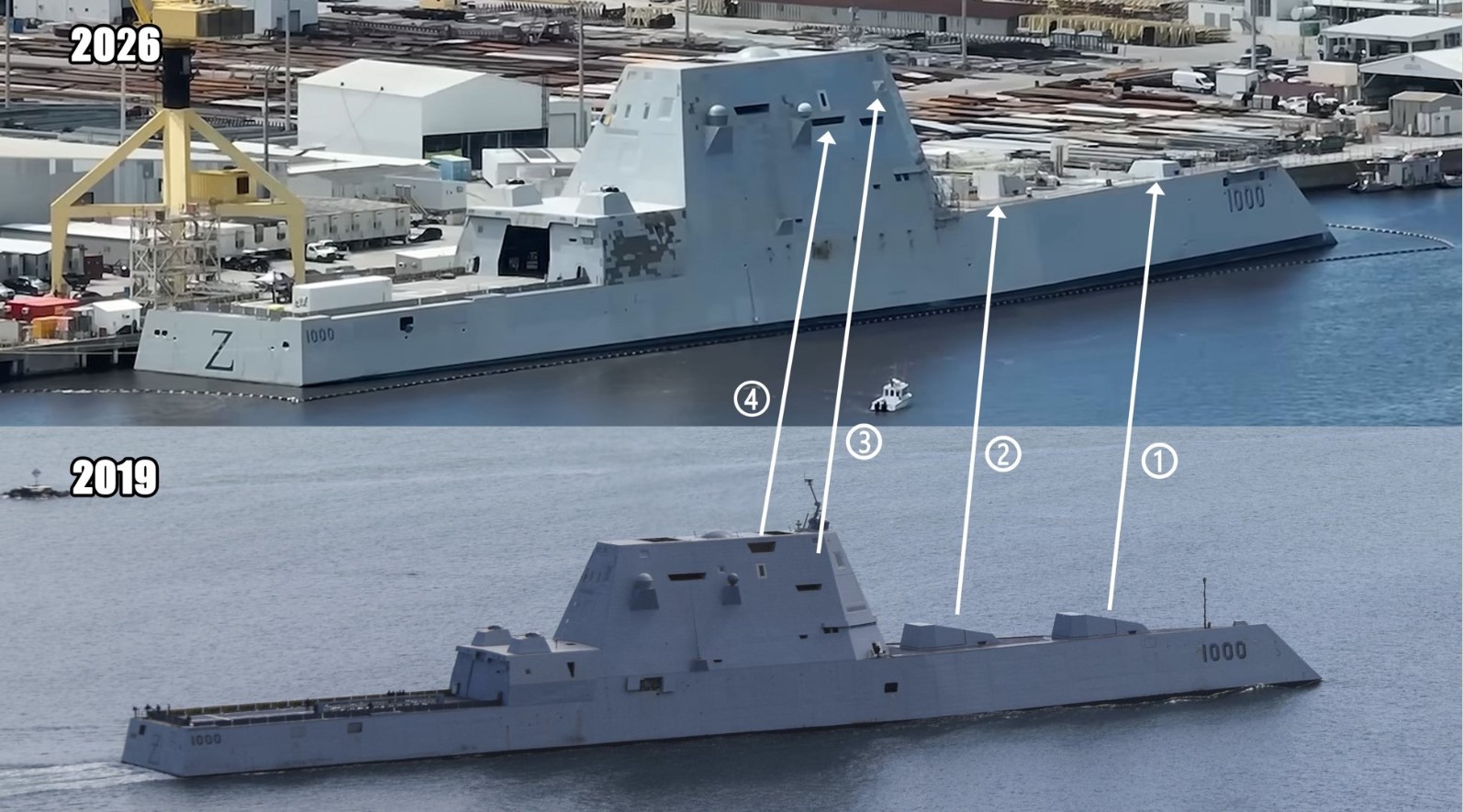
PASCAGOULA, Miss. — The U.S. Navy's stealth destroyer USS Zumwalt (DDG-1000) is in the final stages of a major modernization program that will transform the ship into a platform for long-range hypersonic weapons. Recent images from Bloomberg Television's YouTube video published on July 18, 2026, and analyzed by X account @lfx160219, show several visible external modifications made during the ship's refit at Huntington Ingalls Industries' Ingalls Shipbuilding facility in Pascagoula, Mississippi.
The Navy expects USS Zumwalt to officially return to service in September 2026 after completing its modernization work.
Major External Changes Visible
The latest images highlight several significant structural modifications made to prepare the destroyer for its new role with the Intermediate-Range Conventional Prompt Strike (IR CPS) hypersonic missile system.
The most noticeable change is the removal of the ship's forward 155mm Advanced Gun System (AGS) turret. In its place, engineers have installed four large missile launch tubes protected by a newly designed wave-deflector structure.
The ship's No. 2 AGS turret at the aft has also been removed, leaving only the stealth gun housing in its original position.
Another visible modification is the addition of a new mounting base for the FLIR 380HD electro-optical/infrared (EO/IR) sensor system, which is expected to improve the ship's surveillance and targeting capabilities.
Engineers have also relocated the gas turbine air intakes lower on the hull to help prevent the engines from drawing in exhaust gases from the ship's funnels.
From Naval Gunfire Support to Hypersonic Strike
The modernization represents a major shift in the Zumwalt class's mission.
The destroyers were originally designed around two 155mm Advanced Gun Systems to provide long-range naval gunfire support during amphibious operations. However, the program faced a major setback after the specialized Long-Range Land Attack Projectile (LRLAP) became too expensive for operational use, with each round costing approximately $800,000.
To address this issue, the Navy removed the AGS mounts and installed Advanced Payload Modules, allowing the space previously occupied by the gun magazines to be used for the IR CPS hypersonic missile system. Each Zumwalt-class destroyer is planned to carry 12 Conventional Prompt Strike (CPS) missiles.
Modernization Program and Delays
The Navy's Build Yard Modernization Period (BYMP) for USS Zumwalt began in 2023 and is currently running about 10 months behind its original schedule.
According to government oversight reports and program officials, much of the delay resulted from additional work required during installation of the new missile launch system. Contractors had to remove significantly more cabling than originally expected from the ship's forward section before the new launch tubes could be installed.
The complexity of the destroyer's 78-megawatt Integrated Power System also contributed to the engineering challenges during the refit.
A July 2026 Government Accountability Office (GAO) report also stated that the broader program to equip the Navy's three Zumwalt-class destroyers with hypersonic weapons is running about two years behind schedule, citing integration challenges, additional cabling work, reliability concerns, and missile production timelines.
Hypersonic Missile Testing Ahead
Following its expected return to service in September 2026, USS Zumwalt will serve as the U.S. Navy's primary sea-based test platform for the Intermediate-Range Conventional Prompt Strike weapon.
The ship is expected to conduct the first at-sea test launch of the baseline IR CPS hypersonic missile system by June 2027. The missile uses a two-stage rocket booster to deploy an unpowered hypersonic glide vehicle capable of traveling at speeds above Mach 5.
An enhanced version of the IR CPS featuring anti-ship capability is planned for testing before September 2030, further expanding the Zumwalt's long-range maritime strike role.
Wider Zumwalt-Class Modernization
Modernization work is also planned or underway for the Navy's other two Zumwalt-class destroyers—USS Michael Monsoor (DDG-1001) and USS Lyndon B. Johnson (DDG-1002).
In addition to integrating hypersonic weapons, the Navy is making other modifications to the class, including converting ballast tanks into additional fuel storage to increase operational range and endurance for longer deployments.
With its expected return to service in September 2026, USS Zumwalt will become the first U.S. Navy surface combatant prepared to support operational testing of the Conventional Prompt Strike hypersonic missile system, marking the next phase of the Navy's effort to field long-range hypersonic strike capability at sea.
——— End of Article ———