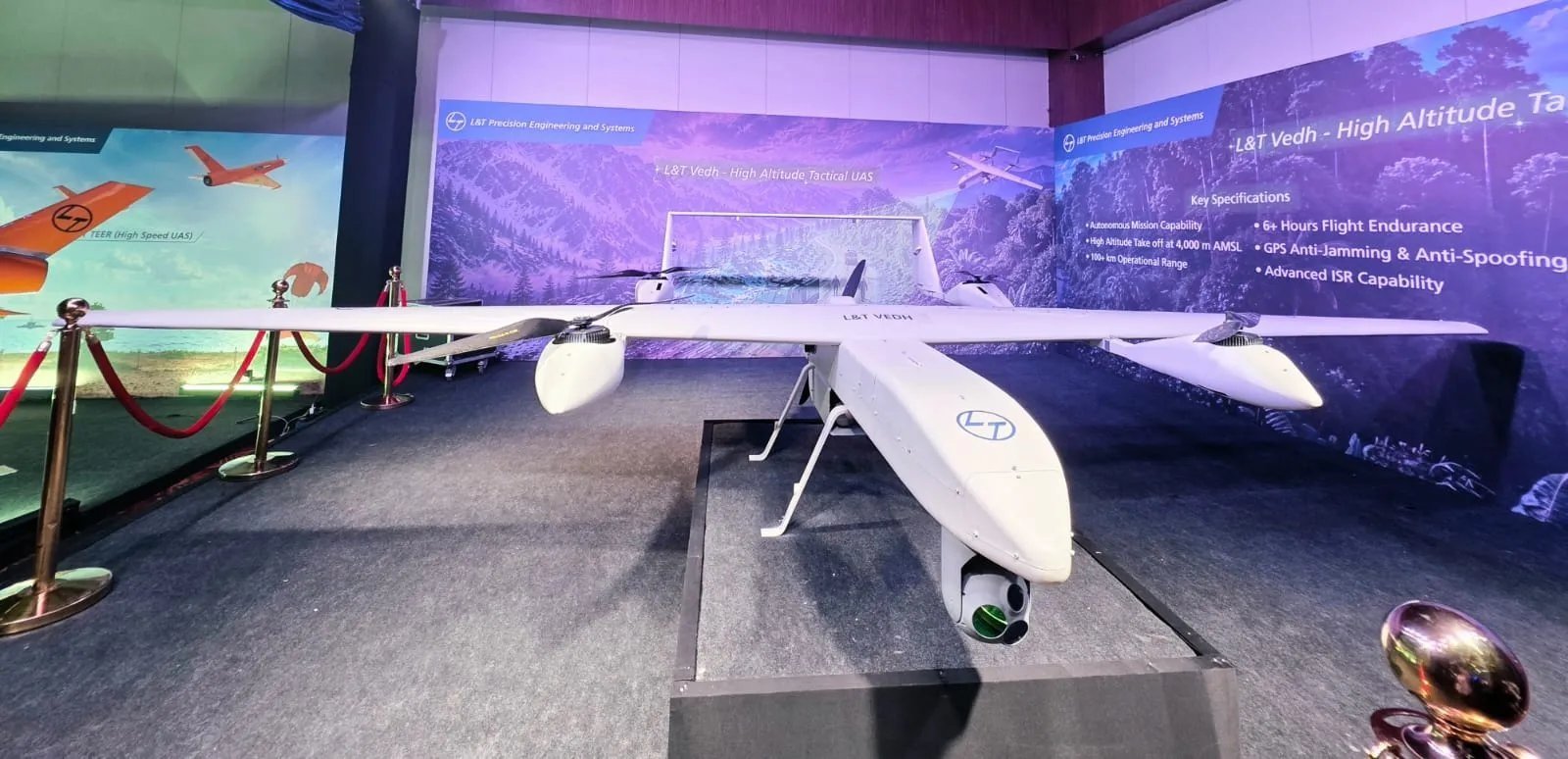
BENGALURU — Larsen & Toubro’s Precision Engineering and Systems (PES) division unveiled two indigenous unmanned systems technologies, the VEDH Mk1 remotely piloted aircraft system (RPAS) and the CHANAKYA collaborative mission autonomy framework, during its Manthan: Drone Demo Day in Bengaluru on August 7.
Organised under the L&T Innovation Fund, the event brought together 21 drone and uncrewed systems startups working on technologies for defence, infrastructure, logistics and public services.
L&T said its focus is on developing and manufacturing components and related technologies and working with emerging companies rather than independently manufacturing complete drone platforms.
VEDH Mk1 designed for high-altitude operations
The VEDH Mk1 is a hybrid vertical take-off and landing (VTOL) RPAS designed to operate without a conventional runway. Its configuration allows deployment from confined or unprepared locations, including forward areas, high-altitude terrain and temporary operating bases.
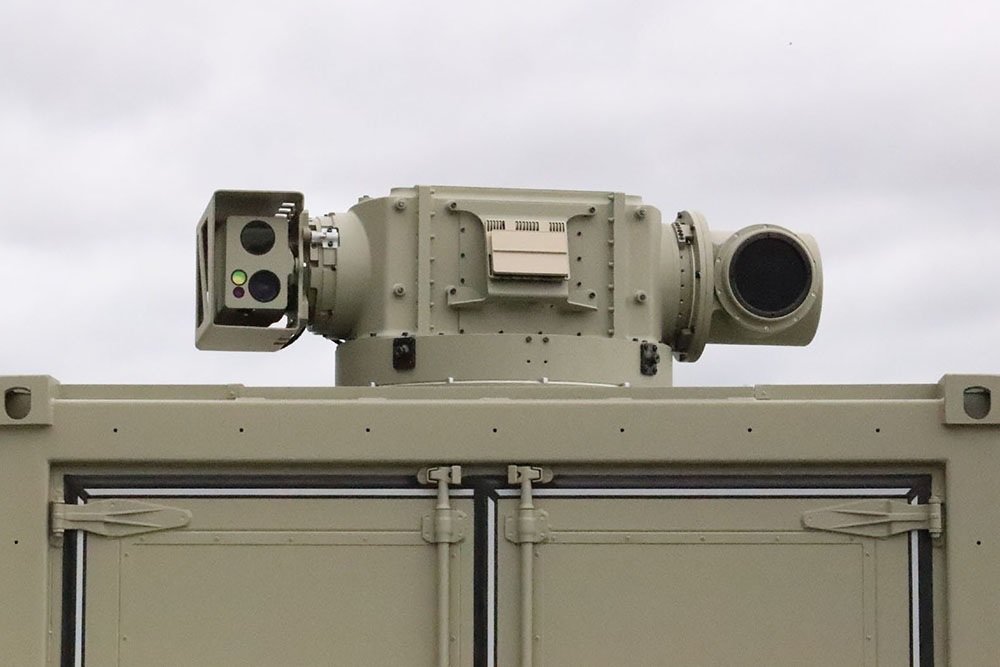
The aircraft is equipped with an electro-optical and infrared payload and a laser range finder for day-and-night intelligence, surveillance and reconnaissance missions. It can also support artillery observation and fire correction.
L&T is offering the system with a containerised ground control station, command and data links, and transport and maintenance infrastructure.
Its stated specifications include:
- Endurance: 6 hours or more
- Launch altitude: More than 4,000 metres above mean sea level
- Ceiling altitude: Up to 5,000 metres above mean sea level
CHANAKYA enables coordinated unmanned operations
L&T also introduced CHANAKYA, a decentralised collaborative mission autonomy framework designed to coordinate heterogeneous unmanned platforms, including aerial, ground, surface and underwater systems.
The framework uses onboard intelligence to support coordinated missions without relying entirely on a central control system. Its functions include flocking, mission-level autonomy, inter-agent collision avoidance and coordinated area surveillance.
CHANAKYA can allocate and reassign tasks between platforms during missions. Its video analytics capabilities can also combine target detection and tracking information from multiple platforms into a common operational picture.
L&T has previously demonstrated the framework using multiple fixed-wing UAVs. During the trials, the aircraft took off, synchronised in flight, followed waypoints and operated as a coordinated group. The company said CHANAKYA has progressed beyond hardware-in-the-loop simulations and is now undergoing field validation in complex operational scenarios.
L&T signs MoUs with technology startups
The event also saw L&T sign several memorandums of understanding (MoUs) with startups and technology partners working in areas including drone autonomy, AI-enabled navigation, propulsion, geospatial intelligence and energy systems.
The partnerships are aimed at identifying deployment-ready technologies and supporting their integration across L&T’s businesses.
Arun T. Ramchandani, Senior Vice President and Head of Precision Engineering & Systems at L&T, said the division is targeting approximately threefold revenue growth over the next five years.
PES currently contributes around 3 per cent of L&T’s overall revenue. L&T reported revenue from operations of ₹2.86 trillion for the year ended March 31, 2026.
The company is increasing its focus on high-value electronics, autonomous systems and advanced engineering solutions, with increased capital expenditure directed mainly toward new electronics manufacturing facilities.
L&T also stated that production of 100 Teer drones for the Indian Air Force is underway.
The company said the Manthan initiative is part of its broader effort to strengthen indigenous capabilities in unmanned systems by working with startups and technology developers.
——— End of Article ———