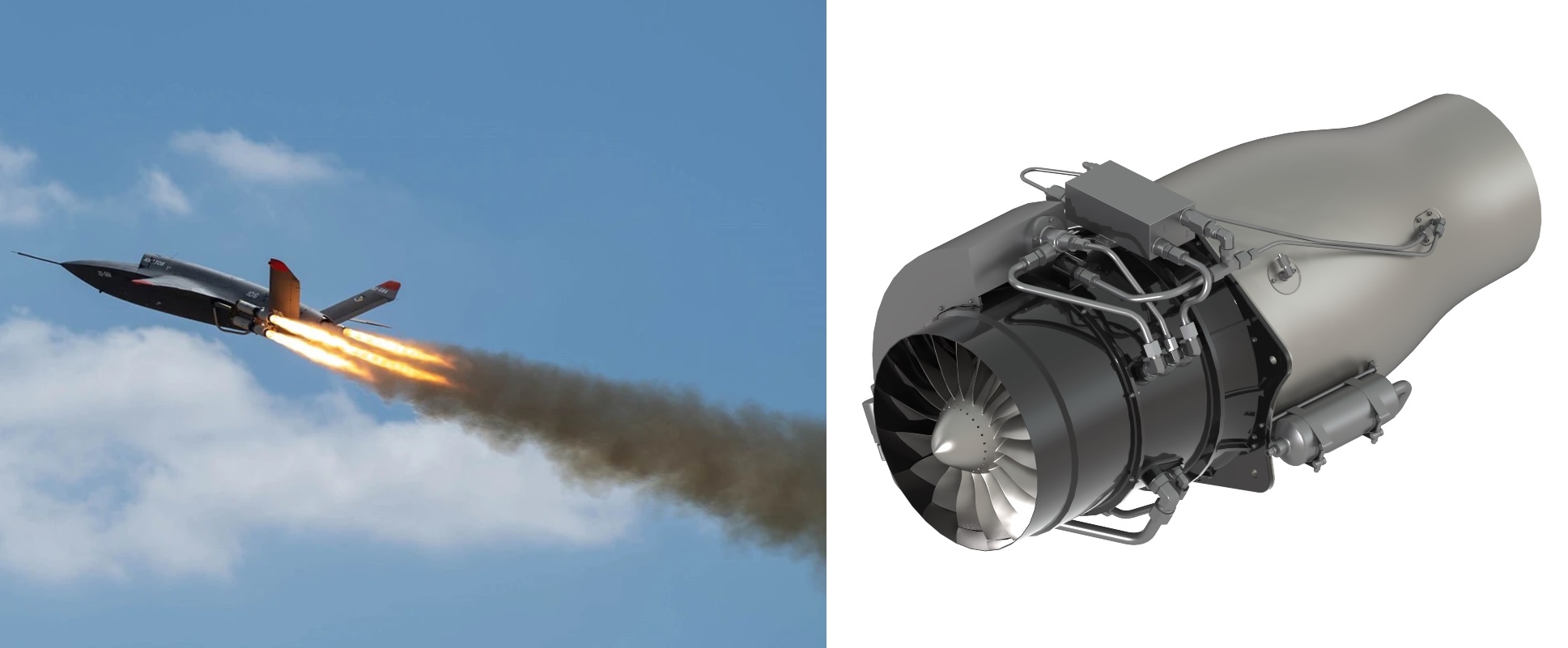
SAN DIEGO, June 28, 2026 — Kratos Defense & Security Solutions, Inc. (Nasdaq: KTOS) has announced plans to increase production of its Spartan family of turbojet engines to approximately 3,000 units annually by 2027 as demand grows across missile, loitering munition, and autonomous defense programs.
The expansion is intended to support increasing requirements for tactical unmanned aerial systems, cruise missiles, and other precision-strike platforms while improving production capacity and delivery timelines.
Kratos has positioned the Spartan engine family as an affordable propulsion solution that combines military-grade performance, reliability, and operational capability with manufacturing costs more commonly associated with commercial products. The engines are currently used by multiple defense customers across a range of missile and unmanned system programs, where demand for scalable, cost-effective propulsion continues to increase.
To support the production ramp-up, the company has already begun internally funded procurement of long-lead materials and made strategic investments across its domestic supply chain. These efforts are aimed at improving production readiness, optimizing manufacturing operations, and reducing lead times for customers.
In November 2025, Kratos opened a new Propulsion Manufacturing Facility in Auburn Hills, Michigan, which will support higher-rate production alongside the company's existing manufacturing sites.
The Spartan family includes the TDI-J45, TDI-J50, TDI-J70, and TDI-J85 turbojet engines, offering thrust ratings ranging from approximately 30 to 200 pounds-force at sea level. The engines feature compact designs, modular exhaust nozzles, multi-fuel capability compatible with JP-8 and Jet-A, and integral generators to power onboard payloads. They also use fuel for cooling and lubrication, eliminating the need for conventional oil systems and simplifying integration into expendable and attritable platforms.
A key feature of the Spartan program is its fully domestic manufacturing base. The engines are designed, produced, and supported entirely within the United States, helping strengthen the U.S. defense industrial base while reducing dependence on foreign suppliers for critical propulsion technologies.
The manufacturing expansion aligns with ongoing U.S. efforts to replenish missile inventories and increase production capacity for precision-strike weapons. Growing procurement of cruise missiles, loitering munitions, and autonomous systems has increased demand for propulsion systems that can be produced rapidly and at scale.
Beyond the Spartan engine family, Kratos continues to expand its propulsion portfolio, which also includes technologies supporting hypersonic vehicles and rocket systems. The company has benefited from growing investment in missile and autonomous defense programs, with its shares rising nearly 40 percent over the past year.
By increasing Spartan engine production to approximately 3,000 units annually by 2027, Kratos aims to strengthen its role as a supplier of affordable, mission-ready propulsion systems for U.S. and allied defense programs.
——— End of Article ———