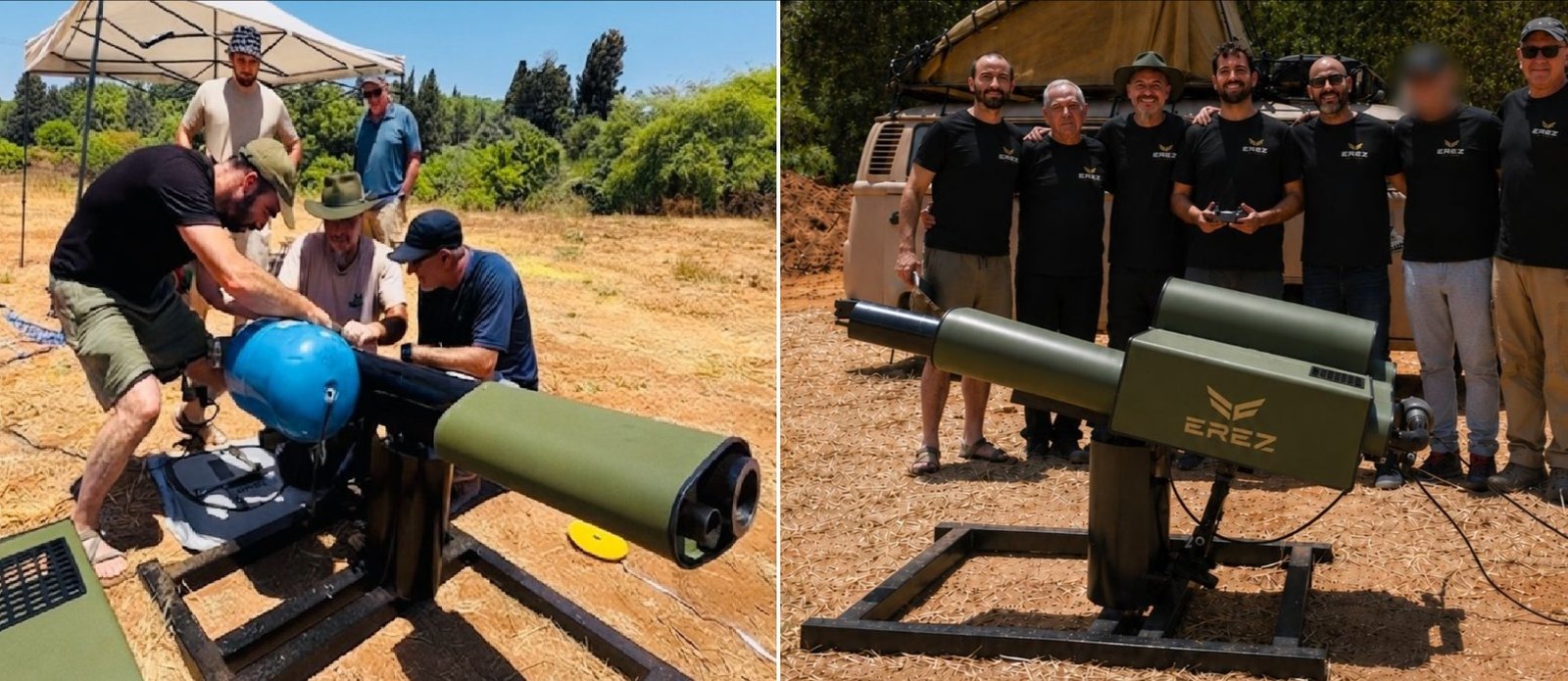
HOD HASHARON, Israel — Israeli defense startup Erez Defense Solutions has completed another round of field testing for its developing counter-drone defense system, focusing on the validation of a proprietary capsule and its launch mechanism as the company continues work on the technology.
The company, based in Hod HaSharon, about 20 kilometers northeast of Tel Aviv in central Israel, said this week's trials concentrated on programming and integration of the system's two core components: a proprietary capsule and the mechanism used to launch it.
Erez Defense Solutions did not disclose the capsule's function after launch or explain whether the system is designed to physically capture drones, disable them electronically, or destroy them. The company also did not release technical specifications or operational details of the system.
According to the company, the latest testing campaign was intended to validate the performance of the launch hardware and capsule under real operating conditions rather than laboratory simulations.
"Field testing is the heartbeat of our innovation. In the world of Electronic Warfare and Counter-Unmanned Aircraft Systems (C-UAS), theory is one thing, but reality is another. No simulation, however advanced, can replace the complex dynamics of the real world," the company said in a statement.
Three Main Objectives
Erez Defense Solutions said the latest field trials were designed around three primary objectives:
- Testing the physical limits of the launch hardware and proprietary capsule under demanding conditions.
- Verifying operational feasibility by confirming the integrity of the ballistic and mechanical launch sequence in real-field conditions.
- Ensuring basic reliability so the core system operates consistently and predictably during operation.
The company said the trials provided important programming and integration data that will support the next stages of development. However, it did not state that the system has reached operational readiness or is ready for military deployment.
The focus on mechanical validation and basic reliability indicates the project remains in an engineering development phase rather than final qualification for procurement or service entry.
Growing Focus on Counter-Drone Technologies
Counter-unmanned aircraft systems (C-UAS) have become an increasingly important area of defense development as small, low-cost drones continue to pose security challenges on battlefields and around military and civilian infrastructure.
C-UAS solutions generally fall into two categories. Hard-kill systems neutralize drones using weapons such as missiles, guns or lasers, while soft-kill systems seek to stop drones without destroying them through methods including electronic jamming, navigation spoofing or physical capture.
Israeli defense companies have introduced several counter-drone technologies in recent years, including soft-kill solutions designed for environments where limiting debris is important.
Israel's defense industry has expanded work on counter-drone capabilities in response to security threats that officials say exist across multiple fronts, including cross-border drone activity and attacks linked to Iran-aligned groups. The evolving threat environment has encouraged continued investment in new C-UAS technologies by both established defense firms and emerging startups.
Development Continues
Erez Defense Solutions credited its engineering and development teams for the progress achieved during the latest round of testing.
"The current success is a testament to the hard and precise work of our engineering and development teams, who never stop researching, learning, and improving," the company said. "We are moving forward full steam ahead to deliver a leading and reliable solution to the market."
The company did not disclose information regarding its founding, funding, development timeline, customers, or potential procurement programs.
As of Aug. 6, 2026, no additional verified public information about the system's technical design, operational concept, or company history had been released.
——— End of Article ———