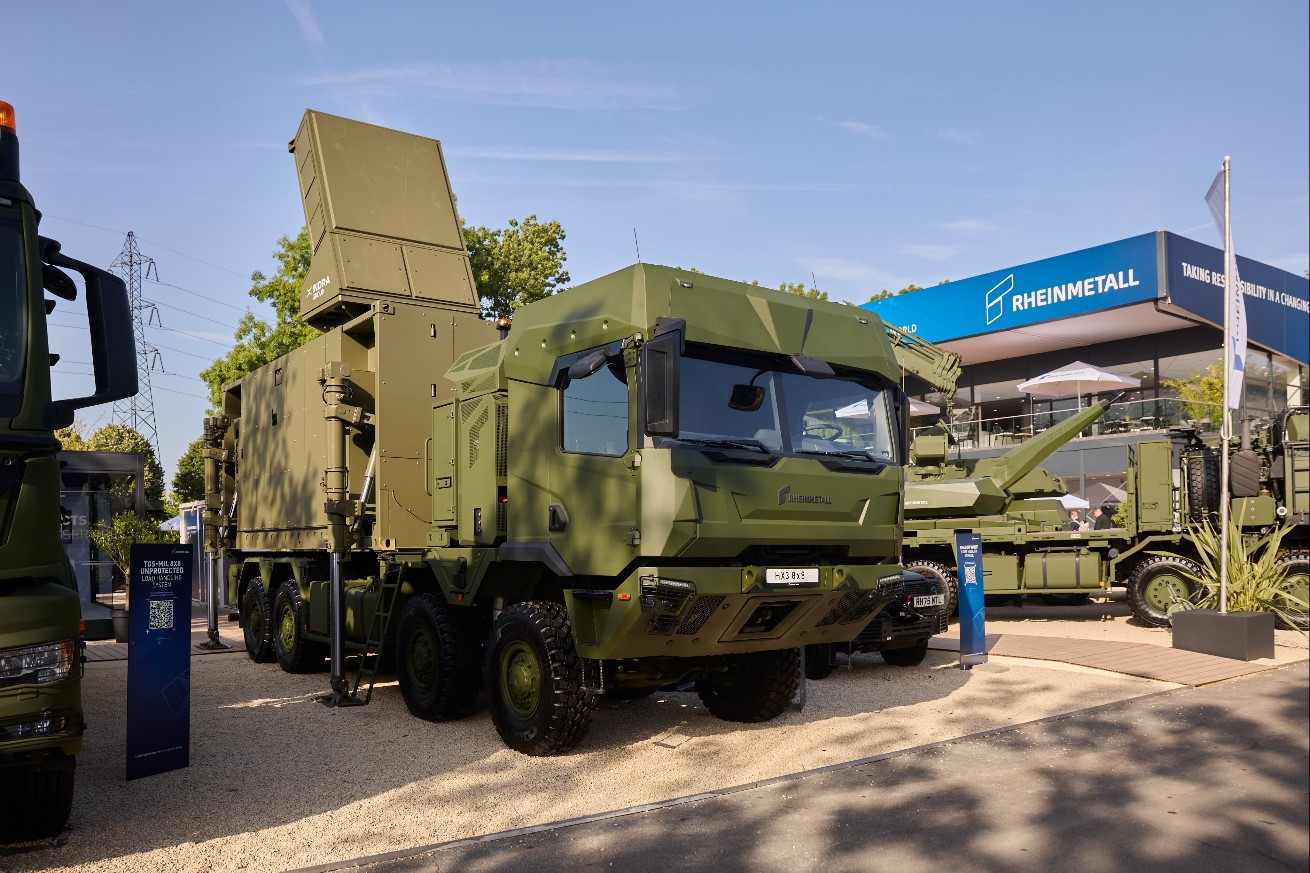
PARIS, — June 18, 2026 : Spanish defense and technology company Indra Group has officially unveiled its new Multimission Terrestrial Radar (MTR) family at the Eurosatory 2026 defense exhibition in Paris. The radar systems were presented mounted on a Rheinmetall HX 8x8 military truck, demonstrating a highly mobile configuration designed to support modern military operations in rapidly changing battlefield environments.
The MTR family represents a new generation of fully digital, multifunction radar systems based entirely on Active Electronically Scanned Array (AESA) technology. Developed to support high-intensity military operations, the radar combines multiple battlefield functions into a single platform, including counter-battery artillery localization, air surveillance, and coastal surveillance.
Designed for Multi-Mission Operations
According to Indra, the MTR family enables armed forces to perform a wide range of surveillance and target-detection tasks without deploying multiple specialized radar systems. This approach reduces logistical requirements while increasing operational flexibility.
The radar employs a fully digital architecture with 4D tracking capabilities, allowing it to detect, track, and analyze the trajectories of projectiles with high precision. The system is designed to identify and monitor a broad range of threats, including artillery rounds, rockets, drones, and high-speed missiles.
To enhance performance, the MTR utilizes Gallium Nitride (GaN) semiconductor technology. GaN-based transmitters provide greater power output, improved efficiency, and enhanced reliability, particularly in demanding operational conditions and extreme environments.
Rapid Deployment and High Mobility
One of the key design features of the MTR radar family is mobility. Modern battlefields increasingly rely on extensive sensor networks capable of detecting and targeting radar emissions. To reduce vulnerability to counter-fire and enemy targeting, the MTR has been engineered for rapid deployment and redeployment.
Mounted on the Rheinmetall HX 8x8 truck, the system can be quickly moved, set up, and relocated within minutes, allowing operators to maintain operational effectiveness while minimizing exposure to hostile detection systems.
The collaboration between Indra and Rheinmetall combines advanced sensor technology with a proven military mobility platform, creating a solution suitable for forces requiring fast repositioning and continuous battlefield coverage.
Two Configurations for Different Mission Requirements
The MTR family is offered in two primary variants designed to meet different operational requirements.
MTR 5
The MTR 5 is the medium-range version of the system and is primarily intended for counter-battery operations. It is capable of detecting and tracking incoming artillery rounds, rockets, projectiles, and drones.
The radar can calculate the origin and predicted impact point of enemy fire, enabling rapid threat warning and supporting counter-battery responses. The system can also provide targeting information to interception and air defense systems.
In addition to counter-battery missions, operators can switch the radar to perform air surveillance or coastal surveillance tasks. The MTR 5 includes an integrated control position, allowing it to operate independently or as part of a larger radar network.
MTR 10
The MTR 10 is the longer-range variant optimized for air surveillance missions. It is designed to operate directly with Air Command and Control (AirC2) systems and can be used to reinforce existing air surveillance networks or fill coverage gaps.
The radar is also designed for integration with Ground-Based Air Defence (GBAD) systems. It can support operations within a Surface-to-Air Missile Operations Centre (SAMOC) and contribute to weapon system command and control activities.
By linking with air defense networks, the MTR 10 provides enhanced situational awareness and supports coordinated responses against airborne threats.
Integration with Air Defence Command Systems
Both the MTR 5 and MTR 10 are fully integrated with Indra's Ground-Based Air Defence Command and Control systems, including the SBAMD-AIRDEF SAMOC architecture.
This integration allows radar data to be rapidly processed and distributed across command networks, enabling faster decision-making and improving coordination between surveillance, command, and weapon systems.
Developed for Evolving Threat Environments
According to Juan José Rodríguez, Business Development Manager for Land Systems at Indra, the MTR radar family was specifically designed to address the changing nature of modern warfare.
He stated that contemporary military operations require greater precision in target detection and engagement, while the increasing concentration of battlefield sensors demands highly mobile radar systems capable of remaining in constant movement to improve survivability.
Part of Indra’s Broader Defense Portfolio
At Eurosatory 2026, Indra also showcased several other defense technologies, including the NEMUS AESA radar for vehicle protection, the ARACNE counter-drone system, electronic warfare solutions, and capabilities associated with the Dragon 8x8 program.
As a European leader in radar technology, Indra has developed a broad portfolio of surveillance and air-defense systems used by NATO and national armed forces. The MTR family builds upon this experience by introducing a multifunction AESA radar capable of supporting land, air, and coastal operations from a single platform.
First International Presentation of the Full MTR Family
The unveiling at Eurosatory 2026, held in Paris from June 15–19, marks the first international defense exhibition appearance of the complete AESA MTR radar family.
With its combination of AESA technology, GaN electronics, 4D tracking capabilities, network integration, and high mobility, the MTR platform is intended to provide armed forces with a flexible and interoperable sensor solution capable of detecting, tracking, and responding to modern battlefield threats across multiple operational domains.
——— End of Article ———