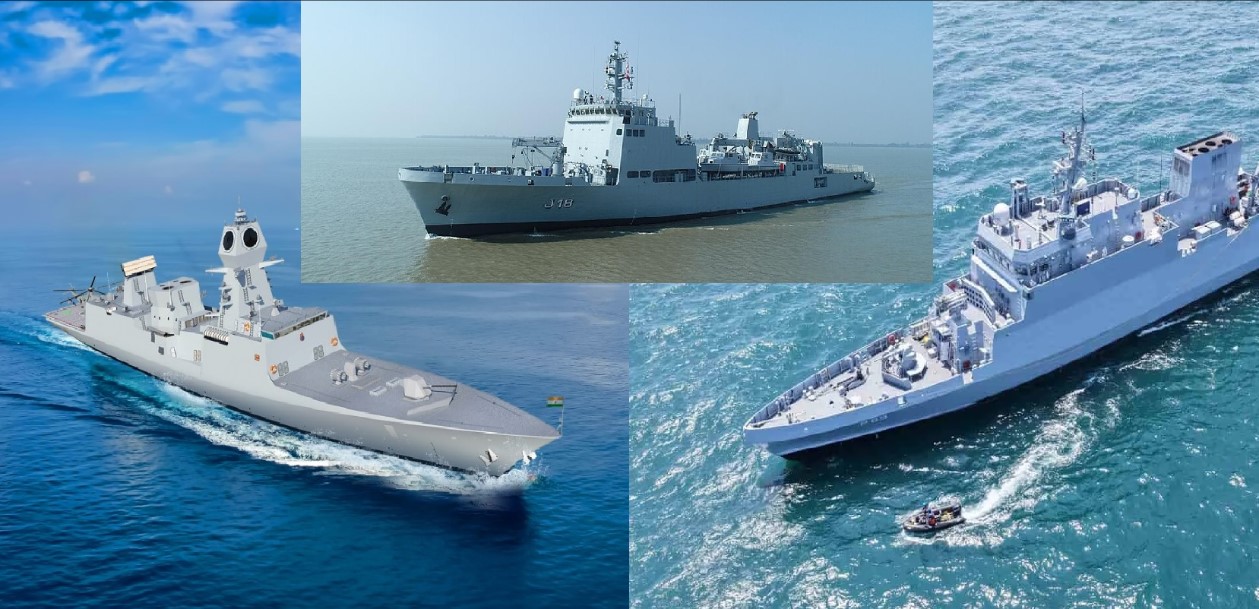
KOLKATA, — June 17, 2026 : The Indian Navy is set to commission three indigenously built warships—INS Dunagiri, INS Agray, and INS Sanshodhak—during a joint ceremony at Garden Reach Shipbuilders & Engineers (GRSE) in Kolkata later this week. The simultaneous induction of the three vessels marks a significant milestone in India's naval modernization program and reflects the growing capabilities of the country's domestic shipbuilding industry under the Aatmanirbhar Bharat initiative.
The commissioning ceremony is expected to be attended by senior Union government dignitaries and may coincide with Prime Minister Narendra Modi’s scheduled visit to Kolkata on June 21. The event will be only the second instance in recent years in which three major frontline naval platforms enter service together. The previous such occasion occurred in January 2025 when INS Surat, INS Nilgiri, and INS Vaghsheer were commissioned in Mumbai.
The three vessels were designed and built in India and recently delivered by GRSE, one of the country's leading defence shipyards. Together, they will enhance the Navy’s capabilities in surface warfare, anti-submarine operations, hydrographic surveying, and maritime domain awareness across the Indian Ocean Region.
INS Dunagiri: Project 17A Stealth Frigate
The most capable combat platform among the three vessels is INS Dunagiri, the fifth Project 17A Nilgiri-class stealth frigate and the second ship of the class constructed by GRSE.
Designed by the Indian Navy’s Warship Design Bureau, the frigate represents an advancement in indigenous warship design, featuring improved stealth characteristics, automation, survivability, and combat capability. The vessel measures 149 metres in length, has a beam of 17.8 metres, and displaces approximately 6,670 tonnes.
INS Dunagiri is powered by a Combined Diesel or Gas (CODOG) propulsion system with controllable pitch propellers and an Integrated Platform Management System, enabling efficient operations and reduced crew workload. The warship can achieve speeds of up to 32 knots and has an operational range of around 5,500 nautical miles.
Its weapons suite includes BrahMos supersonic cruise missiles, Barak-8 Medium Range Surface-to-Air Missiles (MRSAM), a 76 mm naval gun, AK-630 close-in weapon systems, anti-submarine torpedoes, and rocket launchers. The frigate is equipped with advanced sensors such as the EL/M-2248 MF-STAR AESA radar and HUMSA-NG sonar, providing enhanced surveillance and threat detection capabilities.
The vessel has around 75 percent indigenous content, highlighting the growing contribution of domestic industries. GRSE delivered the ship in 80 months, improving significantly upon the 93 months required for the lead vessel of the class, INS Nilgiri. The frigate is also capable of operating naval helicopters, including the HAL Dhruv Advanced Light Helicopter and Sea King helicopters.
Two additional Project 17A frigates, INS Mahendragiri and INS Vindhyagiri, are expected to join the fleet in the future.
INS Agray: Arnala-Class Anti-Submarine Warfare Craft
The second vessel being commissioned is INS Agray, the fifth ship of the Arnala-class Anti-Submarine Warfare Shallow Water Craft (ASW-SWC) program. The 16-ship project was approved in 2013 to strengthen the Navy’s ability to detect and engage submarines operating in coastal and shallow waters.
INS Agray measures approximately 77.6 metres in length and displaces around 900 tonnes. It is among the largest Indian naval vessels powered by water-jet propulsion, a system that provides high maneuverability while reducing underwater noise signatures, making it particularly suitable for anti-submarine missions.
Powered by three marine diesel engines, the vessel can reach speeds of up to 25 knots and has a range of approximately 1,800 nautical miles. The craft is equipped with advanced hull-mounted sonar, variable depth sonar systems, lightweight torpedoes, and indigenous anti-submarine rocket launchers.
The vessel also incorporates a combat management system optimized for tracking and engaging underwater threats in littoral environments. It accommodates a crew of 57 personnel and carries a rigid-hulled inflatable boat for operational support missions.
Earlier this month, the Navy unveiled the ship’s crest, inspired by Arjuna’s legendary bow, Gandiva, symbolizing precision and strength. The induction of INS Agray comes at a time when submarine activity across the Indian Ocean Region continues to increase, reinforcing the need for dedicated coastal anti-submarine assets.
INS Sanshodhak: Advanced Hydrographic Survey Vessel
Completing the trio is INS Sanshodhak, the fourth and final vessel of the Sandhayak-class Survey Vessel (Large) program.
The ship is designed to conduct hydrographic surveys, oceanographic research, and seabed mapping operations essential for naval planning and maritime navigation. Measuring 110 metres in length and displacing approximately 3,300–3,400 tonnes, INS Sanshodhak will support both military and civilian maritime activities.
The vessel is equipped with advanced technologies including Autonomous Underwater Vehicles (AUVs), Remotely Operated Vehicles (ROVs), multi-beam echo sounders, digital side-scan sonar systems, and sophisticated data acquisition equipment. These systems enable accurate mapping of underwater terrain, collection of oceanographic data, and identification of safe navigational routes.
With more than 80 percent indigenous content, the vessel contributes significantly to India's domestic shipbuilding ecosystem. In addition to survey duties, INS Sanshodhak can undertake search and rescue operations, provide medical assistance during emergencies, and function as a hospital ship when required. The vessel is also capable of operating a HAL Dhruv Advanced Light Helicopter.
The first three ships of the class—INS Sandhayak, INS Nirdeshak, and INS Ikshak—have already been inducted into service.
Strengthening Indigenous Naval Power
The commissioning of INS Dunagiri, INS Agray, and INS Sanshodhak highlights the Indian Navy’s continued focus on indigenous design, development, and construction. The three vessels collectively contain more than 75 percent indigenous content and were built with contributions from hundreds of Indian micro, small and medium enterprises (MSMEs), supporting the growth of the domestic defence manufacturing sector.
The delivery of these ships also increases GRSE’s total warship deliveries to 118 vessels, including 80 warships supplied to the Indian Navy. Their induction will strengthen the Navy’s capabilities across multiple operational domains, including surface combat operations, anti-submarine warfare, coastal security, hydrographic surveying, and maritime domain awareness.
As India continues expanding its naval presence across the Indian Ocean Region, the addition of these three indigenous platforms is expected to enhance operational readiness while further advancing the country's long-term objective of self-reliance in defence production.
——— End of Article ———