NEW DELHI — The Indian Navy has issued a Request for Proposal (RFP) for a new Indigenous Harbour Defence System (IHDS) to strengthen surveillance and protection of four major naval bases — Mumbai, Karwar, Kochi and Visakhapatnam.
The proposed system is intended to replace the existing Integrated Underwater Harbour Defence and Surveillance System (IUHDSS). The IUHDSS was designed by Israel Aerospace Industries (IAI) ELTA and was introduced as part of efforts to strengthen harbour security following the 26/11 Mumbai attacks. The first system in India was commissioned at Kochi in July 2015 and combined coastal surveillance radars, electro-optical sensors and sonar systems for detecting and tracking surface and underwater threats.
Large Sensor Network
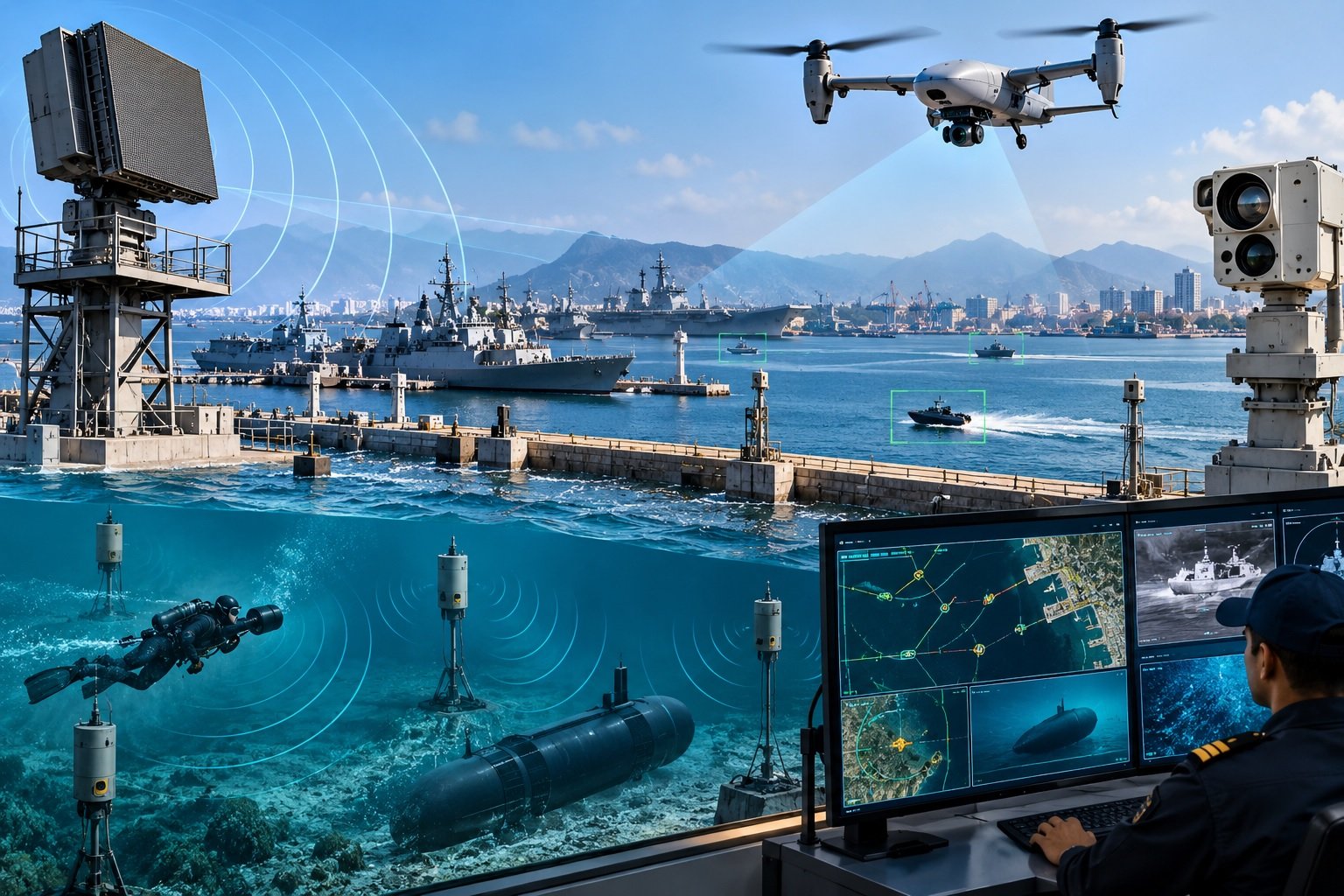
According to the RFP requirements, the new IHDS will include five high-power radars, 13 sonars and five electro-optical/infrared (EO/IR) suites across the four locations.
At the centre of the system will be a Command and Control (C2) system capable of processing and tracking more than 600 surface targets and over 50 subsurface tracks simultaneously.
The network is designed to provide continuous surveillance of both the surface and underwater areas around the naval bases.
Underwater Detection
The sonar component will provide 360-degree coverage for underwater surveillance. The RFP specifies detection ranges of 500–700 metres for combat divers, 1 kilometre for Swimmer Delivery Vehicles (SDVs), and 1.5 kilometres for midget submarines.
These capabilities are intended to strengthen protection against underwater threats approaching naval harbour facilities.
Radar and Electro-Optical Surveillance
The system will also use X-band radars with an instrumented detection range of at least 150 kilometres.
The EO/IR suites are required to combine Medium-Wave Infrared (MWIR), Short-Wave Infrared (SWIR) and high-definition day cameras. The RFP specifies the ability to detect small boats at distances of up to 20 kilometres.
VTOL UAV Integration
The new harbour defence architecture will also include Vertical Take-Off and Landing (VTOL) unmanned aerial vehicles (UAVs).
The UAVs are required to have an operational range of 20–25 kilometres and an endurance of two hours. They will form part of the surveillance network and provide an additional aerial observation capability for investigating detected activity.
The overall procurement is part of the Indian Navy's effort to develop indigenous harbour defence capabilities, with the selected Indian contractor expected to integrate the radar, sonar, EO/IR and UAV components into a single surveillance and command system.
The new IHDS is therefore planned as a multi-layered system combining surface, underwater and aerial surveillance to protect important Indian naval bases and the high-value assets operating from them.
——— End of Article ———