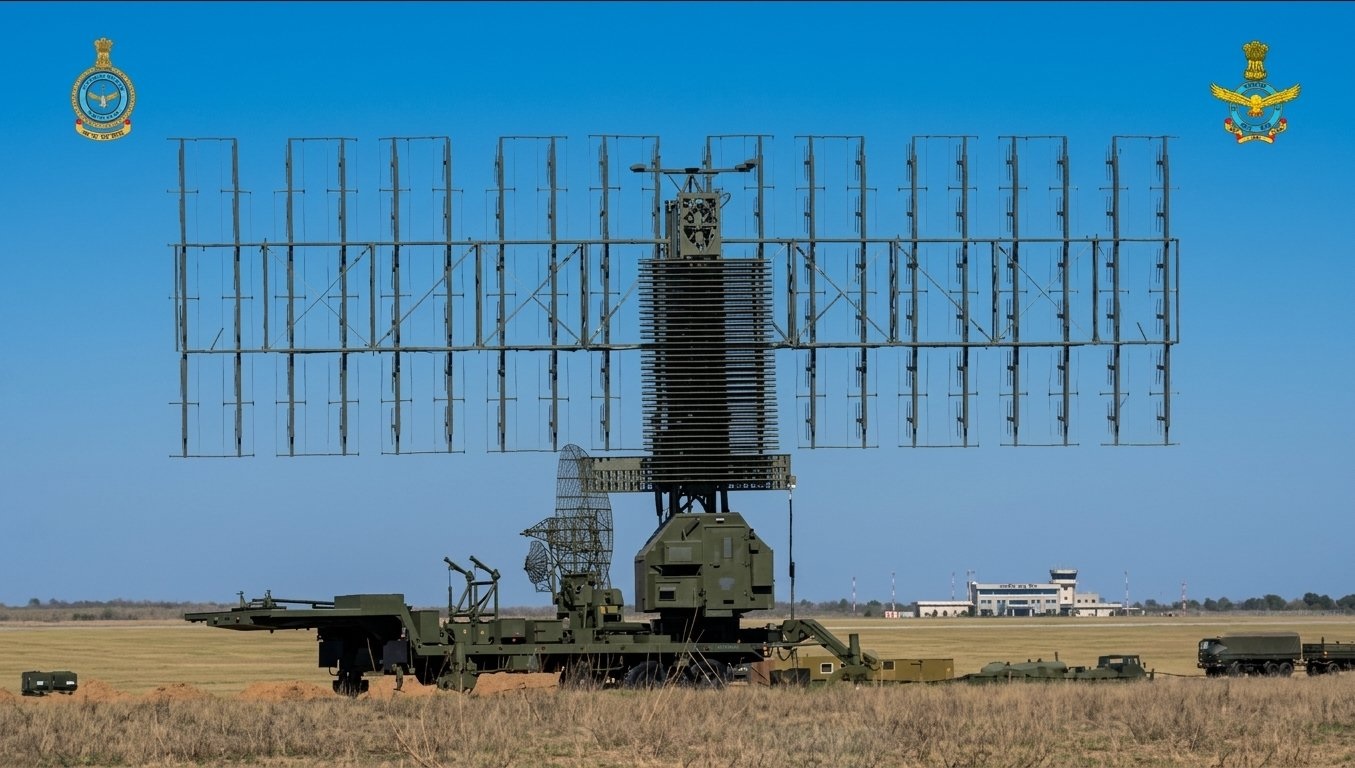
NEW DELHI, June 26, 2026 — The Indian Air Force (IAF) has officially inducted the Russian-made 55Zh6ME Nebo-UM Very High Frequency (VHF) radar into its integrated air defence network, strengthening the country's long-range surveillance and early warning capabilities against advanced aerial threats, including stealth aircraft, cruise missiles, and ballistic missiles.
The 55Zh6ME Nebo-UM is a highly mobile, three-dimensional phased-array radar that operates exclusively in the VHF frequency band. It is designed to detect and track airborne targets at medium and high altitudes while providing long-range surveillance across large areas. The radar operates in two VHF frequency ranges: 133–144 MHz and 216–225 MHz.
Unlike conventional higher-frequency radars, the Nebo-UM uses meter-wavelength radio waves that interact differently with stealth aircraft. These longer wavelengths reduce the effectiveness of radar-absorbent materials and stealth shaping, enabling the radar to detect low-observable aircraft at greater distances. According to available specifications, the system can detect fifth-generation stealth fighters such as China's J-20 and J-35 at ranges exceeding 250 kilometers under suitable operating conditions.
The radar also provides long-range detection of cruise missiles and ballistic missiles at distances of up to 600 kilometers, giving air defence units valuable additional time to assess threats and coordinate interception. The system is capable of tracking targets flying at speeds of up to Mach 6.4 and at altitudes exceeding 80 kilometers, allowing it to monitor a broad range of aerial and missile threats.
The induction of the Nebo-UM supports the Indian Air Force's ongoing effort to build a multi-layered air defence architecture. VHF radars complement higher-frequency surveillance and fire-control radars by providing early detection of targets with low radar cross-sections. Once detected, the radar can transmit target information to command-and-control centers, enabling other sensors and surface-to-air missile systems to engage the threat.
Designed for rapid deployment, the entire Nebo-UM system is mounted on heavy 8×8 wheeled transport vehicles, including the radar antenna, digital signal processing equipment, and onboard diesel power generators. Its high mobility allows operators to quickly relocate the system across difficult terrain, improving survivability against anti-radiation missile attacks and supporting flexible deployment along operational sectors.
After deployment, the radar automatically detects and tracks targets, calculates their flight parameters, performs Identification Friend or Foe (IFF) procedures, and transmits real-time data to India's integrated air defence network. The system can operate independently or as part of a larger networked air defence grid.
The induction follows earlier observations of a radar resembling the Nebo-UM during the Vayu Shakti 2026 exercise, where it appeared to be operating alongside S-400 air defence assets. While the standard S-400 system uses radars such as the 91N6E Big Bird, the addition of a dedicated VHF early warning radar enhances the overall capability of the air defence network against advanced stealth and long-range missile threats.
The Indian Air Force has been steadily modernizing its radar inventory through a combination of indigenous and imported systems. Alongside domestic VHF radar programs, the addition of the Russian 55Zh6ME Nebo-UM expands India's long-range surveillance capability and strengthens situational awareness across its integrated air defence network.
Details regarding the number of radar systems inducted and their deployment locations have not been officially disclosed, consistent with standard practices for sensitive military procurements.
——— End of Article ———