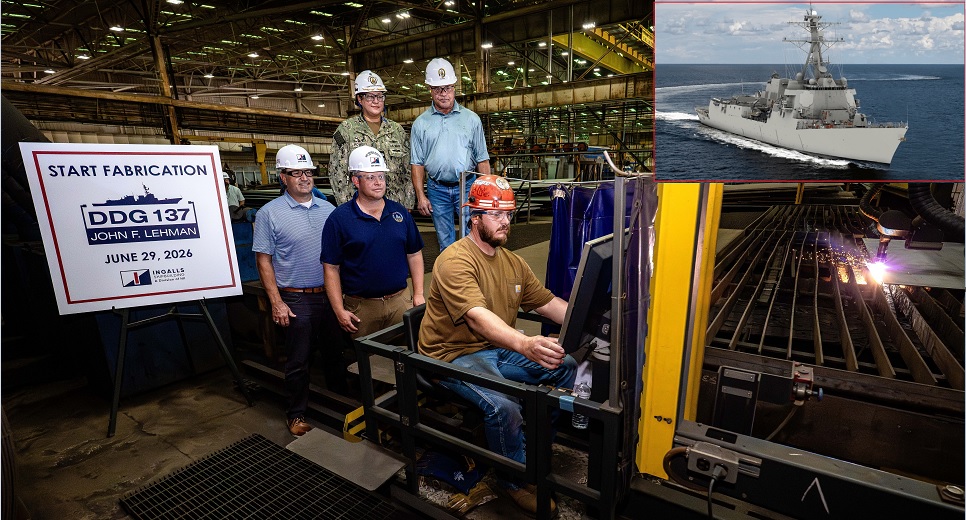
PASCAGOULA, Miss. , July 2, 2026 — Huntington Ingalls Industries (HII) has officially begun fabrication of the U.S. Navy's future USS John F. Lehman (DDG 137), the latest Flight III Arleigh Burke-class guided-missile destroyer, marking another step in the continued expansion of the Navy's next-generation surface combatant fleet.
Construction officially commenced on June 29 at HII's Ingalls Shipbuilding facility in Pascagoula, Mississippi. The vessel is the 87th Arleigh Burke-class destroyer ordered by the U.S. Navy and the seventh Flight III destroyer assigned to Ingalls Shipbuilding.
The new destroyer is part of the Navy's long-term plan to sustain its large surface combatant force while replacing aging Ticonderoga-class guided-missile cruisers and maintaining fleet readiness until the future DDG(X) destroyer enters procurement in the early 2030s.
Flight III Configuration
The Flight III variant retains the proven Arleigh Burke hull design while introducing significant upgrades to radar, combat systems, and electrical power generation to address evolving air and missile threats.
The ship measures 155.3 meters (513 feet) in length, has a 20-meter beam, and a full-load displacement of approximately 9,700 tons. Propulsion is provided by four General Electric LM2500 gas turbines, enabling speeds of more than 31 knots.
Its primary enhancement is the AN/SPY-6(V)1 Air and Missile Defense Radar, which replaces the legacy AN/SPY-1D(V) system. Equipped with 37 Radar Module Assemblies (RMAs), the SPY-6 radar offers improved target detection, discrimination, tracking capacity, and ballistic missile defense performance against increasingly complex threats.
To support these advanced systems, Flight III destroyers feature an upgraded 12-megawatt electrical plant, replacing the previous configuration of three 3-megawatt generators with three 4-megawatt generators. The additional power supports the Aegis Baseline 10 combat system, the SPY-6 radar, and future electronic warfare capabilities.
Although the Flight III design maintains the same 96-cell Mk 41 Vertical Launching System (VLS) found on earlier variants, the ship's improved sensors and combat systems significantly enhance its operational effectiveness. The Mk 41 VLS can employ a wide range of weapons, including SM-2, SM-3, SM-6, ESSM Block 2, Tomahawk, and VL-ASROC missiles.
Additional armament includes a 127 mm (5-inch) naval gun, 25 mm autocannons, a 20 mm Close-In Weapon System (CIWS), and lightweight torpedoes for anti-submarine warfare.
Rather than increasing missile capacity, the Flight III design focuses on improving detection, classification, tracking, and engagement performance while maintaining compatibility with existing Navy missile inventories, logistics, and training systems.
Distributed Shipbuilding Strategy
HII is continuing to expand its distributed shipbuilding model to support production of DDG 137 and other destroyers.
Under this approach, major structural sections of the ship are being fabricated at six partner shipyards located across Texas, Louisiana, Mississippi, and Florida before being transported to Pascagoula for final assembly, outfitting, testing, and combat system integration.
The company plans to outsource more than 2.5 million shipbuilding labor hours during 2026 as part of this strategy, helping address skilled labor shortages, supplier constraints, and production capacity challenges while maintaining construction schedules.
"Our Ingalls shipbuilders have worked hard to reach fabrication start on DDG 137, and by focusing our teams and facilities on final assembly and integration, our distributed shipbuilding partners are enabling us to grow the Flight III fleet," said Chris Brown, Ingalls Shipbuilding DDG 51 program manager.
The distributed production model requires strict quality control, dimensional accuracy, and coordinated scheduling to ensure fabricated modules arrive ready for integration with minimal rework.
Arleigh Burke Program Continues to Expand
The Arleigh Burke-class remains the U.S. Navy's longest-running and largest surface combatant production program, having entered production in 1988.
The class currently includes 75 active destroyers, 10 ships under construction, and 13 on order, with the total fleet expected to approach 99 vessels.
The Flight III program is intended to sustain the Navy's guided-missile destroyer force while replacing retiring Ticonderoga-class cruisers and maintaining escort capability for carrier strike groups and amphibious ready groups until the DDG(X) program enters service.
Ingalls Shipbuilding has delivered 36 Arleigh Burke-class destroyers to the U.S. Navy and currently has five additional Flight III destroyers under construction:
- USS Ted Stevens (DDG 128)
- USS Jeremiah Denton (DDG 129)
- USS George M. Neal (DDG 131)
- USS Sam Nunn (DDG 133)
- USS Thad Cochran (DDG 135)
In addition to DDG 137, Ingalls is conducting early planning and material procurement for future destroyers including USS Telesforo Trinidad (DDG 139), USS Ernest E. Evans (DDG 141), USS Charles French (DDG 142), USS Richard J. Danzig (DDG 143), USS Intrepid (DDG 145), and USS Robert Kerrey (DDG 146).
Honoring John F. Lehman
The future USS John F. Lehman (DDG 137) is named in honor of John F. Lehman, who served as U.S. Secretary of the Navy from 1981 to 1987 during the Reagan administration.
Lehman was the principal architect of the Navy's 600-ship fleet initiative, which emphasized fleet expansion, forward deployment, and wartime surge capacity during the latter years of the Cold War. In addition to his civilian leadership role, he also served as a Naval Reserve commander and naval flight officer.
The start of fabrication marks the first major construction milestone for DDG 137 as Ingalls Shipbuilding continues production of the Flight III Arleigh Burke-class destroyer program, which remains central to the U.S. Navy's long-term surface fleet modernization efforts.
——— End of Article ———