SAN DIEGO, Calif., — May 22, 2026 : General Atomics Aeronautical Systems, Inc. (GA-ASI) and Swedish defense manufacturer Saab have successfully completed the first flight of an MQ-9B remotely piloted aircraft equipped with LoyalEye Airborne Early Warning (AEW) radar pods, marking a significant milestone in the development of an unmanned airborne early warning capability.
The validation flight was conducted on May 19, 2026, at GA-ASI’s Desert Horizon flight operations facility in Southern California using a company-owned MQ-9B aircraft. The test represents the first operational integration of Saab’s newly developed LoyalEye AEW system onto the MQ-9B platform following the strategic partnership announced between the two companies in 2025.
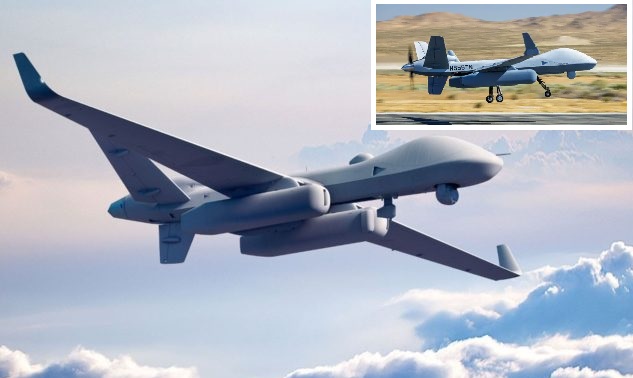
The aircraft was fitted with Saab’s LoyalEye sensor pods featuring advanced Active Electronically Scanned Array (AESA) radar technology. The configuration includes specialized pods mounted under each wing housing the radar arrays, while an additional centerline pod contains common avionics and mission processing systems.
According to the companies, the LoyalEye system is designed to provide early warning, long-range detection and tracking, and simultaneous monitoring of multiple airborne threats. The radar system is capable of detecting and tracking tactical air munitions, guided cruise missiles, drone swarms, fighter aircraft, and bomber aircraft. The capability operates using both line-of-sight communications and satellite communications (SATCOM) connectivity, allowing operators to monitor the radar picture remotely from command centers over extended distances.
The integration of AEW capabilities onto a Medium-Altitude, Long-Endurance (MALE) uncrewed aircraft is intended to provide militaries with a persistent and comparatively cost-effective airborne surveillance platform. The MQ-9B platform offers endurance exceeding 30 to 40 hours, depending on configuration and payload, with an operational range of approximately 6,900 miles. The extended endurance allows continuous radar coverage in remote or contested operational areas without exposing onboard aircrews to risk.
GA-ASI President David R. Alexander said the AEW capability for the MQ-9B will provide critical airborne sensing against tactical air munitions, guided missiles, drones, fighter aircraft, bomber aircraft, and other aerial threats. He added that medium-altitude, long-endurance unmanned aircraft provide among the highest operational availability rates while keeping aircrews out of harm’s way.
Saab Senior Vice President and Head of Business Area Surveillance Carl-Johan Bergholm stated that the integration of LoyalEye with the MQ-9B is intended to complement existing crewed airborne early warning platforms by providing persistent surveillance, improved situational awareness, greater operational flexibility, and extended operational reach.
The LoyalEye AEW capability is planned for the broader MQ-9B family, including the SkyGuardian, maritime-focused SeaGuardian, the United Kingdom’s Protector RG.1, and the developing MQ-9B STOL (Short Takeoff and Landing) variant designed for naval and aircraft carrier operations.
The companies stated that the first flight marks the beginning of a multi-month development and evaluation campaign expected to continue through 2026. A full-capability demonstration flight is planned later this year before the system is made available to existing MQ-9B operators and prospective international customers.
The MQ-9B platform currently supports a wide range of missions including intelligence, surveillance, reconnaissance (ISR), maritime patrol, strike operations, and anti-submarine warfare. The addition of the LoyalEye AEW pods further expands the aircraft’s operational role into airborne early warning and air surveillance missions.
——— End of Article ———