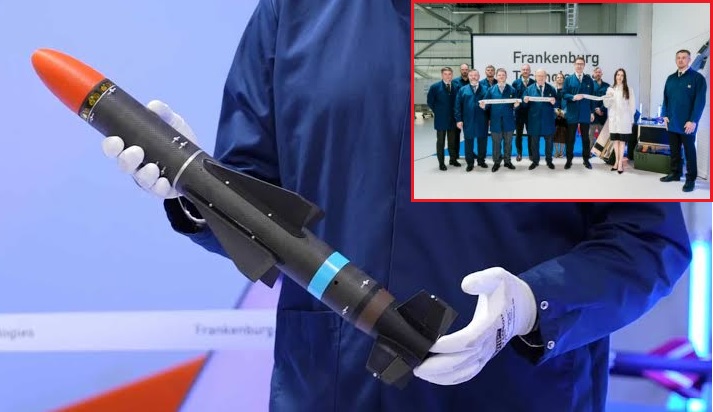
RIGA, Latvia, June 26, 2026 — Estonia-based defense company Frankenburg Technologies has officially opened its Riga Weapon System and Missile Assembly Factory in Latvia, marking a major step toward large-scale production of its Mark 1 counter-unmanned aerial system (C-UAS) missile. The new facility is intended to support growing demand for affordable air defense systems capable of countering the increasing use of drones on modern battlefields.
The Riga facility, together with a final assembly line under construction in the Latvian town of Ādaži, forms the company's first complete FieldFoundry production system. By the end of 2026, the combined Latvian facilities are expected to produce up to 100 Mark 1 missiles per day, with approximately 1,500 missiles planned during the initial production ramp-up in 2026.
Built in just 12 months, the 1,000-square-meter factory is expected to employ up to 50 people. The site carries out missile electronics assembly, warhead production, weapon system integration, fire control system integration, and quality control.
FieldFoundry Manufacturing Model
Frankenburg's FieldFoundry concept uses modular production stations, standardized manufacturing processes, and lean manufacturing techniques to enable rapid expansion of missile production while reducing manufacturing costs.
The company plans to establish additional FieldFoundry production lines in Estonia, the United Kingdom, and Poland as part of a decentralized manufacturing network. This approach is intended to strengthen domestic missile production capabilities for European and NATO-aligned countries, reduce reliance on long international supply chains, and allow stockpiles to be replenished closer to operational requirements.
Frankenburg's long-term objective is to build a manufacturing network capable of producing one million missiles annually.
Mark 1 Missile Specifications and Capabilities
The Mark 1 was developed from concept to a successful live-fire demonstration in just 13 months. It is designed as a compact, low-cost guided interceptor that uses commercially available components, allowing production costs to be reduced by more than tenfold compared with traditional interceptor missiles.
The missile measures approximately 660 mm in length, 60 mm in diameter, and has a launch weight of less than 2 kilograms. Powered by a solid-fuel rocket motor, it reaches high subsonic to supersonic closing speeds exceeding 1,000 km/h during testing.
The Mark 1 has an engagement range of up to 2 kilometers and can intercept targets at altitudes of up to 1,500 meters. It carries a 0.5-kilogram high-explosive fragmentation warhead equipped with a proximity fuze that detonates within about two meters of the target.
Guidance combines an Inertial Navigation System (INS) for midcourse guidance with a TV/electro-optical seeker featuring AI-assisted automatic target recognition, providing a fire-and-forget capability for short-range air defense missions.
The missile is designed to engage Class 1 to Class 3 UAVs, including propeller-driven drones, FPV drones, loitering munitions, jet-powered unmanned aircraft, and larger Shahed-type one-way attack drones.
Live-fire testing at the Ādaži NATO training area demonstrated successful interceptions from standard land-based tripod launchers. The Mark 1 has also been successfully tested from the Airbus Do-DT25 "Bird of Prey" Unmanned Combat Aerial Vehicle (UCAV), demonstrating its use as a reusable airborne interceptor.
Expanding European Missile Production
The opening of the Riga factory represents Frankenburg Technologies' first operational large-scale production facility and supports broader efforts to strengthen Europe's defense industrial base. The inauguration ceremony was attended by European Commissioner for Defence and Space Andrius Kubilius, reflecting regional interest in expanding domestic defense manufacturing.
As additional FieldFoundry production sites are established across Europe, Frankenburg Technologies aims to increase missile output while providing NATO-aligned countries with locally manufactured, scalable counter-drone capabilities.
——— End of Article ———