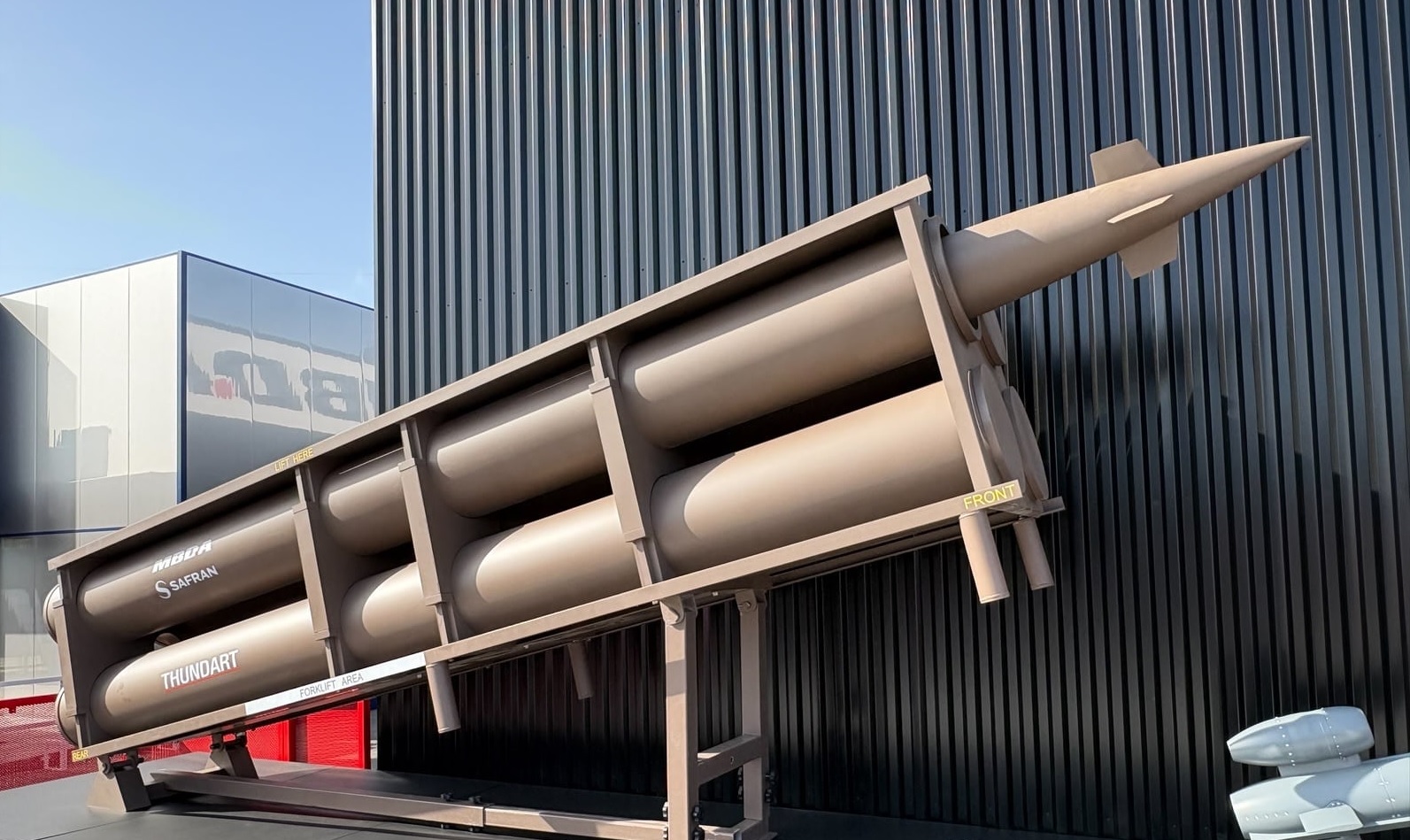
PARIS, — June 15, 2026 : France has selected the domestically developed Thundart rocket artillery system under the FLP-T (Frappe Longue Portée Terrestre) program to replace the French Army's aging Lance-Roquettes Unitaire (LRU) multiple rocket launchers.
The French Ministry of the Armed Forces announced that it has entered exclusive negotiations with a consortium led by MBDA and Safran Electronics & Defense for the supply of the new system. The decision was confirmed by Armed Forces Minister Catherine Vautrin on the opening day of the Eurosatory 2026 defense exhibition in Paris, following a commitment to finalize the selection before summer.
The choice concludes a competition involving domestic and foreign proposals. The MBDA-Safran bid was selected over the FLP-T 150 proposal developed by Thales and ArianeGroup, while foreign alternatives, including Lockheed Martin's HIMARS system and India's Pinaka, were not chosen.
Thundart to Replace Aging LRU Fleet
The FLP-T program was launched to replace the Army's current LRU launchers, which are expected to become obsolete in the coming years. French military officials have identified long-range precision strike capability as a key requirement for future force modernization plans.
Lieutenant General Philippe Geay de Montenon, Commander of the Land Force and Operations (COMFOT), said the Army requires a replacement capability by 2030 to support the transition toward Division 27 and Army Corps 2030 structures.
The French government opted for a sovereign solution, prioritizing national industrial capabilities and independence from foreign supply restrictions.
Range and Precision Improvements
The Thundart system offers a significant increase in range compared with the current LRU fleet.
The launcher fires guided 227 mm rockets capable of striking targets at distances of up to 150 kilometers, more than double the range of existing French rocket artillery systems.
Its guidance package incorporates technology derived from Safran's AASM Hammer precision-guided bomb. The system combines inertial navigation and satellite guidance, allowing accurate targeting even in GNSS-denied or electronically jammed environments.
Successful Test Firing
The Thundart rocket completed its first live-fire demonstration on April 14, 2026, at the Île du Levant test range in the Mediterranean.
The test, conducted with support from the Direction Générale de l'Armement (DGA), validated the rocket's design and propulsion system. According to program officials, performance exceeded initial expectations.
Development progressed from concept stage to successful live firing in just 18 months.
Industrial Partnership
The Thundart program is supported by a wider industrial team that includes:
- Scania, which will provide the 8×8 carrier vehicle.
- Essonne Sécurité, responsible for the armored cab.
- Palfinger, which will supply the reloading crane.
The launcher is mounted on a wheeled platform and carries guided rockets housed in pods. It is designed for rapid deployment and relocation after firing.
MBDA and Safran are also considering the creation of a joint venture to support future development of the program, including longer-range variants.
Procurement Plans and Timeline
The FLP-T program is valued at approximately €600 million, with contract notification expected as early as July 2026.
Under the Military Programming Law (LPM) 2024–2030, currently under parliamentary review, France plans to acquire between 13 and 26 systems in the initial phase. Long-term plans call for up to 52 launchers by 2035.
The French military also intends to procure around 300 rockets before the end of the decade.
MBDA and Safran have committed to delivering an initial operational capability by 2029, ensuring continuity as the LRU fleet is phased out.
Strengthening Sovereign Strike Capability
The selection of Thundart marks a major step in France's effort to field a domestically developed long-range precision strike system. The program will provide the French Army with a modern replacement for the LRU while supporting the country's defense industrial base and maintaining national control over a critical military capability.
Further details regarding the final contract are expected in the coming weeks as negotiations between the government and the MBDA-Safran consortium continue.
——— End of Article ———