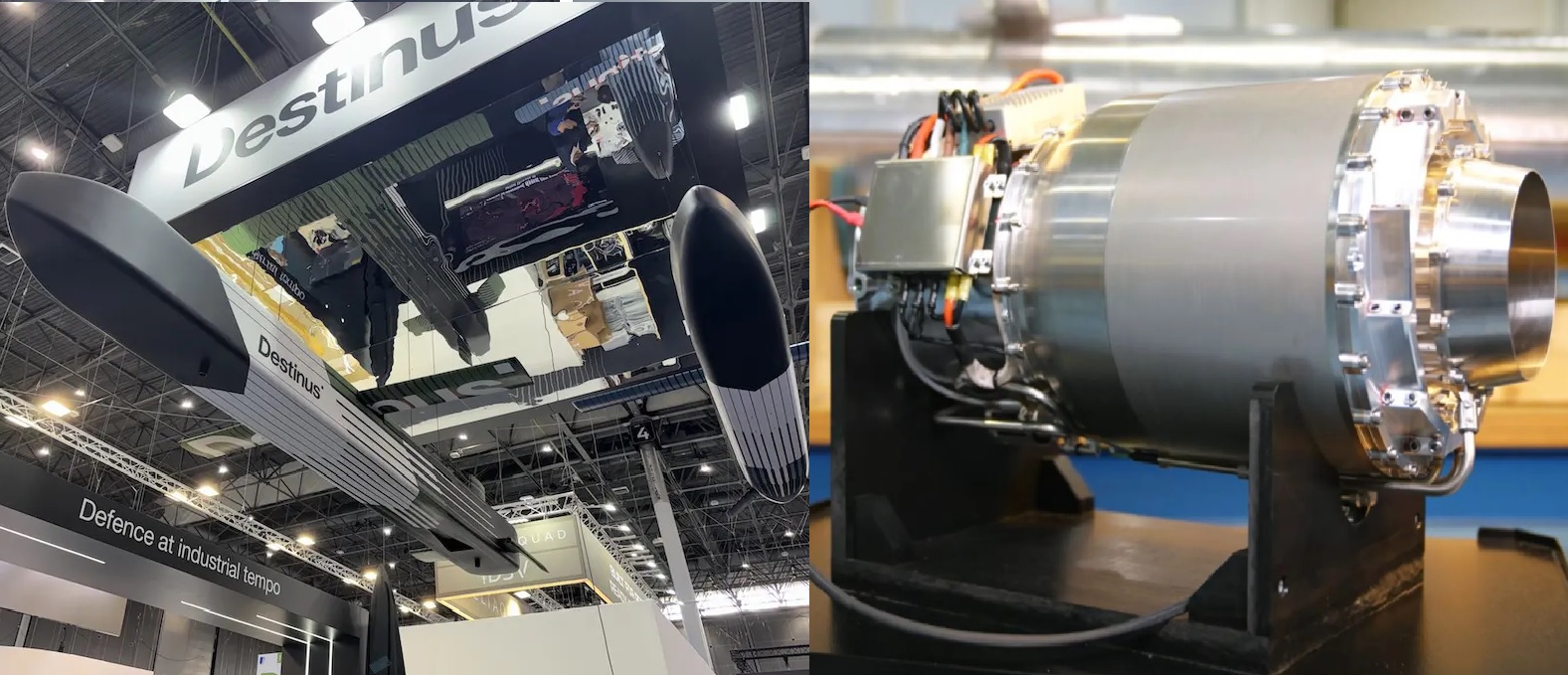
AMSTERDAM, Netherlands — June 20, 2026 : European defense technology company Destinus has announced the production of its 1,000th T150 turbojet engine, marking a significant milestone in the company's effort to establish large-scale, in-house propulsion manufacturing for cruise missile systems in Europe.
The T150 engine, developed and produced entirely within Europe, serves as the primary propulsion system for Destinus' Ruta B1 and Ruta B2 cruise missiles. The achievement reflects the company's transition from prototype development to sustained industrial-scale production and supports ongoing operational deployments as well as future manufacturing expansion plans.
Expanding European Propulsion Production
The production of the 1,000th T150 engine addresses a longstanding challenge in European missile manufacturing, where reliance on external propulsion suppliers has often limited production rates and supply chain flexibility.
To reduce these constraints, Destinus launched the T150 program with the goal of designing a turbojet engine from the ground up while establishing a dedicated manufacturing ecosystem that includes tooling, testing infrastructure, supply chain management, and quality control.
“Producing one engine is engineering. Producing a thousand is industrial capability,” said Sidney Berndt, Chief Manufacturing Officer at Destinus. “The T150 was built from scratch. The design, tooling, test infrastructure, supply chain, and quality control were all developed and are owned by Destinus.”
According to the company, the production system has been designed to support the manufacturing of thousands of missile systems annually while maintaining qualification-driven and repeatable production standards.
T150 Engine Specifications
The T150 is a compact turbojet engine developed for cruise missile and unmanned aerial vehicle applications. The engine weighs 17.5 kilograms and generates a maximum thrust of 1,500 Newtons (150 kgf).
The engine measures 530 millimeters in length and 245 millimeters in diameter and incorporates an overhang rotor design optimized for compact missile integration. Destinus reports a specific fuel consumption of 0.12 kg/h/N, supporting efficient long-range operations.
The company stated that the vertically integrated manufacturing model provides greater control over production schedules, quality standards, and component availability while reducing dependence on external suppliers.
Supporting the Ruta Missile Family
The T150 currently powers the Ruta family of deep-strike cruise missiles.
Ruta Block 1 is already in serial production and offers a range exceeding 300 kilometers with a 150-kilogram payload. The missile uses terrain-following navigation and is designed to operate in environments where satellite navigation signals may be degraded or unavailable.
Ruta Block 2 expands the system's range to between 450 and 700 kilometers while carrying a 250-kilogram warhead. The missile incorporates booster-assisted canister launch capability, foldable wings, low-altitude terrain-following flight profiles, and electro-optical/infrared terminal guidance supported by AI-assisted target recognition technologies.
The company noted that Ruta Block 2 has undergone flight testing, including testing activities conducted in Ukraine.
Rheinmetall Partnership to Increase Production Capacity
The engine production milestone comes as Destinus prepares to expand manufacturing through its planned Rheinmetall Destinus Strike Systems joint venture with German defense contractor Rheinmetall.
The partnership, announced in 2026, combines Destinus' missile system architecture and technology with Rheinmetall's large-scale industrial manufacturing capabilities. Rheinmetall is expected to hold a 51 percent stake in the joint venture, with Destinus holding 49 percent.
The collaboration will focus on serial production of cruise missiles and ballistic rocket artillery systems. Initial manufacturing of Ruta Block 1 and Ruta Block 2 missiles is planned at Rheinmetall's Unterlüß facility in Germany, with deliveries expected before the end of 2026 and continuing into 2027.
The partners aim to provide NATO and European Union member states with certified long-range strike systems that can be launched from standard shipping containers, mobile ground launchers, and multiple launch rocket system (MLRS) platforms.
Development of Ruta B3 and T220 Engine Continues
Following the production milestone, Destinus is advancing development of its next-generation Ruta B3 cruise missile and the accompanying T220 turbojet engine.
The Ruta B3 is designed as a long-range deep-strike weapon capable of engaging high-value targets in contested environments. While the current Ruta B1 and Ruta B2 variants offer ranges of approximately 300 kilometers and 700 kilometers respectively, the new Ruta B3 is intended to achieve a range of up to 2,000 kilometers while carrying a 250-kilogram-class warhead.
To support these extended-range requirements, Destinus is developing the higher-capacity T220 turbojet engine, which will complement the existing T150 and expand the company's propulsion portfolio.
Industrial Growth and Strategic Significance
Destinus currently produces more than 2,000 cruise missile systems annually in Europe. The company says its vertically integrated production model, including in-house engine manufacturing, is essential for increasing output while maintaining supply chain resilience.
With the T150 reaching its 1,000th production unit and the Rheinmetall partnership expected to increase manufacturing capacity further, Destinus is positioning itself to support growing European demand for long-range strike capabilities and domestically produced defense systems.
The company stated that the T150 and future T220 engines will form a common propulsion family supporting multiple cruise missile variants, contributing to Europe's broader efforts to strengthen defense-industrial self-reliance and sustain military production at an industrial scale.
——— End of Article ———