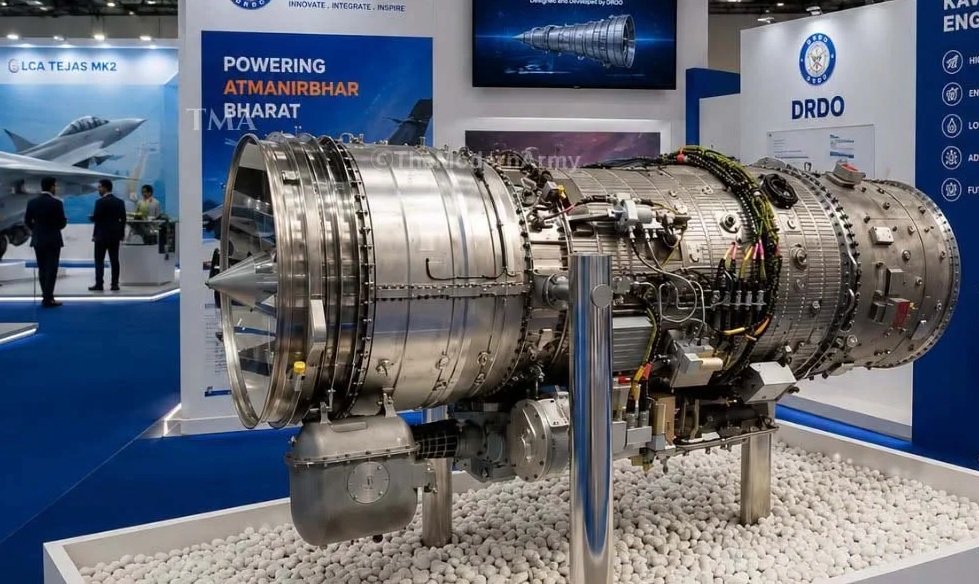
NEW DELHI, — India’s indigenous Kaveri Dry Engine (KDE) has achieved a maximum dry thrust of 48.5 kilonewtons (kN) during flight trials in Russia, exceeding its targeted thrust of around 46 kN.
Developed by the Gas Turbine Research Establishment (GTRE) under the Defence Research and Development Organisation (DRDO), the non-afterburning engine was tested under actual flight conditions using a modified Ilyushin Il-76 flying testbed. One of the aircraft’s standard turbofan engines was replaced with the Kaveri derivative for the evaluation.
The trials were conducted at the Central Institute of Aviation Motors (CIAM) and the Gromov Flight Research Institute. The engine was evaluated across different ambient pressures, Mach numbers and high-altitude conditions, including simulated altitudes of up to 13,000 metres.
The Kaveri Dry Engine is a derivative of the original GTX-35VS Kaveri turbofan, which was initially developed for the LCA Tejas programme. After the original engine did not meet the fighter’s required thrust, development shifted toward a dry variant for unmanned platforms. Officially stated dry-thrust targets have been around 49–51 kN.
The engine is intended to power India’s Ghatak stealth unmanned combat aerial vehicle (UCAV), also associated with the Remotely Piloted Strike Aircraft programme.
With the Russian flight evaluation completed, the test data will undergo further assessment in India. The next major step is certification by the Centre for Military Airworthiness and Certification (CEMILAC) in Bengaluru, which will review the flight-test data and other required safety and structural information.
If certification is completed, further installed-condition testing and system-level integration will be required before the engine can be fitted to Ghatak prototype airframes.
——— End of Article ———