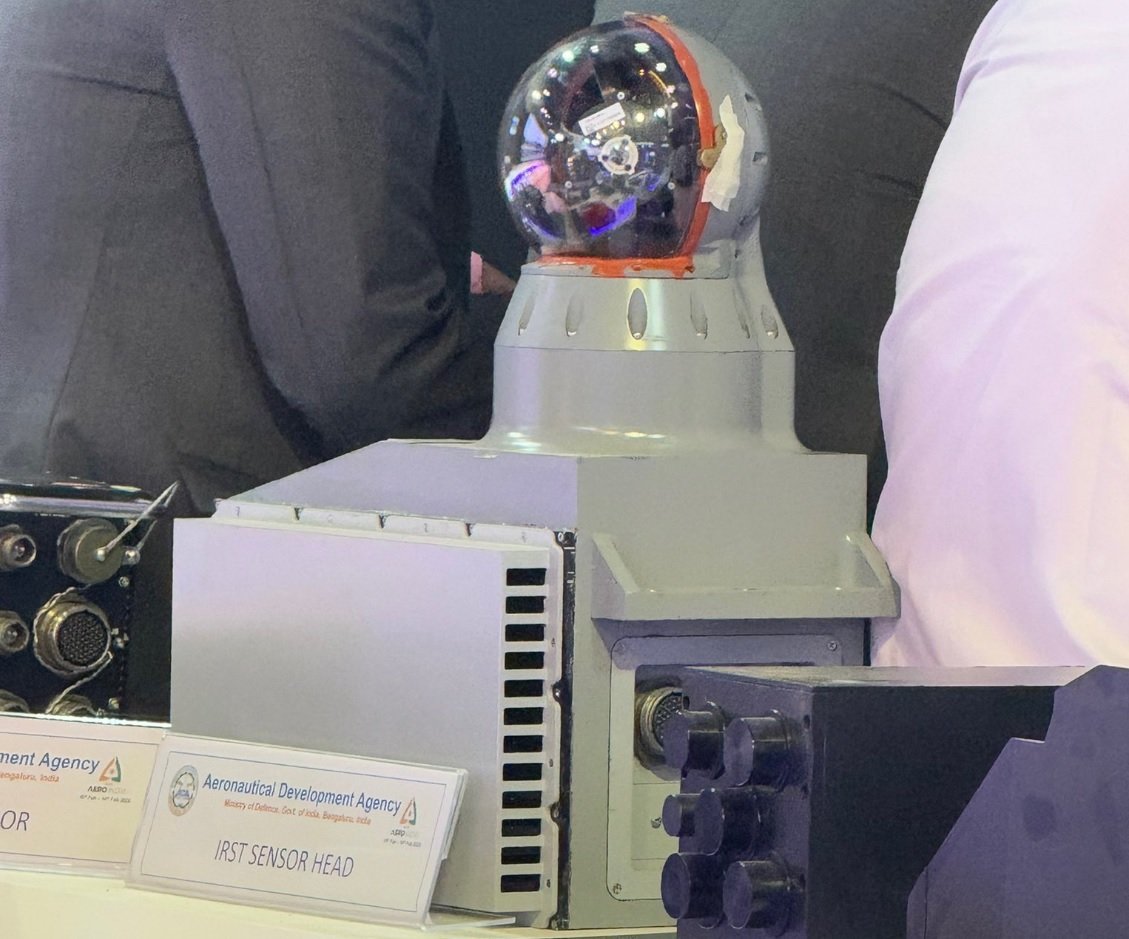
Bengaluru, — India's Defence Research and Development Organisation (DRDO) has completed certification of its indigenous Infra-Red Search and Track (IRST) system, developed for future integration with the Tejas Mk2 and Advanced Medium Combat Aircraft (AMCA).
Developed by DRDO's Instruments Research & Development Establishment (IRDE) in Dehradun, the nose-mounted system was showcased at the Bengaluru Tech Summit 2026, held from November 17 to 19.
Passive Detection of Stealth Aircraft
Unlike conventional radar, which transmits radio signals to detect targets, the IRST operates passively by detecting infrared radiation from aircraft engines and airframes. This allows fighter pilots to search and track airborne targets without revealing their position through radar emissions.
The system reportedly offers detection ranges of approximately 100 kilometres and can track multiple airborne targets simultaneously, including low-observable aircraft.
Multi-Band Sensors and Tracking
The IRST combines three technologies:
-
MWIR: Detects heat signatures from aircraft engines and exhaust.
-
SWIR: Helps identify targets in atmospheric haze and complex backgrounds.
-
Laser Range Finder (LRF): Measures target distance.
The system also features selectable scanning sectors and image de-rotation and de-blur technology to maintain clear tracking during high-speed manoeuvres. Target information, including angular coordinates, is transferred directly to the aircraft's mission computer.
Integration with Tejas Mk2 and AMCA
On the Tejas Mk2, the IRST will complement the indigenous Uttam AESA radar, Unified Electronic Warfare Suite (UEWS) and Dual Colour Missile Approach Warning System (DCMAWS). It will provide an additional passive detection capability rather than replace the aircraft's radar.
The system is also planned for the AMCA fifth-generation fighter, supporting India's development of indigenous airborne sensors.
The Tejas Mk2 prototype is expected to make its maiden flight between June and September 2027, while the AMCA programme targets its first flight in September 2028, according to previously announced government timelines.
Completion of IRST certification marks another development milestone for India's indigenous fighter aircraft sensor technology.
——— End of Article ———