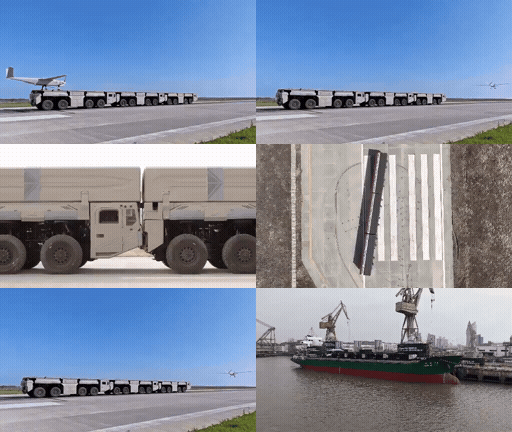
BEIJING, July 2, 2026 — China has publicly demonstrated a truck-mounted Electromagnetic Aircraft Launch System (EMALS) for the first time, successfully launching a fixed-wing unmanned aerial vehicle (UAV) from a modular road-mobile catapult. The demonstration highlights China's continued efforts to expand flexible drone deployment capabilities by enabling aircraft launches without relying on conventional airfields.
The newly released footage shows a propeller-driven fixed-wing drone being launched from a modular catapult assembled by connecting multiple specialized heavy trucks. The system is designed to support operations from austere environments, including highways, remote islands, temporary forward operating bases, and converted civilian vessels.
Modular Truck-Based Launch System
The mobile EMALS consists of three or more specially designed heavy trucks linked together to create a continuous launch rail. According to the system's developer, Tiantao Technology, the launch track can be configured between 20 and 60 meters in length depending on the size and weight of the aircraft being launched.
Unlike conventional drone launch systems that rely on rocket-assisted takeoff or compressed air, the truck-mounted EMALS uses a linear electric motor to accelerate the aircraft along the launch rail. The technology is derived from the electromagnetic launch system currently installed aboard China's Type 003 Fujian aircraft carrier.
Because the launch force is generated electromagnetically, operators can precisely adjust acceleration according to the drone's weight and airframe characteristics. This reduces mechanical stress on the aircraft during launch while allowing support for different UAV types from the same platform.
The specialized launch vehicles are also equipped with an all-wheel steering system, enabling the connected convoy to maneuver with a relatively tight turning radius despite its overall length. This allows operators to align the launch rail into prevailing headwinds, improving aerodynamic performance and launch safety.
Designed for Runway-Independent Operations
The truck-mounted EMALS is intended for operations where conventional runways are unavailable, damaged, or vulnerable to precision strikes. Its modular architecture allows the launch system to be transported by road or ship, assembled quickly, and relocated as operational requirements change.
The system provides military forces with the ability to disperse UAV launch sites across multiple locations rather than relying on fixed airbases. Such distributed operations can increase operational flexibility while reducing dependence on permanent infrastructure.
In addition to land deployment, the modular catapult is designed for installation on converted civilian vessels that can serve as drone carriers, extending launch capability into maritime environments.
Part of China's Containerized Military Platform Initiative
The truck-mounted EMALS forms part of a broader Chinese effort to develop a family of containerized military systems that can be deployed rapidly on land or aboard civilian platforms. The modular ecosystem includes containerized vertical launch systems (VLS) for cruise and anti-ship missiles, radar systems, electronic warfare equipment, command-and-control modules, and other mission systems.
These containerized modules are designed to resemble standard commercial shipping containers, allowing them to be transported using existing logistics infrastructure and installed on a wide range of civilian or military platforms.
Testing on Zhong Da 79
The modular concept has previously been demonstrated aboard the commercial cargo vessel Zhong Da 79, which was converted into an experimental drone carrier and arsenal ship. The vessel was observed equipped with containerized vertical launch cells, close-in weapon systems (CIWS), and a deck-mounted electromagnetic catapult.
Available observations indicated the ship-based EMALS configuration could launch larger unmanned aircraft, including CH-4 medium-altitude long-endurance (MALE) drones and collaborative combat aircraft (CCA) designed for unmanned operations alongside crewed aircraft.
Production Plans
The truck-mounted electromagnetic catapult first emerged publicly toward the end of 2025 and has since undergone testing in multiple configurations.
Chinese sources indicate that production of containerized military modules is planned on a large scale, with an annual output target of up to 2,000 systems. The initiative is intended to expand distributed operational networks and provide flexible deployment options for unmanned aircraft, missile systems, electronic warfare assets, and command infrastructure.
The public demonstration of the truck-mounted EMALS represents the latest step in China's development of mobile electromagnetic launch technology, extending carrier-based launch concepts to road-mobile and modular platforms capable of supporting UAV operations in a wide range of environments.
——— End of Article ———