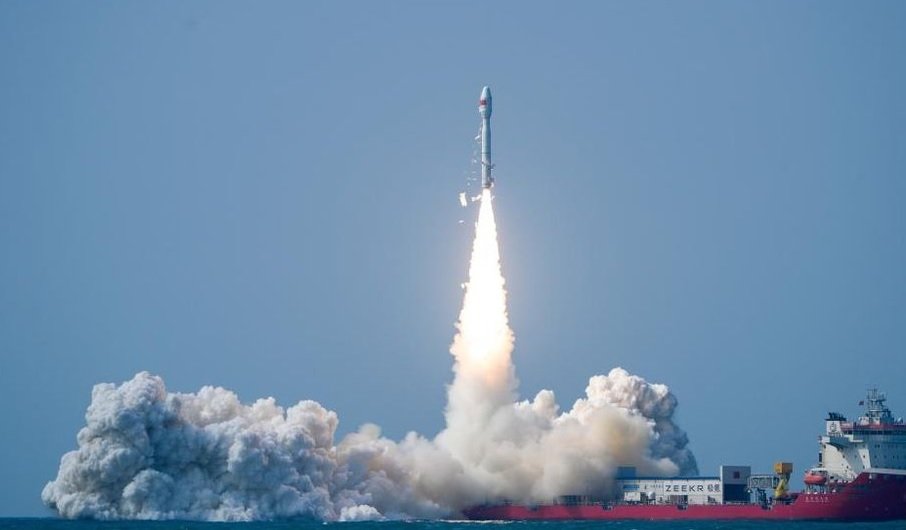
BEIJING — China successfully launched two artificial intelligence-enabled hyperspectral remote sensing satellites into orbit on Wednesday using a Smart Dragon-3 (SD-3), also known as Jielong-3, solid-propellant carrier rocket from a mobile sea-based launch platform.
The rocket lifted off at 10:38 a.m. Beijing Time from waters near Haiyang in eastern Shandong Province under the supervision of the Taiyuan Satellite Launch Center. The mission marked the 12th flight of the Smart Dragon-3, its fourth launch of 2026, and China's second sea-based orbital launch within two weeks.
The launch placed the Oriental Smart Eye (OSE), also known as Dongfang Huiyan, hyperspectral satellites 01 and 02 into their planned orbits. Each satellite weighs approximately 300 kilograms and is designed to provide high-resolution Earth observation using onboard artificial intelligence.
Sea-Based Launch Expands Mission Flexibility
China has continued to increase the use of offshore launch platforms as part of its commercial and orbital launch activities. Compared with fixed inland launch sites, sea-based launches provide greater flexibility in selecting launch trajectories while reducing the risk of rocket debris falling over populated areas.
The latest mission further demonstrates China's continued use of offshore launches for placing satellites into orbit.
AI Processing Moves Data Analysis Into Space
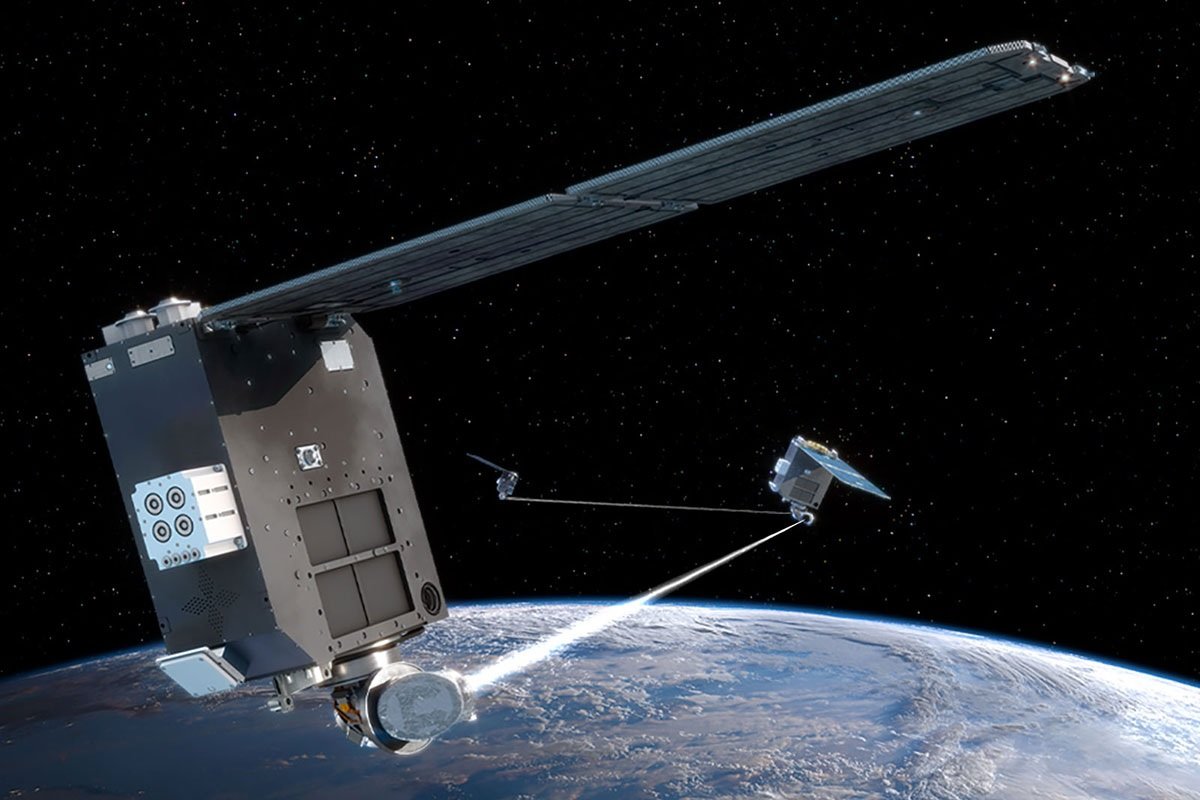
The two satellites are equipped with onboard artificial intelligence computing modules developed by Hangzhou-based Star Vision Aerospace Group Ltd., also referred to as STAR.VISION or Star.ai Spatio-temporal Intelligence Technology Co., Ltd.
Each satellite has onboard computing capability of up to 400 trillion operations per second, enabling data processing directly in orbit instead of relying entirely on ground-based processing after image transmission.
According to official information, the onboard AI system can perform tasks including:
- Anomaly detection
- Surface-feature identification
- Intelligent data compression
- Feature extraction
By processing information in space, the satellites can significantly reduce the amount of raw data transmitted to Earth while shortening response times from several days to the minute level.
Hyperspectral Imaging for Environmental and Resource Monitoring
Unlike conventional optical imaging satellites that primarily capture photographs, the Oriental Smart Eye satellites use hyperspectral imaging technology to collect detailed spectral information for every pixel.
Each satellite carries:
- 22 calibrated spectral bands
- 5-meter spatial resolution
- Approximately 300-kilometer imaging swath
Together, the satellites are designed to provide global revisit coverage every five days.
The hyperspectral sensors allow the satellites to identify different materials and measure characteristics including:
- Vegetation chlorophyll
- Plant moisture
- Water quality
- Soil organic matter
- Mineral composition
The satellites are intended for applications in agriculture, forestry, water resource management, mining, and environmental monitoring.
International Cooperation Included in Mission
The two satellites are part of the broader Dongfang Huiyan spatiotemporal intelligent constellation project, which includes international cooperation.
Satellite 01, also known as Lampung-1, supports cooperation with Indonesia and is intended to help monitor crop growth and assess disaster risks affecting agricultural production.
Satellite 02, also called Samarkand-2028, supports cooperation with Uzbekistan and is designed for full-cycle monitoring of cotton cultivation, from sowing through harvesting.
Part of a Larger Satellite Constellation
The two spacecraft are also part of the broader Oriental Smart Eye Constellation program, which aims to deploy more than 200 intelligent high-resolution satellites by 2030.
According to official reports, once operational the new satellites are expected to work alongside an existing high-resolution satellite already in orbit, combining wide-area surveys with more detailed observations to support high-precision Earth observation and large-scale land and sea monitoring.
Smart Dragon-3 Launch Vehicle
The Smart Dragon-3 is a four-stage solid-propellant carrier rocket developed by the China Academy of Launch Vehicle Technology for commercial launch missions.
According to officially available specifications, the rocket:
- Stands about 31 meters tall
- Has a diameter of approximately 2.65 meters
- Has a liftoff mass of around 140–145 metric tons
- Can carry up to about 1,500–1,600 kilograms to a 500-kilometer sun-synchronous orbit
The vehicle is designed to launch small and medium-sized payloads into sun-synchronous and low Earth orbits, with sea-based operations providing additional flexibility for commercial and government missions.
——— End of Article ———