BEIJING/TOKYO, June 29, 2026 — China and Japan have exchanged conflicting claims over military surveillance activities during the People's Liberation Army Navy (PLAN) aircraft carrier Liaoning's recent 40-day deployment in the Western Pacific and South China Sea, highlighting continuing tensions over naval operations in the region.
Chinese state media accused Japanese warships and aircraft of conducting "targeted simulated attacks" while monitoring the carrier strike group. Japan rejected the allegation, stating that its forces carried out only routine vigilance and surveillance operations.
Liaoning Completes 40-Day Mission
The Liaoning carrier strike group returned to Qingdao on June 22 after a deployment that began on May 19.
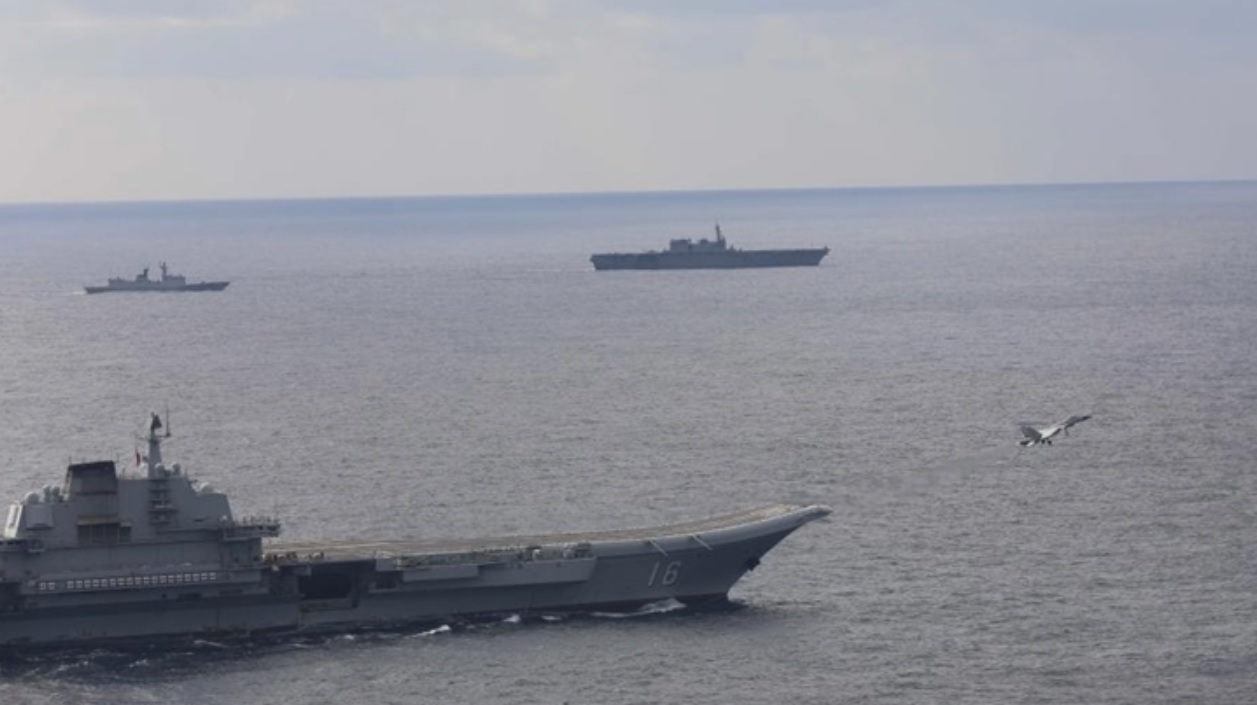
The five-ship formation comprised the aircraft carrier CNS Liaoning (16), cruiser CNS Wuxi (104), destroyer CNS Kaifeng (124), frigate CNS Luohe (545), and fast combat support ship CNS Hulunhu (901).
According to China's Ministry of National Defense, the deployment included integrated shore-sea combat training, carrier-based flight operations, anti-submarine warfare, formation search and rescue exercises, and system-of-systems operational drills. The carrier group also conducted coordinated operations with a Type 075 amphibious assault ship group led by Anhui, expanding the PLAN's experience in large-scale blue-water operations.
A key feature of the deployment was the operational use of the J-15T carrier-based fighter. The upgraded aircraft incorporates improved avionics, radar, and weapons systems and successfully demonstrated rolling takeoffs from Liaoning's ski-jump flight deck despite being designed for electromagnetic catapult-equipped carriers such as the Type 003 Fujian, demonstrating operational compatibility across China's carrier fleet.
Dispute Over Surveillance Operations
The dispute centers on interactions between the Chinese carrier group and Japanese monitoring assets, including the Japan Maritime Self-Defense Force (JMSDF) destroyer JS Asahi.
Chinese state broadcaster CCTV and other official media outlets reported that Japanese warships and aircraft conducted "targeted simulated attacks" while closely tracking the Liaoning. Chinese military commentator Teng Jianqun described the monitoring as a significant departure from previous encounters.
Chinese media cited Japanese reports in support of the allegation but did not provide independent evidence verifying that simulated attack maneuvers had occurred.
On June 26, China's Ministry of National Defense accused Japan of interfering with the carrier group's routine training activities and called for an end to what it described as unsafe monitoring operations.
Japan's Joint Staff Office rejected the allegation as inaccurate, maintaining that the JMSDF conducted only routine surveillance and vigilance missions while prioritizing operational safety.
Regional Context
The latest dispute follows another incident during a December 2025 Liaoning deployment, when two J-15 fighters reportedly locked fire-control radars onto Japanese F-15 aircraft monitoring the carrier group. The incident prompted consultations between Japan and the United States over Chinese naval activity near Japan's southwestern islands.
The recent deployment also coincided with significant allied naval activity in the Western Pacific. The USS George Washington Carrier Strike Group conducted anti-submarine warfare exercises near Guam alongside the Japanese helicopter carrier JS Kaga, destroyer JS Fuyuzuki, and the Royal Canadian Navy frigate HMCS Charlottetown. P-8A Poseidon maritime patrol aircraft from the United States, Australia, and New Zealand also participated in anti-submarine training operations.
Independent reporting, including by USNI News, confirmed the timeline and composition of the Liaoning carrier strike group's deployment. However, no independent source has verified the Chinese allegation that Japanese forces conducted simulated attack maneuvers during the mission.
——— End of Article ———