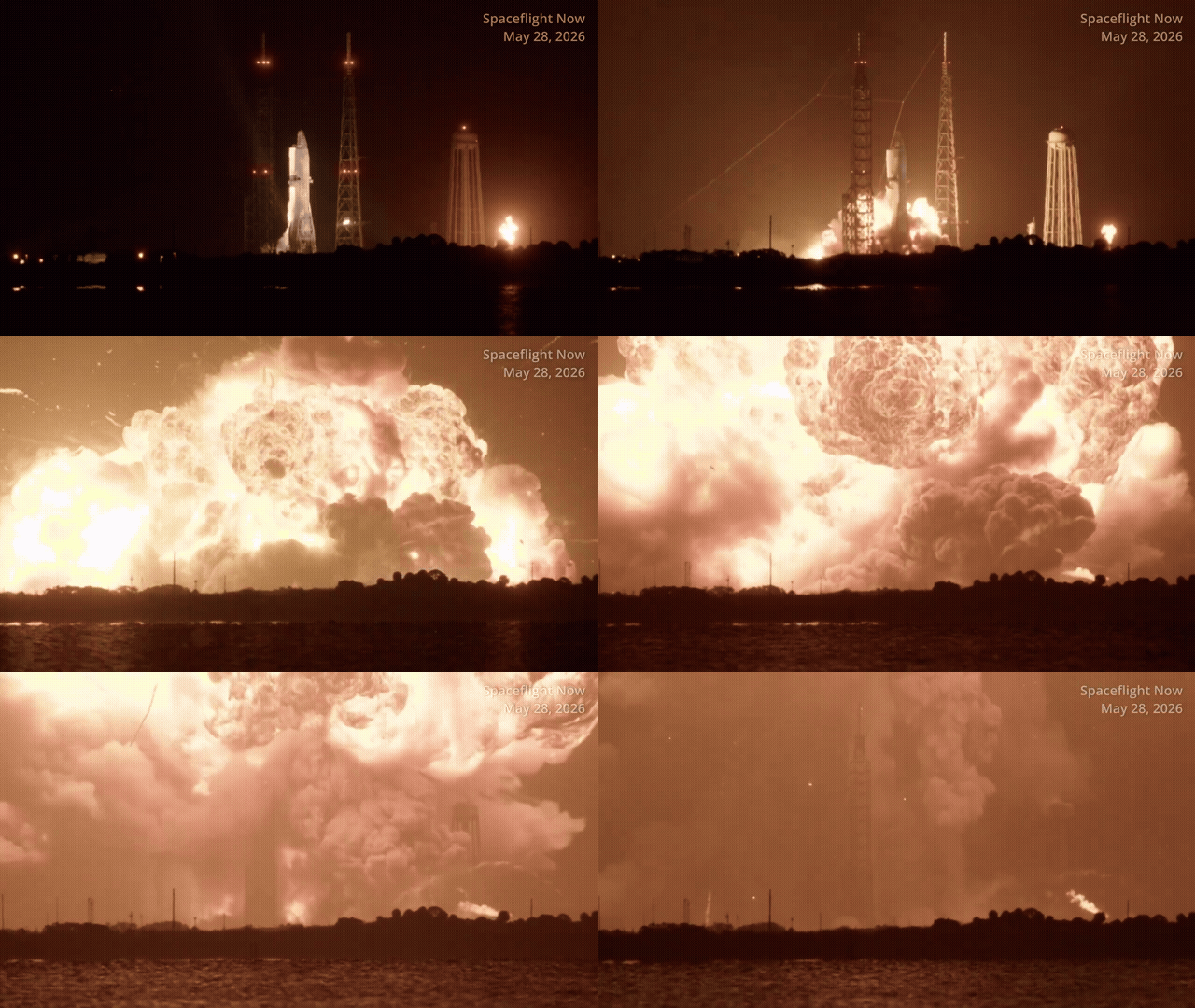
CAPE CANAVERAL, Fla. — May 29, 2026 : Blue Origin’s New Glenn rocket was destroyed Thursday evening after an anomaly occurred during a routine static fire test at Cape Canaveral Space Force Station in Florida, resulting in an explosion at the launch site. The company confirmed that all personnel were accounted for and no injuries were reported.
The incident occurred at approximately 9:00 p.m. EDT at Space Launch Complex 36 (LC-36), where engineering teams were conducting a hotfire static fire test as part of preparations for the rocket’s fourth overall mission, designated NG-4. During a static fire test, a rocket’s engines are ignited while the vehicle remains firmly secured to the launch pad to verify propulsion system performance, engine behavior, and overall launch readiness prior to flight.
According to preliminary information, the fully fueled 320-foot-tall New Glenn rocket experienced a failure moments after ignition of its seven BE-4 engines, triggering an explosion and fire at the launch complex. Video footage from the site showed a large fireball and pressure wave shortly after engine startup. Residents in nearby Cocoa Beach reported hearing the blast and feeling vibrations.
Public Safety and Damage Assessment
Following the explosion, local emergency authorities, including Brevard County Emergency Management and the U.S. Space Force, confirmed there was no threat to public safety from toxic fumes or other hazards. Officials stated that all personnel at the launch facility were accounted for, while the Federal Aviation Administration (FAA) said the test was not part of licensed launch operations and had no impact on commercial air traffic.
Although Blue Origin has not yet released a complete damage assessment, local reports and visual evidence indicate that the blast caused major destruction to the launch vehicle and infrastructure at LC-36. Early reports suggested structural damage at the site, including the collapse of a nearby lightning tower. Engineers are continuing evaluations to determine the full extent of the damage.
NG-4 Mission and Planned Satellite Deployment
The static fire test was being conducted ahead of New Glenn’s fourth planned mission, NG-4, which had been scheduled to launch as early as June 4, 2026. The mission was expected to carry 48 broadband satellites into low-Earth orbit for Amazon’s Project Kuiper, also referred to as Amazon Leo, a satellite internet constellation intended to compete with SpaceX’s Starlink network.
Blue Origin confirmed that the payload of satellites was not installed on the rocket during the test, meaning losses were limited to the launch vehicle itself and infrastructure at Space Launch Complex 36.
Statements from Blue Origin and Industry Leaders
Following the incident, Blue Origin issued a public statement confirming that an anomaly had occurred during the hotfire test and that all personnel remained safe. Founder Jeff Bezos later stated that it was too early to determine the root cause of the failure but confirmed that an investigation had begun to identify what caused the explosion.
Industry leaders also reacted to the incident. SpaceX Chief Executive Elon Musk described the event as unfortunate and acknowledged the technical difficulty involved in rocket development. NASA Administrator Jared Isaacman said the agency was monitoring the situation closely and would coordinate with partners to evaluate possible mission impacts while supporting a thorough investigation.
New Glenn Program and Broader Impact
New Glenn is Blue Origin’s two-stage, partially reusable heavy-lift launch vehicle designed for commercial, government, and lunar exploration missions. Standing approximately 98 meters tall, the rocket uses seven methane-fueled BE-4 engines on its first stage and two BE-3U engines on the second stage. The vehicle is designed to carry up to 45 metric tons to low-Earth orbit and around 13 metric tons to geostationary transfer orbit.
The rocket is also a key component of Blue Origin’s participation in NASA’s Artemis lunar exploration program, where New Glenn is expected to support launches related to the Blue Moon lunar lander system.
Thursday’s explosion represents another setback for the New Glenn program after an engine-related issue during the vehicle’s third flight in April 2026 resulted in a satellite being inserted into an incorrect orbit. The FAA had recently cleared the rocket to resume flights following that investigation.
With LC-36 currently serving as Blue Origin’s only launch facility capable of supporting New Glenn missions, the damage is expected to delay upcoming operations while investigators determine the cause of the failure and repair work begins at the launch site.
——— End of Article ———