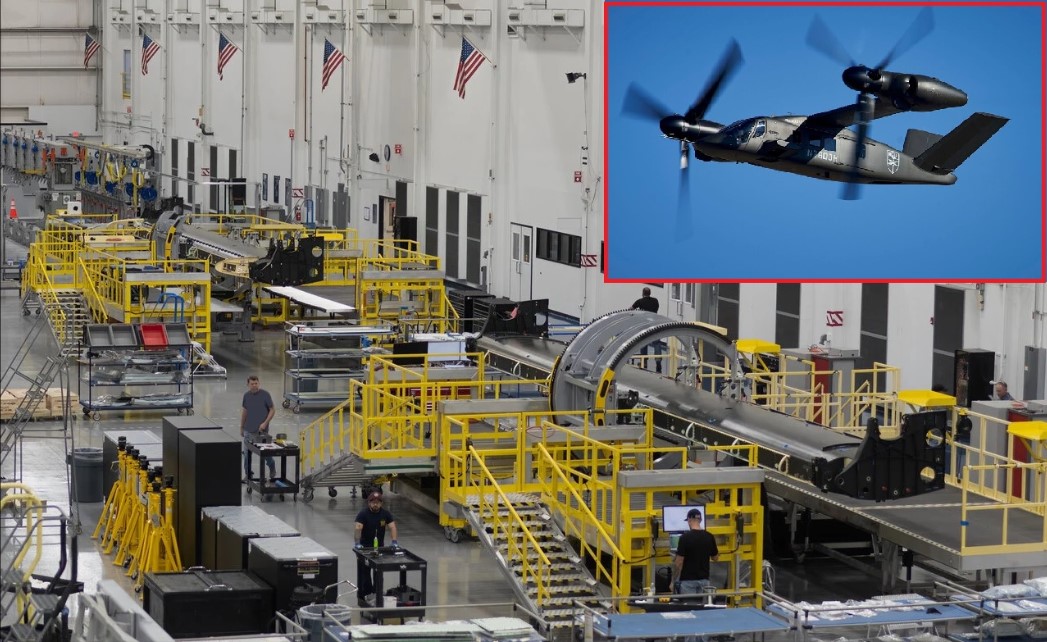
FORT WORTH, Texas, — June 12, 2026 : Bell Textron Inc. has completed the assembly of the first two primary wing structures for the MV-75 Cheyenne tiltrotor aircraft, marking a key production milestone for the U.S. Army’s Future Long-Range Assault Aircraft (FLRAA) program. The completed wings will be integrated into the first two MV-75 test aircraft as the program moves toward flight testing.
The wing structures serve as a major component of the aircraft, providing structural strength, aerodynamic stiffness, and survivability. Following assembly, Bell has begun integrating system provisions into the wings. The next phase will involve mating the wings with the fuselage and nacelle assemblies.
The fuselage is currently being assembled at Bell’s Wichita Assembly Center in Kansas, while nacelle production is also progressing.
Manufacturing Progress
Bell reported significant improvements in production efficiency during wing assembly. The first wing, completed in February 2026, required 90 percent fewer labor hours than the initial wing produced for the V-22 Osprey program. The second wing required an additional 40 percent fewer labor hours, demonstrating further manufacturing improvements.
The wings are built using carbon fiber reinforced polymer composite materials, reducing weight while supporting affordability and production readiness goals.
FLRAA Aircraft Development
The MV-75 Cheyenne was selected by the U.S. Army in December 2022 as the winner of the Future Long-Range Assault Aircraft competition. Developed from Bell’s V-280 Valor technology demonstrator, the aircraft is intended to replace the Army’s UH-60 Black Hawk helicopter fleet.
The Army designated the aircraft as MV-75 in May 2025. The designation stands for Multi-Mission Vertical Takeoff, while “75” honors the Army’s founding year of 1775. In April 2026, the Army announced the name Cheyenne II, continuing its tradition of naming rotorcraft after Native American tribes.
Improved Speed and Range
The tiltrotor design allows the aircraft to take off and land vertically while achieving higher speeds in forward flight. The Army expects the MV-75 to provide approximately twice the speed and twice the range of the Black Hawk.
The aircraft is designed to cruise at speeds exceeding 300 miles per hour and achieve a ferry range of up to 2,400 miles, supporting operations across large distances, including the Indo-Pacific region.
The MV-75 also features a Modular Open Systems Approach (MOSA), enabling faster integration of future technologies, sensors, and mission systems throughout its service life.
Next Steps
Bell continues assembling the first test aircraft as the FLRAA program advances through development. The completion of the first two wing structures marks a major step toward aircraft integration and the upcoming flight-test phase.
The U.S. Army is currently targeting initial operational fielding around 2031 as part of its broader aviation modernization effort.
——— End of Article ———