June 21, 2026 : Recent criticism of India's Advanced Medium Combat Aircraft (AMCA) has focused on reports that the aircraft's internal weapons bay may not be able to accommodate the approximately 5.5-meter-long Rudram-1 anti-radiation missile in stealth configuration. Critics have portrayed this as a major design limitation. However, a comparison with the world's leading stealth aircraft shows that internal weapon carriage constraints are a common reality across virtually every stealth fighter program.
Comparing Internal Weapons Bays of Major Stealth Aircraft
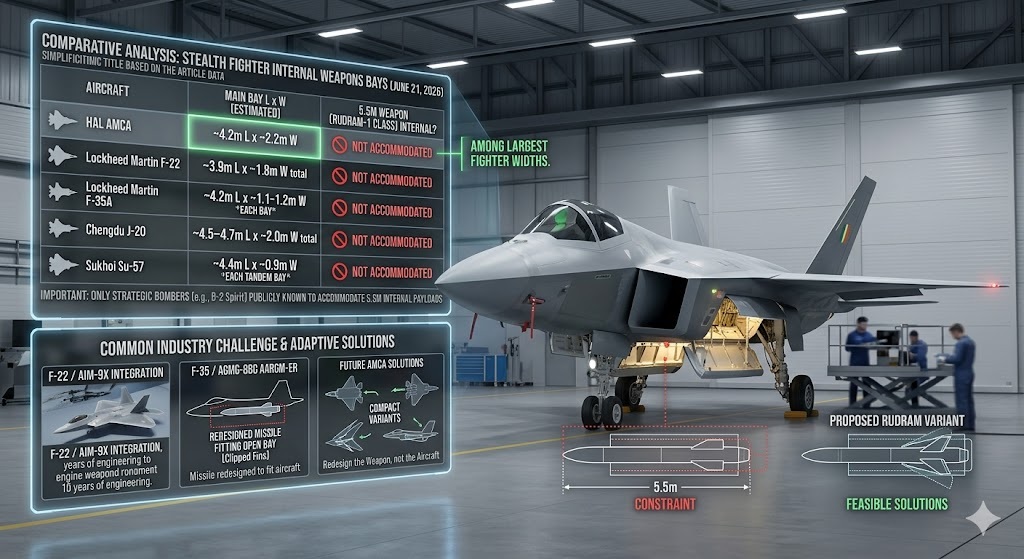
| Aircraft | Main Internal Bay Length | Main Internal Bay Width | Notes |
|---|---|---|---|
| Lockheed Martin F-22 Raptor | ~3.9 m (12.8 ft) | ~1.8 m (total) | One large central main bay plus two side bays for AIM-9 missiles. |
| Lockheed Martin F-35A Lightning II | ~4.2 m (13.8 ft) | ~1.1–1.2 m (each bay) | Two parallel bays sized for 2,000-lb class munitions. |
| Sukhoi Su-57 | ~4.4 m (14.4 ft) | ~0.9 m (each bay) | Two tandem main bays plus two side bays for short-range missiles. |
| Chengdu J-20 | ~4.5–4.7 m | ~2.0 m (total) | One large main bay plus two side bays. |
| Shenyang J-35A | ~4.0 m | ~0.85 m (each bay) | Estimated from subsystem constraints and aircraft size. |
| HAL AMCA | ~4.2 m | ~2.2 m | Reported/estimated from publicly available information. |
| Lockheed Martin F-117 Nighthawk | ~4.7 m | ~1.7 m | Single bay primarily used for laser-guided bombs. |
| Northrop B-2 Spirit | ~5.8 m (each bay) | ~2.7 m (each bay) | Two large bomb bays for strategic payloads. |
| Northrop Grumman B-21 Raider | Classified | Classified | Exact dimensions remain undisclosed. |
One important detail often overlooked is that the AMCA's reported internal bay width of approximately 2.2 meters is among the largest of any stealth fighter currently known. Only strategic stealth bombers such as the B-2 Spirit are believed to possess significantly larger internal weapon bays.
The F-35's two parallel weapon bays should not be interpreted as a combined 2.2-meter-wide compartment. Each bay operates independently and can only accommodate weapons within its individual dimensions. Similarly, the Su-57 employs two separate tandem bays rather than one continuous internal compartment.
Which Stealth Aircraft Can Carry a 5.5-Meter Weapon Internally?
Based on publicly available estimates, very few stealth aircraft appear capable of carrying a weapon approximately 5.5 meters in length entirely within their internal weapon bays.
Among fighter-sized stealth aircraft:
- F-22 Raptor: No
- F-35A Lightning II: No
- J-35A: No
- Su-57: No based on publicly available estimates
- J-20: No based on publicly available estimates
Among currently known stealth aircraft, only strategic bombers such as the B-2 Spirit are publicly known to possess internal weapon bays large enough to accommodate a 5.5-meter-class weapon. The B-21 Raider's exact bay dimensions remain classified, but it is widely expected to support weapons of comparable size.
This means AMCA is far from unique in facing limitations when integrating unusually long weapons.
A Common Challenge Across Every Stealth Fighter Program
The history of stealth aviation shows that weapon integration challenges are normal and expected.
The F-22 Raptor initially could not carry the AIM-9X Sidewinder internally despite being designed as the world's premier air-superiority fighter. Years of engineering work involving software updates, launcher modifications, and testing were required before full internal AIM-9X capability was achieved.
Every stealth fighter program must balance internal weapon carriage, stealth, fuel capacity, range, and aerodynamic performance. As new weapons are developed, aircraft manufacturers frequently modify launchers, software, and weapon designs to maintain internal carriage compatibility. This is a normal part of stealth fighter evolution rather than an indication of a flawed aircraft design.
The Su-57 faces similar considerations. Its internal bay configuration affects which weapons can be carried internally and influences future weapon integration efforts.
The F-35 program provides perhaps the clearest example of how the aerospace industry addresses such challenges. Rather than redesigning the aircraft every time a new weapon is introduced, developers adapt both the weapon and the aircraft.
Examples include:
- The Meteor beyond-visual-range missile received clipped fins to fit within the F-35's internal weapon bay.
- SPEAR 3 was designed around the F-35's bay dimensions from the beginning.
- New ejector racks, launchers, software packages, and integration updates continue expanding the range of weapons the aircraft can carry internally.
Another example is the AGM-88G AARGM-ER (Advanced Anti-Radiation Guided Missile-Extended Range). Unlike earlier AGM-88 HARM variants, the AARGM-ER was redesigned with a new airframe, revised control surfaces, and a modified layout specifically to enable internal carriage aboard the F-35A and F-35C. The missile received Milestone C approval in 2021 and entered low-rate initial production, with compatibility with the F-35's internal weapon bays being a key design requirement. Rather than redesigning the aircraft to fit the missile, engineers redesigned the missile to fit the aircraft's stealth requirements.
Even the F-22 required years of integration work before carrying AIM-9X internally.
Internal carriage constraints are therefore not unique to AMCA. They are an industry-wide reality affecting every modern stealth fighter.
Why Stealth Aircraft Cannot Have Unlimited Internal Space
Stealth aircraft are designed around multiple competing requirements:
- Low radar cross-section
- Internal weapon carriage
- Fuel capacity
- Aerodynamic performance
- Structural strength
- Weight limitations
- Range and survivability
Increasing internal bay length significantly affects aircraft structure, weight distribution, stealth shaping, and aerodynamic efficiency. Every stealth fighter program therefore optimizes its internal weapon bays around expected mission requirements rather than attempting to accommodate every possible future weapon.
This is a design tradeoff accepted by all major aerospace powers.
The Rudram-1 Question
If current reports are accurate and the existing Rudram-1 configuration cannot fit inside the AMCA's internal bay, that does not automatically represent a failure of either the aircraft or the missile.
The global aerospace industry has repeatedly solved similar challenges through:
- Missile redesigns
- Folding or modified control surfaces
- Compact internal-carriage variants
- New launcher systems
- Software integration updates
- Future weapons specifically optimized for internal carriage
The United States, China, Russia, and European nations have all adopted these approaches when integrating weapons into stealth aircraft.
Conclusion
Claims that AMCA is fundamentally flawed because it may not carry a 5.5-meter-long Rudram-1 missile internally ignore the realities of stealth fighter development worldwide.
The F-22 initially could not carry AIM-9X internally. The F-35 community solved similar challenges by adapting both weapons and aircraft. Meteor received clipped fins to fit the internal bay, SPEAR 3 was designed around F-35 bay dimensions, and the AARGM-ER was redesigned specifically for internal carriage aboard the F-35A and F-35C. The Su-57 also faces internal carriage limitations that influence weapon selection and future integration efforts.
In practical terms, the challenge is not unique to India. The United States redesigned the AARGM-ER for internal F-35 carriage, modified Meteor for compatibility with the F-35, and spent years integrating AIM-9X into the F-22. Across the world, stealth aircraft and weapons evolve together. Aircraft are not redesigned for every weapon, and weapons are not frozen in their original configuration.
Internal carriage constraints are a common feature of stealth fighters, not proof that a program is "dead on arrival."
If a current Rudram variant does not fit inside AMCA's weapon bay, the solution remains the same one adopted by every major aerospace power: redesign the weapon, modify the launcher, develop a compact variant, or adapt the integration package.
Viewed in a global context, AMCA's reported internal weapons bay dimensions of approximately 4.2 meters in length and 2.2 meters in width remain highly competitive among fighter-sized stealth aircraft. The inability to carry a specific 5.5-meter weapon internally says more about the size of the weapon than it does about the viability of the aircraft itself.
——— End of Article ———