Why the U.S. Navy Is Slow to Adopt Electromagnetic Catapults While China Becomes First to Deploy EM Catapults
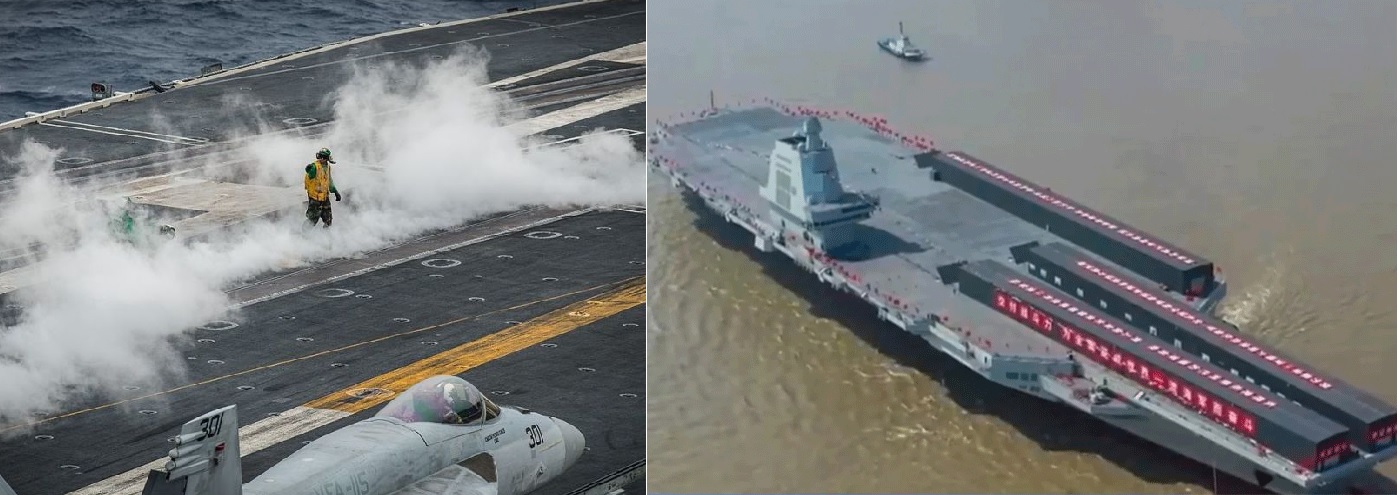
For over six decades, steam catapults have been the defining feature of American aircraft carriers. They have launched everything from F-4 Phantoms to F/A-18 Hornets, reliably flinging thousands of aircraft from the decks of supercarriers across the world’s oceans. Yet, as the 21st century ushered in a new era of naval technology, the U.S. Navy began developing what many considered the future of carrier aviation — the Electromagnetic Aircraft Launch System (EMALS).
However, despite the initial excitement, the United States has not yet adopted electromagnetic catapult systems across its entire carrier fleet. In fact, only the USS Gerald R. Ford (CVN-78) currently uses EMALS, while the rest of the Navy’s carriers still rely on tried-and-tested steam catapults. The reasons behind this are complex, combining technical hurdles, integration challenges, financial pressures, and political oversight.
The Promise of EMALS
At its core, EMALS was designed to replace steam catapults with a far more efficient and modern alternative. Instead of relying on high-pressure steam, EMALS uses linear induction motors — long tracks of electromagnetic coils that create a controlled magnetic field — to propel aircraft down the flight deck.
The benefits were meant to be transformative. EMALS offers smoother acceleration, reducing stress on both the airframe and pilot. It can launch a wider range of aircraft, including light unmanned aerial vehicles (UAVs) and heavy next-generation fighters. It also eliminates the need for massive boilers, complex plumbing, and heavy maintenance required by steam systems.
From a design perspective, EMALS was expected to improve sortie generation rates, reduce manpower, and allow future carriers to launch both manned and unmanned aircraft seamlessly.
Why the U.S. Didn’t Abandon Steam Completely
Despite the advantages, the transition from steam to electromagnetic launch systems has been far more difficult than expected. While EMALS was successfully built and installed on the Ford-class carriers, its early performance fell short of expectations — and the Navy decided to proceed cautiously before committing it fleet-wide.
1. Reliability Challenges
The first and foremost issue was reliability. EMALS is an incredibly complex electrical system requiring precise synchronization between its motor components, energy storage systems, and power electronics. Early testing revealed frequent system failures and inconsistent performance, leading to delays in flight operations.
According to internal test reports, EMALS initially suffered mean cycles between failure rates far below Navy targets. For a carrier designed to conduct hundreds of launches per day, even minor reliability issues can quickly escalate into operational disruptions. Steam catapults, though old-fashioned, are rugged, well-understood, and proven — making the Navy hesitant to take on unnecessary risks in combat operations.
2. Power System Integration
EMALS is also extremely power-hungry. Unlike steam catapults that draw power from the ship’s boilers, electromagnetic systems require enormous amounts of electrical energy storage and rapid power discharge. The Ford-class nuclear reactors were specifically designed to provide this capability, but older Nimitz-class carriers were not.
Retrofitting Nimitz-class ships with EMALS would require a complete redesign of their power generation and distribution systems — an effort costing billions and requiring years in dry dock. In practical terms, it simply isn’t worth the expense or the downtime for ships already halfway through their service life.
3. Cost and Schedule Overruns
EMALS became a high-profile part of the Ford-class cost overruns, with its development and integration contributing to budget escalations and schedule delays. The program became a lightning rod for criticism in Congress, where lawmakers demanded accountability for the Navy’s ambitious technology programs.
Under such scrutiny, Navy leadership prioritized stabilizing performance and reducing risk before moving forward with additional EMALS-equipped carriers. The result was a slower, more conservative rollout rather than a wholesale shift.
4. Political Oversight and Public Criticism
While no formal political decision stopped EMALS, Congressional oversight created strong pressure on the Navy to “prove it works before expanding it.” Lawmakers, defense analysts, and watchdog groups questioned whether it was wise to introduce multiple untested systems (EMALS, advanced arresting gear, dual-band radar) on the same ship class.
The Navy, already facing criticism for delays in Ford’s readiness, decided to consolidate efforts on making EMALS reliable on CVN-78 before expanding its use to future ships like USS John F. Kennedy (CVN-79) and USS Enterprise (CVN-80).
Not Abandoned — Just a Slow Transition
It’s important to note that the United States did not abandon EMALS. The system is operational aboard USS Gerald R. Ford, which completed its first deployment in 2023 and launched thousands of aircraft during trials. Subsequent ships in the Ford-class — including CVN-79 and CVN-80 — are also planned to feature EMALS once reliability metrics improve.
In other words, EMALS is built and in use, but it’s still in the refinement stage, not yet mature enough to justify large-scale retrofits or rapid fleet integration.
Why Steam Still Rules — For Now
The steam catapult remains in use not because of nostalgia, but because of practicality. It’s proven, dependable, and deeply integrated into existing ship systems. As long as Nimitz-class carriers remain the workhorses of the U.S. Navy, steam will continue to serve.
Furthermore, the Navy’s next-generation carrier strategy focuses on balancing innovation with operational reliability. It has learned from the Ford-class experience that introducing too many revolutionary systems simultaneously creates unnecessary risk. The service is now pacing its modernization efforts to ensure reliability, cost efficiency, and combat readiness come first.
The Global Context: China’s Challenge
Meanwhile, the People’s Liberation Army Navy (PLAN) has introduced its own electromagnetic catapult on the Fujian (Type 003) carrier, signaling China’s ambition to close the technology gap. Beijing’s adoption of an EM launch system has reignited debate in Washington over whether the U.S. should accelerate its own adoption timeline.
However, while China’s progress is noteworthy, its system has not yet been tested in real carrier operations. The U.S. Navy, with decades of experience in carrier aviation, is taking a deliberate, data-driven approach — preferring proven reliability over rushed technological demonstration.
The U.S. Navy’s cautious handling of EMALS reflects a broader truth about military innovation: revolutionary technology must earn its place through reliability and performance, not just promise.
As the Navy works through EMALS’ remaining issues, the system’s long-term advantages — reduced maintenance, improved sortie rates, and support for next-generation UAVs — will likely ensure its place in future carriers.
For now, however, steam catapults remain the backbone of American naval aviation — a 20th-century invention still launching the world’s most advanced aircraft, while the electromagnetic future slowly takes shape on the deck of the USS Gerald R. Ford.
About the Author
Aditya Kumar:
Defense & Geopolitics Analyst
Aditya Kumar tracks military developments in South Asia, specializing in Indian missile technology and naval strategy.