Why Russia’s Oreshnik Missile Doesn’t Need Explosives, Hypersonic Speed Does the Damage
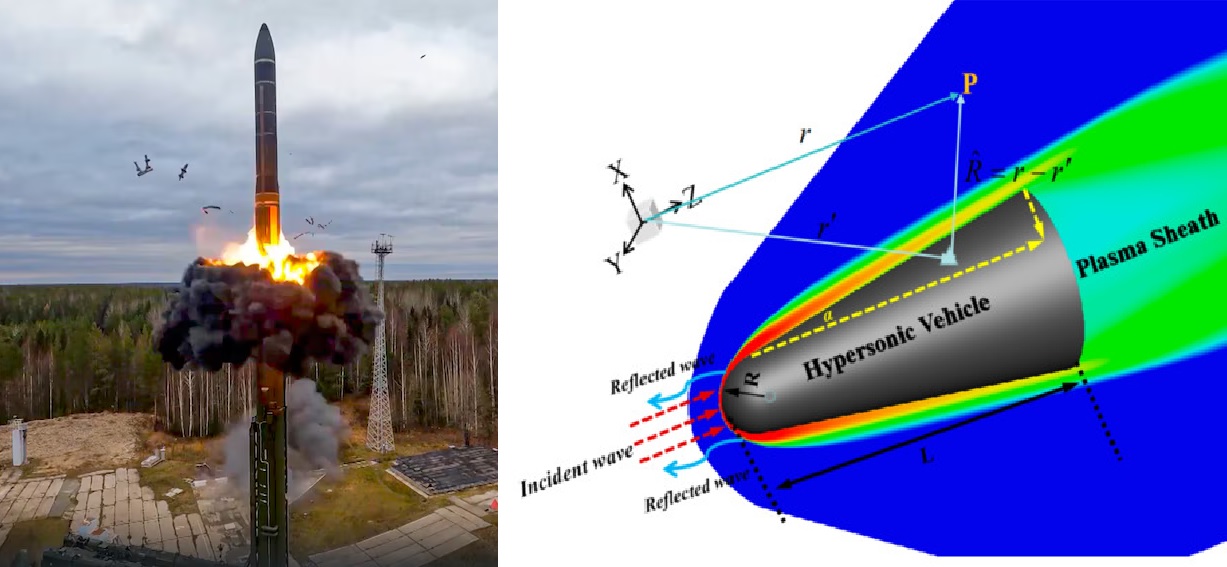
Moscow : As scrutiny intensifies around Russia’s reported Oreshnik hypersonic strike system, military analysts are drawing attention to one of its most unconventional features: the apparent absence of a conventional explosive charge. Far from being a limitation, experts say this design choice reflects a deliberate shift toward purely kinetic destruction, where speed itself becomes the weapon.
At hypersonic velocities—approaching Mach 10, or more than 12,000 kilometers per hour—the energy carried by a descending warhead dramatically exceeds what chemical explosives of similar mass can deliver. This reality is driving a quiet but significant transformation in modern warhead design.
When Speed Replaces Explosives
In traditional missile systems, explosive payloads are used to maximize damage upon impact. However, at extreme hypersonic speeds, the kinetic energy of the warhead becomes the dominant destructive force.
Defense physicists explain that kinetic energy scales with the square of velocity, meaning that each incremental increase in speed produces disproportionately larger energy gains. At Mach 10, the stored kinetic energy of the warhead is so large that adding explosives offers diminishing returns.
Public aerospace engineering studies indicate that in hypersonic reentry vehicles, only a limited portion of total mass can be allocated to explosives—often estimated in open literature at no more than roughly one-quarter to one-third of the vehicle’s mass. The remainder must be devoted to structural reinforcement, thermal protection, and guidance systems capable of surviving immense stress.
At these speeds, the explosive charge contributes less total energy than the motion of the warhead itself.
Structural Limits at Hypersonic Overloads
Hypersonic warheads experience extreme conditions during flight and terminal descent. Rapid maneuvering and sudden deceleration generate overloads tens to hundreds of times greater than gravity, forces that conventional explosive casings struggle to withstand.
To survive, the warhead must be built from dense, heat-resistant materials. This structural requirement inherently limits how much space and mass can be safely allocated to explosives without compromising integrity. The result is a natural ceiling on explosive payload size—one that becomes increasingly restrictive as velocity rises.
Military engineers argue that beyond a certain speed threshold, explosives become inefficient baggage.
Heat, Plasma, and a Different Kind of Explosion
Another key factor is thermal physics. As a hypersonic warhead decelerates in the atmosphere or upon impact, immense frictional heating occurs. Surface temperatures can rise to the point where portions of the warhead material partially ionize, forming short-lived plasma.
This process does not require explosives. Instead, the sudden release of stored kinetic energy causes the warhead body to fragment violently, ejecting ultra-high-velocity droplets and shards. These fragments behave like micro-jets, focused in the direction of travel, producing penetration effects comparable to or exceeding shaped-charge explosives.
Analysts describe this as a kinetic fragmentation field, capable of punching through reinforced structures, hardened bunkers, or missile defenses through raw momentum alone.
Simpler Design, Harder to Defend Against
Eliminating explosives offers additional advantages. Without a chemical detonation system, the warhead becomes simpler, more compact, and potentially more reliable. There is no fuse to jam, no explosive to prematurely detonate, and fewer failure points overall.
From a defensive standpoint, this complicates interception. Missile defense systems designed to neutralize explosive warheads may still face catastrophic damage from a non-explosive kinetic impact, even if interception occurs late in the engagement.
A Broader Shift in Modern Warfare
The reported design philosophy behind Oreshnik reflects a broader global trend. The United States, China, and India are all exploring kinetic-only hypersonic weapons, where destructive power comes from velocity, mass, and material science rather than explosives.
In this emerging paradigm, warheads are no longer bombs—they are precision-guided meteorites, engineered to deliver controlled devastation through physics alone.
As hypersonic technology matures, experts expect explosive payloads to play a shrinking role, replaced by designs that exploit the raw, unavoidable consequences of moving extremely fast through matter.
About the Author
Aditya Kumar:
Defense & Geopolitics Analyst
Aditya Kumar tracks military developments in South Asia, specializing in Indian missile technology and naval strategy.