World
Defense
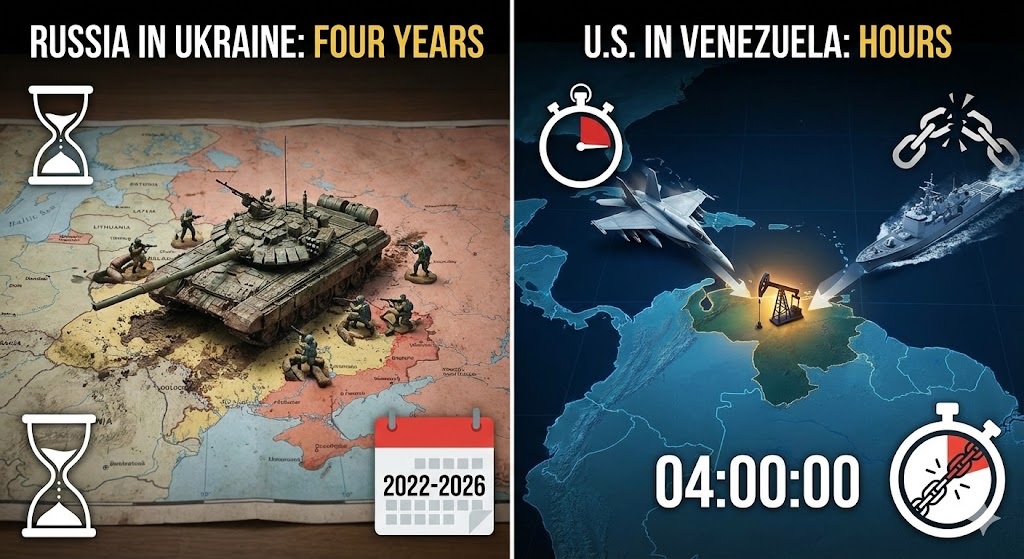
History repeatedly shows that wars often end not when armies are exhausted, but when leaders fall. From ancient battlefields to modern capitals, the capture or elimination of a head of state has frequently collapsed resistance in hours rather than years. Yet the contrast between Russia’s prolonged war in Ukraine and the United States’ lightning-fast operation in Venezuela highlights why this old military logic succeeds in some cases — and fails disastrously in others.
A Strategy as Old as War Itself
The principle is ancient. In 1896, the Anglo-Zanzibar War ended in just 38 minutes after Sultan Khalid bin Barghash fled following British naval bombardment. More than 2,300 years earlier, Alexander the Great twice crushed Persian armies — at Issus in 333 BC and Gaugamela in 331 BC — yet the war dragged on because Darius III escaped both times. Only after Darius was murdered by his own generals in 330 BC could Alexander proclaim himself “King of Asia.”
The lesson has endured: as long as the leader lives free, resistance survives.
Venezuela: A State That Collapsed in Hours
That logic resurfaced dramatically with the swift capture of Venezuelan President Nicolas Maduro during a U.S. military operation that unfolded in less than half a day. Despite Venezuela’s imposing military inventory, not a single American soldier was killed, and no meaningful resistance was recorded.
On paper, Venezuela was no weak target. The country spans 912,050 sq km, roughly 1.5 times Ukraine’s territory, and has a population approaching 30 million. Its armed forces fielded S-300VM, Buk-M2, and Pechora air-defense systems, supported by long-range Chinese radars with detection ranges of up to 500 km. The navy operated C-802/C-892A anti-ship missiles with 180 km reach, while the air force flew Su-30 fighters armed with Kh-31 missiles. Ground forces reportedly possessed over 5,000 MANPADS and 100+ air-defense units.
Yet during the operation over Caracas, U.S. Chinooks and AH-64 Apaches flew extremely low, well within MANPADS engagement envelopes — and were never fired upon. Advanced Venezuelan systems were destroyed or neutralized within the first hour, many apparently unused. Local reporting described no coordinated counterattack, no sustained air defense fire, and no mobilization of reserve formations.
The conclusion drawn by multiple regional observers was stark: Maduro was abandoned by his own military leadership. As with Darius III, internal betrayal — not battlefield defeat — ended the fight.
Ukraine: The Opposite Reality
Russia faced a radically different environment in Ukraine. When Moscow launched its full-scale invasion on 24 February 2022, it knew the Ukrainian Armed Forces would fight. Since 2014, after the annexation of Crimea, Ukraine had spent eight years preparing for a Russian assault, reforming command structures, training troops, and integrating Western intelligence and doctrine.
Unlike Venezuela, Ukraine is physically connected by land to its supporters. From the first weeks of the war, Europe provided an uninterrupted logistics corridor, funneling anti-tank missiles, MANPADS, artillery, armored vehicles, air-defense systems, and later advanced weapons such as HIMARS, Patriots, Storm Shadow/SCALP missiles, and Leopard and Challenger tanks. Intelligence, satellite imagery, and real-time targeting data flowed continuously.
Venezuela’s main backers — China, Russia, and Iran — were thousands of kilometers away, separated by oceans, with no land bridge, no rapid resupply, and no ability to intervene during the critical opening hours.
The Three-Day Plan That Failed
President Vladimir Putin did have a plan to end the war quickly. The objective was blunt: decapitate the Ukrainian state by capturing Kyiv and forcing the surrender of President Volodymyr Zelenskyy within three to four days.
The centerpiece was the airborne assault on Hostomel (Antonov) Airport, just 25 km from central Kyiv. On day one, Russia’s elite VDV airborne forces, spearheaded by the 31st Guards Air Assault Brigade, attacked under cover of Ka-52 “Alligator” helicopters flying low to evade radar. The plan envisioned turning Hostomel into a forward air bridge, flying in armor, artillery, and thousands of troops, then driving directly into Kyiv.
Initially, Russian forces did seize the airport on 25 February 2022. But they failed to secure the surrounding areas. Ukrainian special forces, territorial units, and local defenders counterattacked relentlessly. By late February, Major General Andrei Sukhovetsky, a senior VDV commander, had been killed by sniper fire. Supply lines collapsed, fuel ran dry, and the infamous 40-mile convoy north of Kyiv stalled.
By 4 March, satellite imagery showed destroyed Russian equipment littering Hostomel. On 29 March, Moscow ordered a full withdrawal from Kyiv Oblast. Russian forces abandoned or destroyed at least 16 BMD-4M armored vehicles and advanced electronic-warfare systems before retreating under artillery fire.
The window to capture Zelensky — and end the war early — had closed.
Loyalty, Geography, and Capability
The decisive difference between Venezuela and Ukraine was not firepower on paper, but three structural realities.
First, army loyalty. Ukraine’s military, political elite, and population rallied around Zelensky. In Venezuela, the armed forces stood down, and senior officers reportedly facilitated the U.S. operation.
Second, geography and support. Ukraine sits at the heart of Europe, directly connected to NATO’s industrial and military base by road and rail. Venezuela is isolated, with allies unable to intervene rapidly.
Third, training and readiness. Ukrainian forces had spent years integrating advanced Western systems and doctrine. In Venezuela, multiple advanced platforms were reportedly poorly maintained, inadequately crewed, or never brought into action, suggesting severe training and readiness gaps.
A War Measured in Years, Not Hours
Russia’s failure to capture Kyiv in the opening days reshaped everything. What was meant to be a three-day decapitation strike turned into a multi-year war of attrition. By 2023, trench warfare dominated. In 2024 and 2025, Russia made incremental gains at enormous cost — hundreds of aircraft, thousands of armored vehicles, and nearly a million casualties by some estimates, alongside hundreds of billions of dollars in expenditure.
The contrast could not be sharper. Venezuela collapsed in hours because its state collapsed from within. Ukraine endured because its state, army, and allies held firm.
Rules of War vs. Raw Power: Why Moscow Held Back and Washington Did Not
One crucial but rarely discussed dimension of the Ukraine conflict is Russia’s conscious decision to avoid a direct leadership decapitation strike. Despite possessing the military capability to do so, Moscow has refrained from launching precision or hypersonic missile attacks aimed at eliminating President Volodymyr Zelenskyy. Had the Kremlin’s sole objective been to end the war swiftly by removing Ukraine’s political leadership, such an option was well within reach during the opening hours of the invasion. President Vladimir Putin instead chose to conduct the campaign as a conventional interstate war, adhering to long-standing — albeit unwritten — norms among major powers that discourage the explicit assassination of a sitting head of state, even during active hostilities.
The U.S. operation in Venezuela followed an entirely different logic. Rather than fighting a traditional war, American forces directly targeted and seized President Nicolas Maduro within hours, bypassing any sustained battlefield engagement. The operation bore little resemblance to a conventional military campaign and far more to a state-level kidnapping, enabled by the near-total collapse of resistance within Venezuela’s own armed forces. This contrast underscores a critical reality of modern conflict: rules matter only when both sides choose to respect them — and when internal loyalty prevents a regime from being sold from within.
The Enduring Lesson
Modern weapons have changed warfare, but not its core political truth. Wars still end fastest when leaders fall — but only when armies, institutions, and allies allow them to. In Caracas, the door was opened from inside. In Kyiv, it was slammed shut — and reinforced by Europe.
About the Author
Aditya Kumar:
Defense & Geopolitics Analyst
Aditya Kumar tracks military developments in South Asia, specializing in Indian missile technology and naval strategy.