Why Indian Analysts Now See The Su-57 With Full ToT As A Superior Option To A $36 Billion 114-Jet Rafale Deal
New Delhi : For more than a decade, the Dassault Rafale has enjoyed near-mythical status within India’s defence ecosystem. Air Force veterans praised its combat readiness, analysts highlighted its deterrent effect after Balakot, and defence enthusiasts largely assumed that the Indian Air Force’s long-delayed 114-jet Multi-Role Fighter Aircraft (MRFA) tender would inevitably favour France once again.
That assumption is now under serious strain.
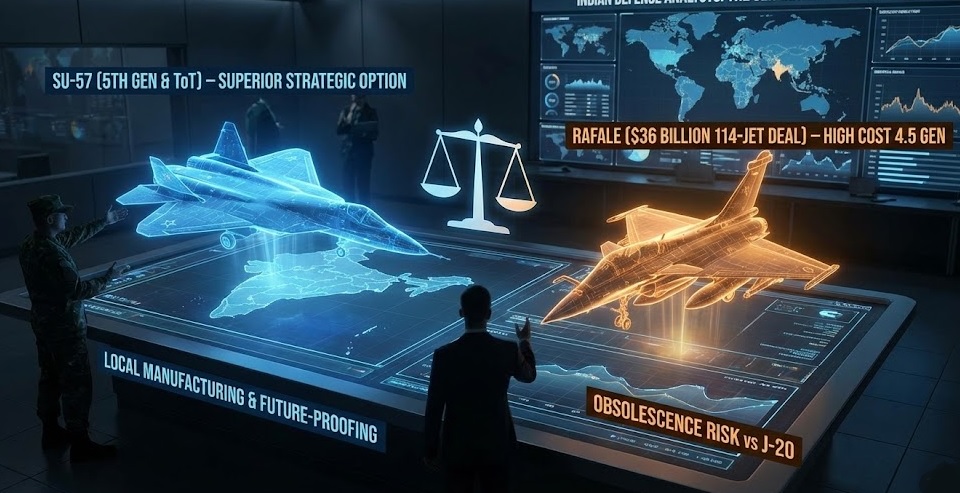
As clearer cost estimates and delivery timelines emerge, a growing section of India’s strategic community is reassessing the Rafale option and, in parallel, taking a fresh and unexpectedly serious look at Russia’s fifth-generation Sukhoi Su-57. The debate is no longer about whether the Rafale is a capable aircraft. It is about whether committing roughly $36 billion to a 4.5-generation fleet makes strategic sense at a time when India’s principal adversary is rapidly fielding stealth fighters at scale.
The Rafale Equation Under The Microscope
The outline of the prospective French package has triggered what many analysts describe as “sticker shock.” Under the structure being discussed in strategic circles, India would spend close to $36 billion for a mix of 114 new Rafales and upgrades to the existing fleet. This includes 24 fly-away Rafale F5 aircraft imported directly from France, 90 Rafale F4 fighters assembled in India under the Make-in-India framework, and the modernization of the current 36 India-specific Rafales from the F3R to the F4 standard.
From a capability standpoint, the Rafale F4 and proposed F5 variants remain formidable. They promise enhanced network-centric warfare, more powerful sensors, and closer integration with unmanned systems. Yet they remain, by design, advanced 4.5-generation fighters. Their survivability in the most hostile airspace depends on electronic warfare and stand-off tactics, not on inherent low-observability.
For many Indian analysts, the concern is not what the Rafale can do today, but what it may struggle to do in the mid-2030s. By then, China is expected to operate several hundred Chengdu J-20 aircraft alongside the emerging Shenyang J-35, supported by dense integrated air-defence networks and advanced sensors. Pakistan, meanwhile, is actively exploring fifth-generation pathways through China and Turkey. Against this backdrop, critics argue that investing such a large share of India’s capital acquisition budget in a platform approaching its technological ceiling carries an undeniable obsolescence risk.
The Su-57 And The Fifth-Generation Imperative
It is this strategic backdrop that has revived interest in the Su-57. For the Indian Air Force to credibly deter China in the 2030–2035 timeframe, analysts argue, it needs aircraft designed from the outset to penetrate Anti-Access/Area Denial (A2/AD) environments, operate deep inside contested airspace, and contest air superiority against stealth adversaries on more equal terms.
The Su-57 was conceived for precisely this role. While Western commentary has often focused on how it compares unfavourably with the F-22, Indian observers tend to view it through a different lens. They point to its frontal stealth characteristics, large internal weapon bays, sensor-fusion architecture, supercruise capability, and emphasis on long-range engagement as a decisive leap beyond any 4.5-generation design.
Equally significant is Russia’s claim that the Su-57 will soon transition fully to its true fifth-generation powerplant. Moscow has repeatedly stated that the aircraft will be equipped with the AL-51 (Izdeliye-30) engine within the next two to three years, offering higher thrust, improved fuel efficiency, and sustained supercruise. For Indian analysts, this addresses one of the long-standing criticisms of the platform and aligns its timeline with India’s future threat environment.
Reframing The Cost Debate: What $36 Billion Buys By 2030
What has truly energised the discussion is the question of value versus outcomes. Western combat aircraft are expensive not only because of their sophistication but also because of high labour costs, overheads, and tightly controlled intellectual property. Russian platforms, by contrast, have historically been offered at significantly lower program costs.
While exact figures remain classified, analysts have attempted to model what India could realistically obtain from Russia for the same $36 billion being discussed for Rafale. Even under conservative assumptions that factor in export premiums, weapons, spares, training, infrastructure, and an unprecedented level of transfer of technology, estimates suggest that India could potentially field 240 to 260 Su-57 aircraft within that budget envelope.
Crucially, proponents argue that first deliveries could begin around 2030, precisely when China’s fifth-generation fleet is expected to reach critical mass. In that context, the strategic comparison becomes stark. One path leads to a fleet of roughly 150 highly capable but non-stealth fighters when upgrades are included. The other offers the possibility of a large, homogeneous fifth-generation force available during the most dangerous decade of regional competition.
Transfer Of Technology, Engines, And The AMCA Factor
Beyond numbers and stealth, the most powerful argument driving renewed interest in the Su-57 lies in transfer of technology (ToT). France has been a reliable defence partner, but it has consistently drawn red lines around its most sensitive technologies. The reluctance to share jet-engine hot-section know-how has been a persistent frustration for Indian planners.
Russia’s strategic isolation has altered this calculus. Desperate for partners, funding, and long-term production stability, Moscow is widely believed to be offering levels of deep ToT that were unthinkable a decade ago. This reportedly includes access to avionics, sensor-fusion software, advanced radars, and most critically, the AL-51 engine program.
This has direct implications for India’s own ambitions. India’s indigenous Advanced Medium Combat Aircraft (AMCA) is expected to be inducted into the Indian Air Force around 2035. Analysts argue that exposure to a true fifth-generation engine and stealth ecosystem through a Su-57 program could compress learning curves, de-risk AMCA development, and ensure that India is not left with a capability gap between 2030 and AMCA induction.
A Strategic Debate, Not A Verdict
None of this diminishes the Rafale’s achievements or its current importance to the Indian Air Force. The aircraft has proven itself operationally, and it remains a cornerstone of India’s present-day combat aviation. Yet defence planning is inherently forward-looking.
As the MRFA debate intensifies, the question confronting New Delhi is no longer simply which aircraft is most refined or politically comfortable. It is what India gains by 2030—in numbers, technology, and deterrence—against a rapidly modernising China, while preparing for AMCA induction by 2035.
For a growing number of Indian defence analysts and enthusiasts, the answer is shifting. In their view, a locally manufactured Su-57 fleet, powered by a true fifth-generation engine and backed by deep technology transfer, may offer not just air superiority in the next decade, but a rare chance at genuine strategic and technological independence.
About the Author
Aditya Kumar:
Defense & Geopolitics Analyst
Aditya Kumar tracks military developments in South Asia, specializing in Indian missile technology and naval strategy.