Why India Reverse-Engineered an Unexploded PL-15 Missile During Operation Sindoor
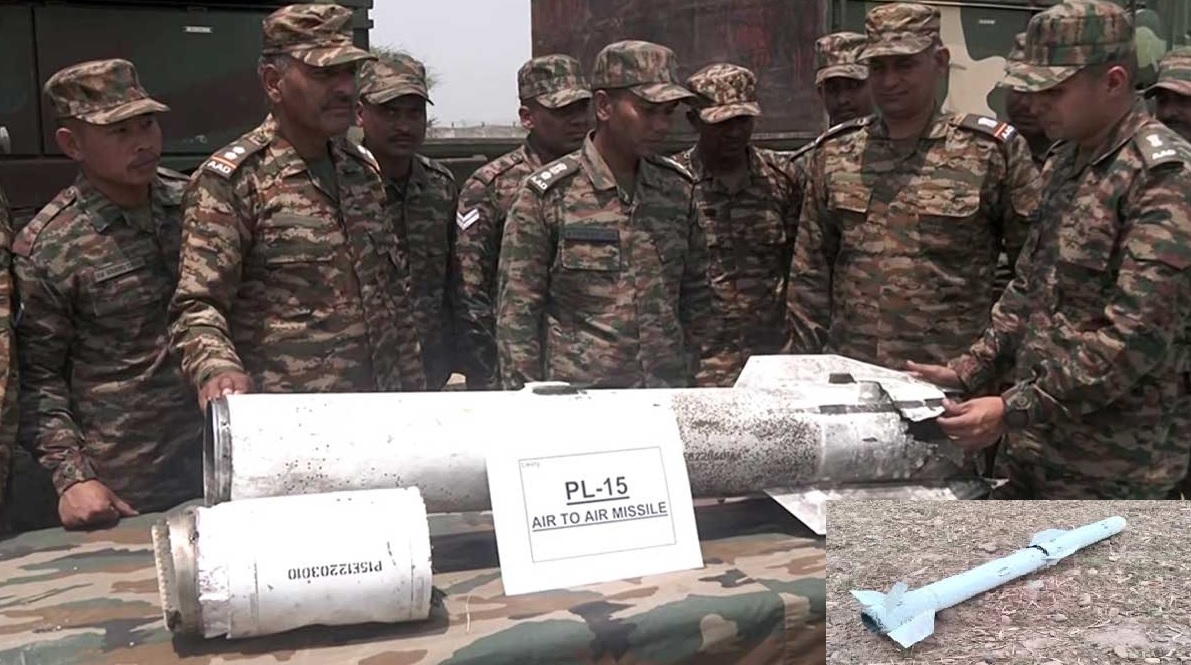
When parts of a Chinese PL-15 long-range air-to-air missile were recovered in India during the May 2025 clashes (widely reported in media coverage of Operation Sindoor), two parallel stories immediately appeared. One: a sober, technical effort inside DRDO and allied labs to disassemble, analyse, and understand the weapon so India could defeat it if used again. Two: sensational headlines claiming DRDO would simply graft PL-15 technology into India’s Astra Mk-2/Mk-3 programmes. The truth is the first story is the realistic one — reverse-engineering a captured missile is overwhelmingly about defeat and resilience, not quick cloning.
What India Actually Recovered — and What Forensic Analysis Gives You
Open-source reporting from the May 2025 engagements documents that export variants of the PL-15 were used by Pakistani fighters, and that wreckage and debris were recovered inside India. That recovery made it possible for Indian labs to do hands-on forensic work: identify seeker type and likely radar waveforms, inspect guidance and datalink hardware, characterise propellant residue and plume signatures, and examine fuze and autopilot design.
In short, the debris provides fingerprints — the very information defenders need to design effective countermeasures and to tune sensors and tactics.
Why does that matter? Because modern BVR (beyond-visual-range) missiles are defeated not only by out-riding them with a better missile, but by making them ineffective through a layered response: improved warning and tracking, electronic countermeasures (ECM) tuned to the missile’s seeker, better chaff/flare signatures, optimized engagement doctrine, and coordinated sensor fusion (airborne-to-airborne and ground-based). A reverse-engineering exercise supplies the data needed to implement those countermeasures quickly and accurately.
Reverse-Engineering ≠ Cloning: The Engineering Reality
There’s a persistent misconception in some media and social posts: that if you take a foreign seeker or propulsion unit, you can bolt it onto your missile and instantly match its performance. That’s not how complex aerospace systems work.
A seeker’s hardware and software are deeply coupled to the missile’s guidance algorithms, datalink design, airframe aerodynamics, thermal environment, and manufacturing processes. Integrating a foreign subsystem requires years of systems-level re-engineering, flight qualification, and supply-chain adaptation.
So while reverse-engineering can produce valuable design insights, turning those into a production-worthy component for Astra Mk-2 or Mk-3 would be a long-term, resource-intensive process — not a shortcut.
The Pragmatic Objective: Build Countermeasures, Protect Platforms
DRDO’s immediate priority after recovering a foreign missile is defensive: how to stop it. Practical outputs from forensic work include:
-
Seeker-waveform signatures that let RWRs (radar-warning receivers) and MAWS (missile approach warning systems) detect the missile earlier.
-
ECM waveforms tuned against that seeker’s weaknesses.
-
Chaff/decoy profiles and dispense logic optimized to fool the missile’s radar tracker.
-
Tactics and rules of engagement that minimize exposure to the missile’s no-escape zone, with cooperative jamming and sensor fusion support.
These defensive improvements raise the cost and risk for an adversary relying on the PL-15 family — often more quickly and effectively than trying to copy a foreign design. Analysts reviewing the May 2025 events confirmed that India’s focus was on threat defeat and hardening, not imitation.
On Claims That Astra Mk-2 / Mk-3 Already Surpass PL-15 or Meteor
There are two key threads that often get mixed together:
-
Open claims and expert analysis: Several Indian defence research platforms and analysts — including reports cited by the Indian Defence Research Wing (IDRW) — have stated that Astra Mk-3, built around an advanced ramjet/ducted rocket propulsion system, is designed to match or even exceed the European Meteor missile. The missile’s improved seeker, high-energy motor, and advanced guidance algorithms reportedly give it greater accuracy and sustained speed at long ranges. These sources indicate that Astra Mk-2 and Mk-3 are not only closing the gap but are technologically ahead of both PL-15 and Meteor in key performance areas like target-lock precision and no-escape zone.
-
The honey-trap espionage revelation: In 2023–24, during an investigation into a DRDO honey-trap case, a senior scientist reportedly disclosed in his private chat with a foreign operative that Astra’s guidance and strike accuracy are superior to Meteor’s. This conversation — later part of the investigation record — revealed that even within DRDO’s internal assessments, the Astra missile’s precision systems outperform Meteor’s in real-world targeting capability. The revelation confirmed what many within India’s defence community had already believed: the Astra program has achieved a technical maturity surpassing its Western counterpart in accuracy and reliability.
-
During the May 2025 conflict, the Chinese-origin PL-15 missiles used by Pakistani fighter jets were observed to be largely ineffective against Indian Air Force aircraft, failing to achieve the expected engagement success rate. Several intercept attempts reportedly missed or were countered by Indian electronic warfare systems, advanced sensor fusion, and tactical manoeuvres that neutralized the missile’s long-range advantage. This operational outcome exposed performance limitations of the PL-15’s seeker and datalink under real combat conditions. Following these setbacks, Pakistan reportedly began exploring other countries’ BVR missile options, a move that itself underscores growing doubts about the reliability and overall quality of PL-15 technology in high-intensity engagements.
-
The Astra Mk-2 160-kilometre variant weighs 175 kilograms, while the PL-15E has a 150-kilometre range and weighs 210 kilograms, so despite offering a longer stated reach the Astra is about 35 kilograms lighter, which implies better mass-efficiency in propulsion, propellant energy or structural/design packaging and likely a more optimized integration of seeker/avionics and warhead; on these simple mass-to-range metrics the Astra Mk-2’s figures suggest a more advanced, better-optimized design than the PL-15E.
Why the “DRDO Will Copy PL-15 Into Astra” Headlines Are Misleading
After Operation Sindoor, some websites and social media posts claimed DRDO’s forensic work was an attempt to harvest PL-15 technology to accelerate Astra development. Those takes miss two core facts:
-
The most immediate and actionable gains from analysing a captured missile are defensive — improving countermeasures and tactics, not cloning.
-
Any effort to transplant foreign seeker or propulsion designs into Astra would require a multi-year engineering program, create supply dependencies, and contradict India’s emphasis on indigenisation.
Calling the forensic effort “reverse-engineering to copy PL-15 into Astra” is a misleading oversimplification that serves a sensational narrative, not technical accuracy.
India’s hands-on analysis of PL-15 wreckage after Operation Sindoor was a textbook defensive strategy: gather real-world threat data, reduce uncertainty, and enhance electronic warfare (EW) defences to neutralize the missile’s effectiveness. That approach protects aircraft and pilots far more effectively than trying to import foreign design elements.
Claims that Astra Mk-2/3 already dominate PL-15 or Meteor, or that DRDO copied PL-15 technology, are either premature or misleading when measured against the real technical timelines and goals of India’s missile development program.
About the Author
Aditya Kumar:
Defense & Geopolitics Analyst
Aditya Kumar tracks military developments in South Asia, specializing in Indian missile technology and naval strategy.