Western Intelligence Warns Russia May Be Developing Debris-Based Anti-Satellite Weapon To Cripple Starlink
New intelligence assessments from two NATO countries are fueling fresh concern that Russia may be pursuing a new class of anti-satellite (ASAT) weapon aimed at SpaceX’s Starlink—the vast low-Earth orbit (LEO) constellation that has become a critical communications backbone for Ukraine’s military and a pillar of Western connectivity in contested environments.
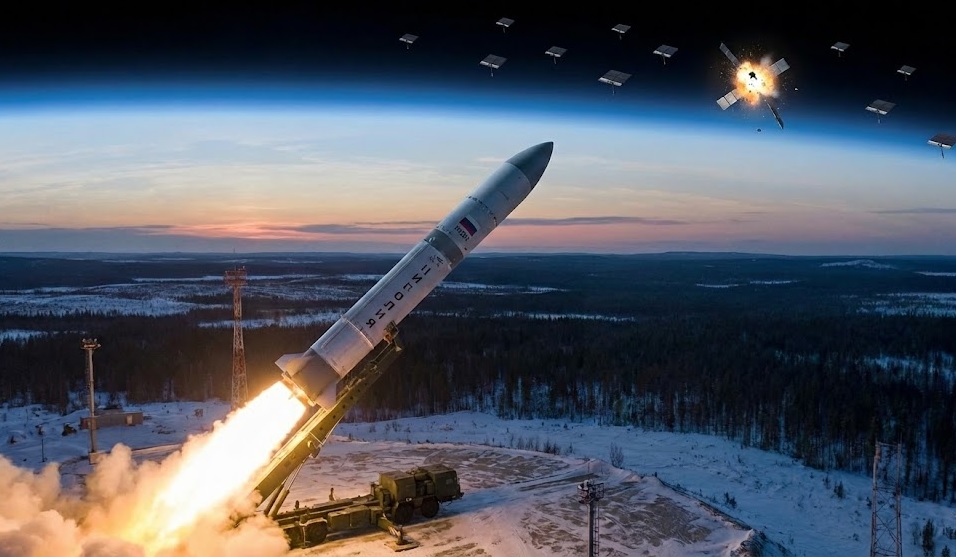
According to reporting citing officials and experts familiar with the assessments, the suspected approach is not a traditional missile intercept nor a jamming-only campaign. Instead, it reportedly centers on a “zone-effect” concept: creating a cloud of high-density pellets or fragments in orbit capable of damaging or disabling satellites transiting through a targeted orbital band—potentially affecting multiple satellites simultaneously.
A Weapon Concept Built Around Debris, Not A Single Strike
Western officials and analysts describe the alleged system as a mass-disruption tool. Rather than hunting satellites one by one, it would seek to contaminate an entire “zone” in orbit with fast-moving projectiles that are difficult to track and catastrophic on impact given extreme orbital velocities.
The intelligence assessments discussed publicly do not claim the system has been deployed. Reporting also highlights skepticism among some experts regarding technical feasibility and whether Moscow would risk consequences that could also damage Russia’s own space assets.
Why Starlink Is The Obvious Target
Starlink’s strength—and its vulnerability—comes from scale.
As of December 19, 2025, tracking summaries cited by Space.com place Starlink at 9,357 satellites in orbit, with 9,347 operational. Another independent tracker lists 9,404 active satellites, noting that 10,750 satellites have been launched in total, while 1,346 have decayed or been deorbited—underscoring how rapidly the constellation changes week to week.
That sheer density in LEO makes Starlink highly resilient to the loss of individual spacecraft, but also uniquely exposed to any tactic designed to strike “many at once” within a specific orbital region rather than precisely targeting single satellites.
The Battlefield Link: Ukraine, Western Space Advantage, And The New “High Ground”
Starlink terminals have been widely credited with supporting Ukraine’s battlefield communications, enabling secure connectivity for dispersed units, unmanned systems, and command elements operating far from reliable terrestrial networks.
This role has transformed commercial satellite constellations into strategic military infrastructure, intensifying Russia’s hostility toward Western space-enabled capabilities. In parallel, the United States and its allies have accelerated plans for more distributed and resilient military space architectures, reflecting the reality that space systems can no longer be assumed safe in crisis or war.
What Happens If A Debris Cloud Is Created: From Local Outages To A Runaway Orbital Crisis
Space experts warn that the most dangerous feature of a “zone-effect” debris strategy is that it may not remain confined. In LEO, even tiny fragments can become long-lived hazards, spreading collision risk across multiple orbital shells and threatening unrelated spacecraft.
If a large number of satellites were damaged or shattered, the result could be a sharp rise in space debris, increasing the likelihood of cascading collisions—often described under the Kessler Syndrome, where debris from one collision triggers additional impacts. Even without a full cascade, a dense debris field could force operators into costly avoidance maneuvers, shorten satellite lifespans, and create persistent “no-go” orbital bands that degrade global services.
The collateral risk would extend far beyond Starlink, potentially endangering civil, commercial, and military satellites worldwide, complicating human spaceflight, and increasing risks to space stations and crewed vehicles operating at similar altitudes. Analysts argue this makes the concept strategically destabilizing, even if it is never employed.
Feasibility Questions And The Deterrence Angle
A central counterargument raised by analysts is self-harm. Any state that deliberately seeds orbit with hard-to-detect hazards could create a long-term threat to its own satellites, those of its partners, and even its future launch and spaceflight operations.
This has led some experts to suggest the concept may function primarily as deterrence signaling—a warning that Western reliance on proliferated LEO constellations carries inherent risk—rather than a weapon Moscow would realistically use.
What To Watch Next
The most immediate indicators will be technical and behavioral:
unusual Russian launches into crowded orbital regimes, satellites exhibiting unexplained release events, or intelligence-linked warnings about new counterspace demonstrations.
For now, the public record remains a collection of suspicions and assessments, not proof of deployment. Yet the debate itself is already intensifying calls for tighter space traffic management, improved debris tracking, and clearer international norms against actions that could pollute shared orbits and endanger space for all.
✍️ This article is written by the team of The Defense News.