VEDA Aeronautics Signs Deal With France’s METRAVIB To Equip Indian Tanks With Acoustic Gunshot & Drone Detectors
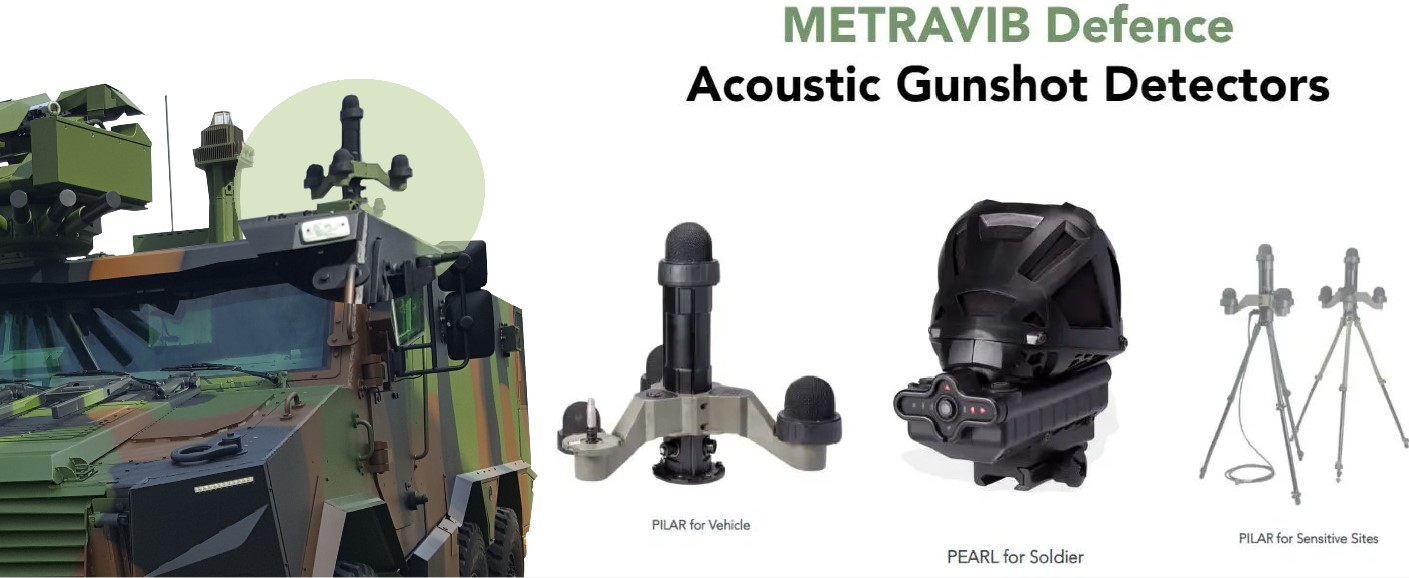
Delhi-based VEDA Aeronautics has signed an agreement with French firm METRAVIB Defence to integrate acoustic gunshot-detection and drone-detection systems on light tanks, main battle tanks and armoured vehicles under the ‘Make in India’ framework. The partnership aims to give Indian armoured formations an automated “early-warning ear” against small-arms fire, anti-tank weapons and low-flying drones.
According to social media posts and defence industry reports, the collaboration is structured as an exclusive Make in India partnership, with VEDA responsible for local integration, industrialisation and support, while METRAVIB provides its combat-proven acoustic technology.
What These Systems Are And How They Work
METRAVIB, a brand of the French ACOEM group, specialises in acoustic situational awareness solutions that detect and locate gunshots, explosions and drones in real time by analysing sound waves.
On armoured vehicles, METRAVIB’s flagship product line is the PILAR Vehicle Protection system – a compact tetrahedral array of microphones mounted on the roof, linked to a processing unit and the vehicle’s battle management system (BMS).
In simplified terms, the system works in four steps:
-
Detection
-
When a weapon is fired, it generates a muzzle blast and, for supersonic rounds, a shock wave.
-
The microphones around the vehicle capture these acoustic signatures from all directions.
-
-
Time-Difference Analysis
-
The system measures the tiny differences in the time at which each microphone hears the sound.
-
Using these delays, it triangulates the direction and elevation of the incoming fire.
-
-
Classification And Ranging
-
Digital signal processors and AI-based algorithms compare the recorded signature with a threat library.
-
The system can classify calibre types and estimate range; PILAR Vehicle Protection typically offers 360° coverage with accuracy of about ±2° in azimuth, ±3° in elevation and ±10% in range, and detection envelopes from 250 m up to around 24 km, depending on the weapon.
-
-
Cueing Weapons And Crew
-
The calculated bearing, elevation and distance are pushed to the vehicle’s BMS or fire-control / remote weapon station, allowing slew-to-cue of the turret or RWS towards the threat.
-
The crew gets an immediate visual display and audio alert, often with GPS coordinates of the shooter.
-
The same acoustic principle is extended to drone detection. Small UAVs and quadcopters emit distinctive propeller and motor noise patterns; METRAVIB’s newer solutions use onboard acoustic AI to identify and track such targets against background noise, even when they are difficult to spot optically or on radar.
What The VEDA–METRAVIB Deal Brings To India
While detailed technical specs of the India-specific configuration have not been published, Indian defence outlets state that the partnership will see:
-
Gunshot-detection modules for mounting on:
-
Light tanks (such as future high-altitude platforms),
-
Main battle tanks (MBTs),
-
Infantry combat vehicles and other armoured platforms.
-
-
A new anti-drone acoustic module entering the Indian market for the first time through this tie-up.
-
Real-time cueing to onboard battle management and fire-control systems, allowing rapid counter-fire or defensive manoeuvres.
VEDA Aeronautics, which already works on AI-driven military technologies, electro-optics and robotics, is expected to handle system integration, adaptation to Indian vehicles and eventual local manufacture, in line with the government’s Atmanirbhar Bharat / Make in India drive.
Combat-Proven Technology Coming To Indian Platforms
METRAVIB’s PILAR family is combat-proven in more than 45 countries, and variants are already fielded on France’s Griffon and Jaguar armoured vehicles under the SCORPION programme, as well as on other NATO platforms.
On these vehicles, the system:
-
Provides continuous 360° coverage and remains “always on”.
-
Filters outgoing friendly fire, reducing false alarms.
-
Can detect not just small arms but also RPGs, mortars and medium-calibre weapons, and share threat data between multiple vehicles to triangulate shooter positions.
The Indian integration is expected to follow a similar concept: armoured vehicles networked through a BMS will be able to share acoustic threat data, improving situational awareness and enabling faster, more accurate retaliatory action.
Make In India, Export Potential And Next Steps
The agreement also has an industrial dimension. With VEDA as the Indian partner and system integrator, the programme aligns with:
-
Local manufacturing and assembly of key subsystems over time.
-
Building domestic capability in acoustic sensing, AI-based signal processing and vehicle vetronics.
-
Possible future exports of India-integrated solutions to friendly countries operating similar platforms.
Given METRAVIB’s experience moving from pure sensors to data fusion and collaborative combat, and VEDA’s focus on AI and robotics, the partnership could evolve beyond simple gunshot detectors into broader situational-awareness suites integrating acoustic, optical and electronic sensors on Indian vehicles.
Formal details such as order quantities, platform lists and timelines have not yet been disclosed. However, the tie-up underlines a clear trend: Indian armoured units are preparing for a battlefield where the first warning may not be something they see, but something their vehicles hear – and react to – in milliseconds.
About the Author
Aditya Kumar:
Defense & Geopolitics Analyst
Aditya Kumar tracks military developments in South Asia, specializing in Indian missile technology and naval strategy.