Ukraine Set to Deploy 200 km FP-7 and 855 km FP-9 Ballistic Missiles by End-2025
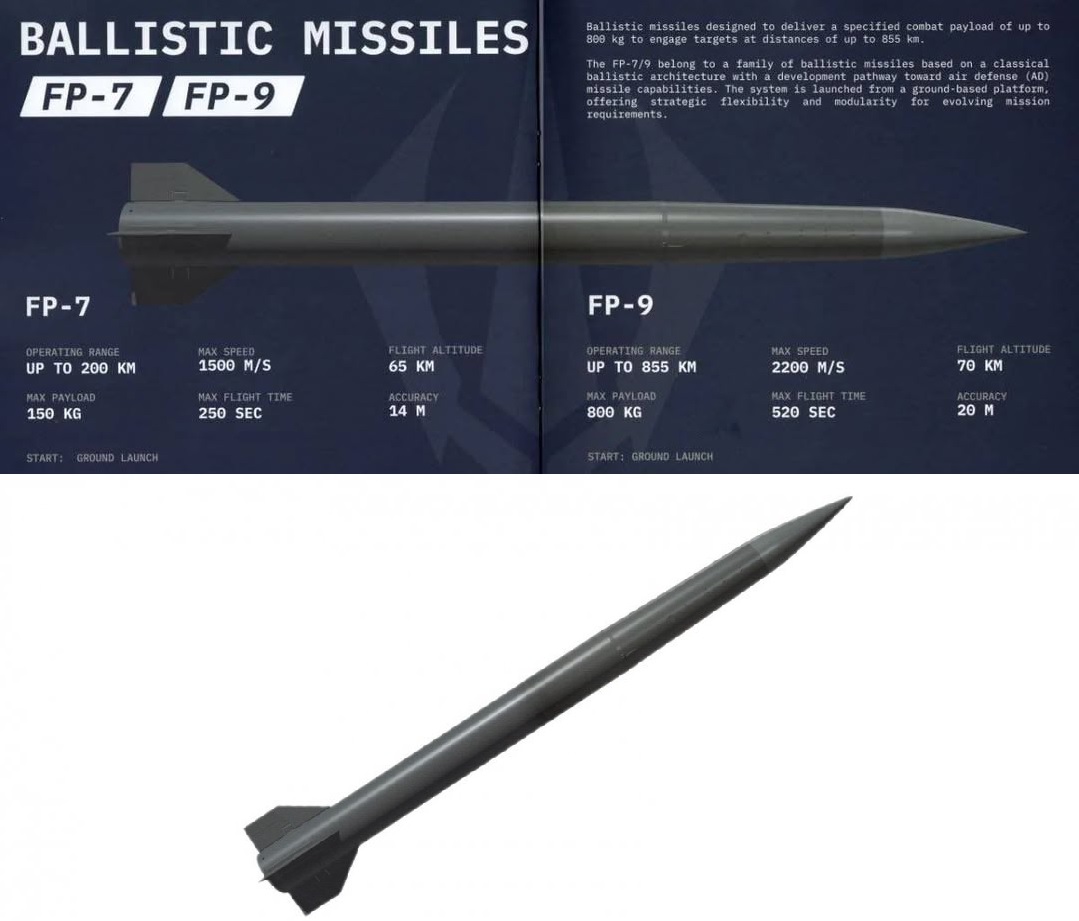
Ukraine is pushing into a new phase of strategic autonomy as its defense industry accelerates the development of long-range ballistic missiles. Fire Point, the Ukrainian company spearheading the effort, has confirmed that its FP-7 short-range ballistic missile range 200 Km will be ready for army induction before the end of 2025. The more powerful FP-9, with a range nearing 855 km, is expected to follow soon after testing concludes.
Fire Point openly acknowledges that the aerodynamic layout of these missiles is inspired by the Russian 48N6 surface-to-air missile. But company engineers emphasize that the resemblance ends there: the Ukrainian missiles use composite airframes, upgraded guidance systems, and re-engineered propulsion that significantly enhance range and performance. This shift marks Ukraine’s most serious effort yet to establish a long-range domestic strike capability.
The FP-7: Ukraine’s First Serial Ballistic Missile
In a narrative long dominated by foreign-supplied munitions, the FP-7 represents a symbolic and practical milestone — Ukraine’s first serially produced ballistic missile.
The FP-7 is being designed for battlefield interdiction, giving Ukraine the ability to strike high-value Russian targets across a 200-kilometer radius. Engineers estimate that formal codification, the process by which the Armed Forces officially accept the weapon into service, will be completed by late 2025, clearing the path for mass production.
FP-7 Specifications:
-
Range: 200 km
-
Maximum Speed: 1,500 m/s
-
Flight Altitude: approx. 14 km
-
Warhead: 150 kg
-
Guidance: INS with satellite correction
-
Structure: Lightweight composite body
-
Launch Platform: Mobile TEL
These specifications place the FP-7 in a performance class comparable to several Western short-range ballistic systems, but with the advantage of domestic production unaffected by export restrictions.
The FP-9: Ukraine’s Bid for Deep-Strike Capability
If the FP-7 represents a tactical milestone, the FP-9 marks an entirely new strategic threshold. Early evaluations suggest the FP-9 can reach 850–855 km, placing Russian airbases, logistics hubs, and strategic infrastructure deep behind the frontlines within Ukrainian reach.
Fire Point intends to finalize testing after the FP-7 program stabilizes, with codification expected afterward.
Key Characteristics of the FP-9:
-
Range: 850–855 km
-
Propulsion: Extended-burn solid fuel motor
-
Warhead: 150–200 kg class
-
Guidance: Likely multi-mode, with future terminal seeker
-
Design: Composite fuselage optimized for long-range energy retention
If serial production ramps up, the FP-9 could become Ukraine’s first homegrown weapon capable of striking targets nearly across the entire breadth of European Russia.
The “Flamingo” Cruise Missile Enters Daily Production
While the ballistic missile programs advance, Fire Point has already achieved high-volume production of its “Flamingo” cruise missile, confirming output of three units per day. This pace is unusual for a country at war, especially given repeated Russian strikes against Ukrainian industry.
The Flamingo, though less publicized than the FP-series missiles, is believed to follow a terrain-hugging flight profile and is optimized for precision strikes against air-defense positions, command posts, and infrastructure.
Its rapid scaling hints at Ukraine’s broader intention: creating a diversified and self-sufficient strike weapon ecosystem capable of sustaining long-term conflict.
Why These Missiles Matter for Ukraine’s Strategy
Ukraine’s push for indigenous ballistic missiles stems largely from operational and political realities. Western long-range munitions remain limited, both in supply and usage permissions. By developing its own systems, Ukraine gains:
-
Freedom to strike without external restrictions
-
Sustained production regardless of shifting foreign policy
-
Capability to disrupt Russian logistics networks at depth
-
A long-term industrial foundation for deterrence
The FP-7 and FP-9 systems, coupled with the Flamingo cruise missile, bring Ukraine closer to forming a complete domestic precision-strike arsenal — something no post-Soviet state outside Russia has attempted at this scale.
By the end of 2025, Ukraine expects to have the FP-7 in service, with the FP-9 nearing completion. Combined with ongoing cruise-missile production, these advances signal a profound change in Ukraine’s wartime capabilities.
If production stays on schedule, Ukraine will enter 2026 with a functional layered strike system:
a 200-km battlefield missile, an 850-km strategic missile, and a high-volume cruise missile.
This shift promises to reshape not just the battlefield, but the long-term balance of deterrence between Ukraine and Russia — a transformation driven not by foreign supply, but by Ukraine’s own rapidly evolving defense industry.
About the Author
Aditya Kumar:
Defense & Geopolitics Analyst
Aditya Kumar tracks military developments in South Asia, specializing in Indian missile technology and naval strategy.