Ukraine Faces a Demographic Collapse: Population Drops From 42 Million to 36 Million and Could Fall to 25 Million
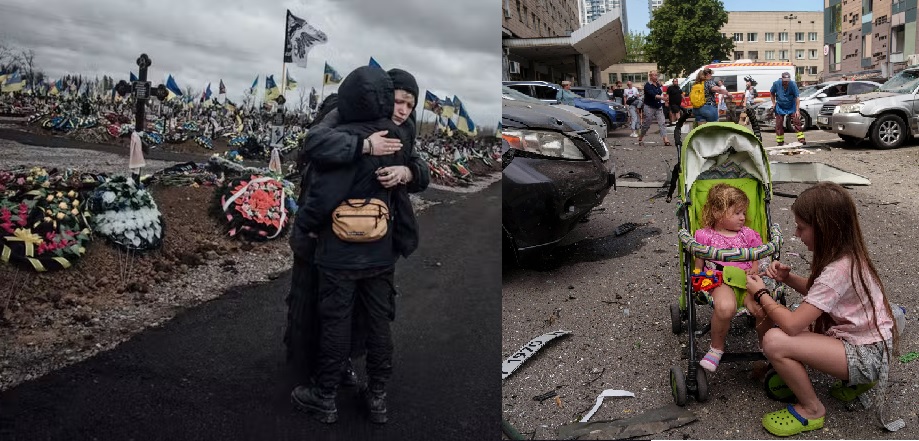
Ukraine’s population has shrunk from about 42 million before Russia’s full-scale invasion to fewer than 36 million today – and demographers warn it could fall to around 25 million by mid-century.
What began as a military crisis is now turning into a long-term demographic emergency that could shape Ukraine’s ability to rebuild, defend itself and remain a viable modern state.
Population in Free Fall
Before February 2022, Ukraine’s population (within internationally recognized borders) was commonly put at around 41–42 million. Today, government and international estimates suggest that the number of people actually living in Ukrainian-controlled territory has dropped to under 36 million, once the loss of occupied regions and the mass outflow of refugees are taken into account.
Official UN and World Bank datasets still show roughly 38 million residents in 2024, but these include territories under Russian occupation and do not fully reflect wartime displacement. IMF modeling, which tries to capture the impact of the war more directly, estimates that the population fell from around 41 million in 2021 to about 33.3 million in 2024 and will only slowly edge back toward 34 million in the late 2020s, even in optimistic scenarios.
Looking further ahead, Ukraine’s Institute for Demography and Social Research forecasts that, if current trends persist, the population could decline to 28.9 million by 2041 and about 25.2 million by 2051. Other long-range UN projections suggest the total could keep falling toward 20 million by 2100.
The scale of this contraction is unprecedented for a European country outside of outright state collapse.
Births Collapse as Deaths Triple Them
The most alarming trend is not only people leaving, but the collapse in births inside the country.
Government and independent data show that for every child born in Ukraine today, roughly three people die – one of the most extreme birth-to-death ratios recorded anywhere in the world.
In the first half of 2024, just 87,655 babies were registered, compared to 132,595 in the same period of 2021 – a drop of about one-and-a-half times. Over the same months of 2024, deaths reached around 251,000, producing the now-familiar ratio of three deaths for every birth.
Behind those monthly statistics lies a collapse in the total fertility rate (TFR) – the average number of children a woman will have over her lifetime.
-
Before the invasion, UN data already showed Ukraine hovering around 1.1–1.3 children per woman, well below the “replacement level” of 2.1 needed to keep a population stable.
-
After 2022, the situation deteriorated sharply: the U.N. Population Division estimates the TFR dropped to about 0.9 in 2022.
-
Ukrainian officials now speak of a historically low birth rate of roughly 0.8–0.9 children per woman, among the lowest anywhere on earth.
Demographers say this steep fall is driven by several overlapping factors:
-
War-time insecurity, with missile strikes, blackouts and mobilization making family plans feel too risky.
-
Economic uncertainty – salaries, housing and services are under pressure, discouraging long-term commitments.
-
Separation of couples, as many women and children moved abroad while men stayed to fight or were barred from leaving.
Even if peace came quickly, such a low fertility rate will echo through the population structure for decades.
Men Missing From the Future
War casualties and mass emigration are reshaping Ukraine’s age and gender profile.
Demographers estimate that hundreds of thousands of Ukrainians have been killed or seriously wounded since 2022, many of them young men in their 20s, 30s and 40s – the very age groups that normally form families and raise children.
At the same time, millions of women and children have left. Around 5–6 million Ukrainians are registered as refugees across Europe, with more than 5.1 million Ukrainians abroad according to the Ministry of Social Policy. Many say they are unsure whether they will ever return.
The result is a sharply skewed population:
-
Women now clearly outnumber men, especially in older age groups, with fewer potential fathers in the key 20–39 age bracket.
-
The share of people aged 65 and above is around 19–20%, making Ukraine one of the “oldest” societies in Eastern Europe by population structure.
Health indicators have deteriorated as well. Average male life expectancy has plunged from about 65.2 years before the war to just 57.3 years in 2024, while women’s life expectancy has fallen from roughly 74.4 to 70.9. For comparison, before the invasion overall life expectancy in Ukraine was about 73 years.
Experts warn this combination – fewer men, fewer babies, and more elderly citizens – is pushing Ukraine toward an inverted age pyramid, where each worker must support a growing number of dependents.
A Looming Shortage of 4.5 Million Workers
The demographic crisis is no longer an abstract statistic; it is starting to show up on construction sites, in factories and in hospitals.
Ukraine’s Deputy Prime Minister and other senior officials say that the country will need an additional 4.5 million workers over the next decade to rebuild at current productivity levels. A KPMG analysis, drawing on government data, reaches a similar conclusion and warns that by 2040 the labour shortfall could reach 4.5 million if nothing changes.
The sectors most at risk include:
-
Construction and infrastructure, where vast numbers of engineers, skilled trades and machine operators will be needed to rebuild destroyed cities and energy networks.
-
Manufacturing and metallurgy, historically pillars of Ukraine’s industrial base.
-
Healthcare and education, which are losing staff both to emigration and to burn-out at home.
-
Technology and services, crucial for Ukraine’s ambition to become a modern, export-oriented economy.
Without enough working-age people, economists warn, even generous Western funding for reconstruction could hit a wall: there may simply not be enough Ukrainians to do the work, or to sustain a large standing army in the long run.
Government Response: Baby Bonuses, Return Hubs and Migration
Recognizing the scale of the problem, Kyiv has begun to treat demography as a national security issue.
Key elements of the emerging strategy include:
-
Demographic recovery plans that aim to curb emigration, attract back refugees and encourage larger families, described by officials as “no less important than tanks or air defense systems” for long-term security.
-
Financial incentives for childbirth, including higher maternity payments and proposed “baby bonuses”, which analysts say may help at the margins but cannot fully offset insecurity and economic concerns.
-
Support for soldiers’ families, such as state-funded fertility treatments and sperm banking programs, designed to preserve the possibility of children even if fathers are killed at the front.
-
Return-migration “hubs” abroad, set up in EU countries to help Ukrainians with legal advice, job matching and schooling if they choose to go back. Authorities are focusing on the roughly 40% of refugees who say they are undecided.
-
A gradual opening to foreign workers and dual citizenship, a politically sensitive step in a country that has long defined itself by ethnic and linguistic identity, but one many experts see as unavoidable if Ukraine is to fill its labour gap.
Demographers caution that none of these measures will deliver quick results. Even if fertility rose sharply tomorrow, the children born this year would not enter the workforce until the 2040s. For the next two decades, Ukraine will have to manage with fewer workers and a rapidly ageing population, while still under threat from Russia.
“The decisive front is the cradle”
For now, the immediate priorities in Kyiv remain winning the war and securing long-term Western security guarantees. But a growing number of Ukrainian officials and experts argue that the country’s decisive battles may ultimately be fought in maternity wards, classrooms and labour-market reforms, not just on the front line.
If Ukraine can stabilize its population near 34 million, as some optimistic IMF scenarios suggest, and draw back a critical mass of young families and professionals, the state may yet preserve enough economic and military strength to deter future aggression.
If not, the combination of an ageing society, a shrinking tax base and a depleted army could, over time, become as dangerous as any missile salvo.
About the Author
Aditya Kumar:
Defense & Geopolitics Analyst
Aditya Kumar tracks military developments in South Asia, specializing in Indian missile technology and naval strategy.