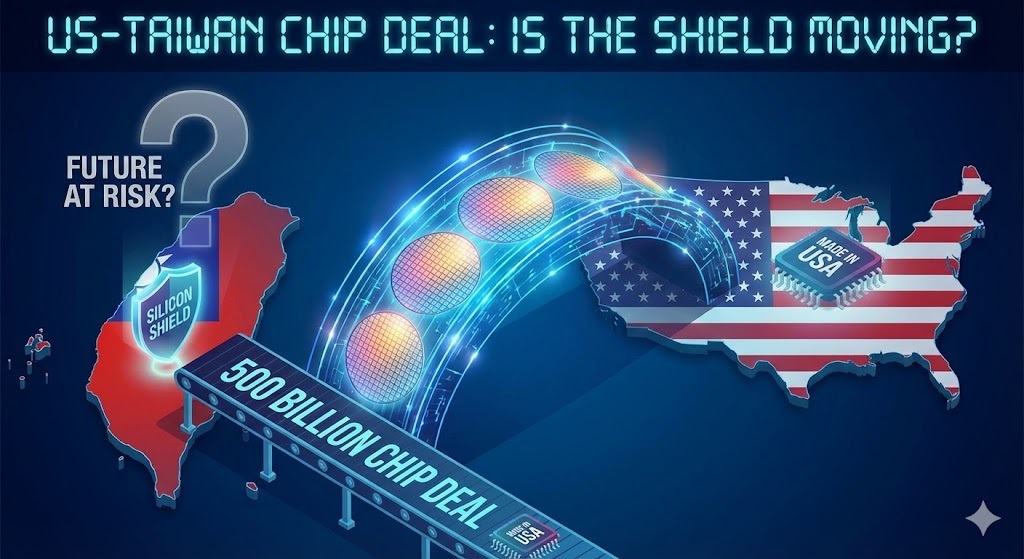
Washington / Taipei : From a data-driven analyst’s perspective, the newly announced United States–Taiwan trade agreement represents far more than a $500 billion investment pact. It may mark a structural shift in global power, one that fundamentally alters why Taiwan has mattered to Washington for decades — and raises a provocative question now circulating in geopolitical circles: has Donald Trump effectively paved the way for Taiwan–China reunification by relocating the island’s most strategic asset to American soil?
The deal, described by the US Department of Commerce as a “historic economic partnership,” slashes tariffs on key Taiwanese goods while unlocking an unprecedented flow of capital into the United States. At its core is a massive effort to transfer the heart of the global semiconductor ecosystem — long concentrated in Taiwan — into American industrial parks, research hubs and advanced manufacturing facilities.
The $500 Billion Shift That Changes Everything
Under the agreement, Taiwanese companies and state-backed institutions will channel roughly $250 billion in direct investments into US industries, with semiconductors, artificial intelligence applications and advanced energy systems at the center. A further $250 billion in credit guarantees will support overseas expansion, effectively de-risking Taiwanese capital flowing into the United States.
Tariffs will be eliminated on selected Taiwanese imports, including generic pharmaceuticals and aircraft components. Semiconductor firms investing in the US will receive even broader exemptions, faster customs clearance for sensitive equipment and relaxed regulatory hurdles — incentives designed to accelerate factory construction and production timelines.
From a data standpoint, this is the most aggressive reshoring initiative in modern American industrial history. For decades, US chip manufacturing migrated to East Asia. Now, Washington is attempting to reverse that trend in a single strategic leap.
Why Semiconductors Have Defined Taiwan’s Strategic Value
Taiwan’s importance to Washington has never been purely ideological. The island produces more than 60 percent of the world’s advanced semiconductors, powering smartphones, electric vehicles, cloud computing and modern weapons systems. The crown jewel of this ecosystem is TSMC, whose fabs manufacture chips several generations ahead of global competitors.
This concentration created what analysts have long called the “silicon shield” — the idea that the United States would be compelled to defend Taiwan militarily to prevent China from controlling the world’s most critical technology supply chain.
The new agreement directly challenges that logic.
If the Chips Move, What Remains to Defend?
If large portions of Taiwan’s semiconductor production — along with engineering talent, research capacity and supply chains — are relocated to the United States, Washington’s strategic calculus changes dramatically. From a purely data-driven perspective, the cost-benefit analysis of deploying US naval power in a Taiwan conflict shifts once the primary economic and technological incentive is removed.
Today, the US Navy’s forward presence in the Western Pacific is partly justified by the need to deter a Chinese takeover that could disrupt global chip supplies. If those supplies increasingly originate from Arizona, Texas or Ohio, that justification weakens.
This is why critics argue the deal amounts to a quiet acceptance of future reunification — not through diplomacy, but through economic hollowing.
Beijing’s Reaction: “Economic Plunder”
China responded with fury. One day before the agreement was formally announced, Chinese officials condemned it as “economic plunder,” accusing Washington of stripping Taiwan of its most valuable industries while leaving the island exposed.
From Beijing’s viewpoint, the deal undermines Taiwan’s long-term leverage and accelerates conditions under which reunification becomes less risky, both economically and militarily.
Taipei, however, sees it differently.
Taipei’s Defense: The “Taiwan Model”
Taiwan’s executive branch framed the agreement as an export of success, not a surrender of capability. Officials argue that overseas expansion will strengthen Taiwanese firms’ global competitiveness while deepening integration with the US economy, creating political and financial interdependence that still benefits the island.
Yet data suggests a more complex picture. As capital, equipment and talent migrate, domestic capacity inevitably shrinks relative to its former dominance. Over time, Taiwan risks shifting from an indispensable producer to a high-value partner — a subtle but critical downgrade in strategic importance.
Trump’s Legacy Question
Although framed as an economic win-win, the agreement’s geopolitical implications may define Donald Trump’s long-term legacy. By prioritizing domestic manufacturing security, Washington may have chosen stability at home over permanent confrontation abroad.
For some American strategists, this is preferable to a future war in the Taiwan Strait. As one blunt assessment circulating online puts it: “Better than World War III.”
A Future Without the Silicon Shield
Looking ahead, analysts see a phased transformation. As US-based fabs come online and supply chains mature, Taiwan’s role as the linchpin of global chip production diminishes. In that scenario, the United States may still voice diplomatic support, but its willingness to risk naval escalation against China becomes far less certain.
The trade deal, then, is not just about tariffs or factories. It is about redefining interests. If America’s primary stake in Taiwan has always been semiconductors, and those semiconductors are moving west, the strategic equation of East Asia may already be entering a new era — one where reunification is no longer unthinkable, but economically inevitable.