USS Bainbridge Deploys Coyote Counter-Drone System in NATO Exercise, Marking Shift in Naval Air Defense
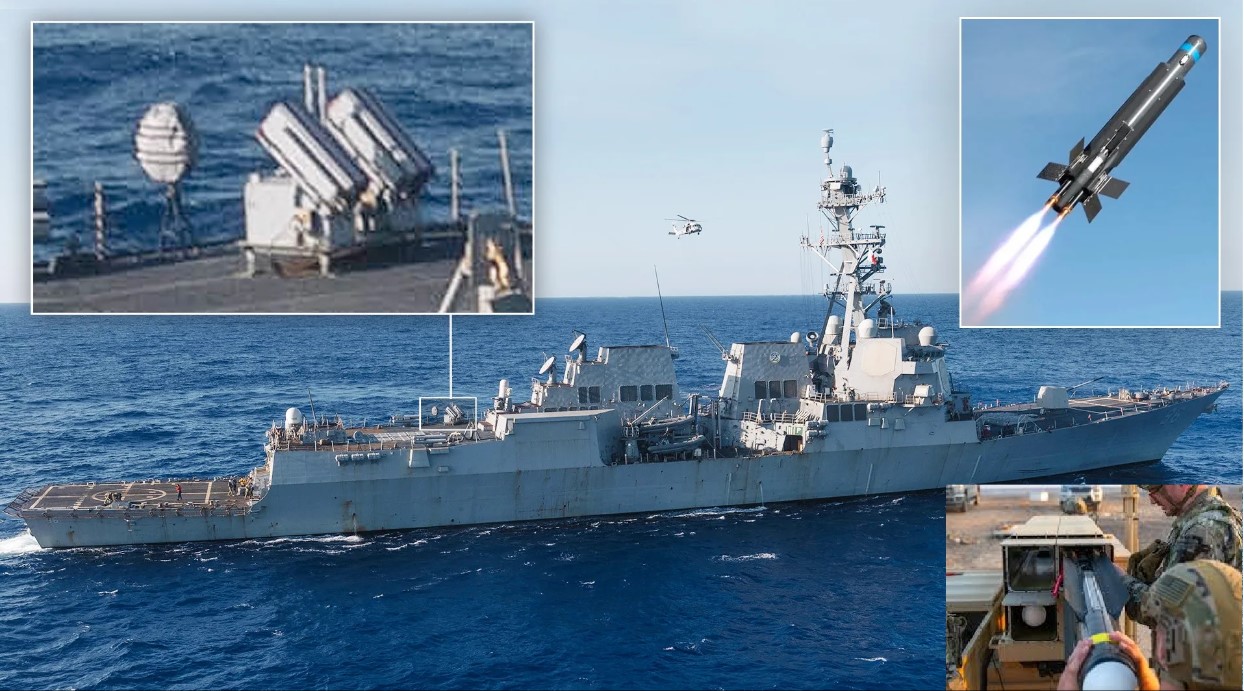
The US Navy has given the world its first clear look at the Coyote Block 2 counter-drone system installed aboard an operational destroyer, after releasing a photograph of the USS Bainbridge (DDG 96) during NATO’s Neptune Strike exercise. The image, taken amid a helicopter, board, search, and seizure drill in the Ionian Sea, marks a significant milestone in the Navy’s push to strengthen shipboard defenses against the fast-evolving threat of unmanned aerial systems (UAS).
The USS Bainbridge, an Arleigh Burke-class Flight IIA guided-missile destroyer assigned to the Gerald R. Ford Carrier Strike Group, now carries multiple Coyote launchers mounted near its aft Mk 41 Vertical Launch System (VLS) cells. This location allows the interceptors to work seamlessly alongside the ship’s primary air-defense weapons, providing a layered defense that conserves high-value missiles like the SM-2 and ESSM for larger, more dangerous targets.
A New Layer in Ship Defense
The Coyote Block 2 interceptor, developed by Raytheon, is a small, tube-launched, turbine-powered unmanned aircraft designed to loiter in the air while actively hunting for aerial targets. Unlike expensive long-range ship missiles such as the SM-2 Block IIIC (($2 million) or an ESSM ($1.65 million), the Coyote’s estimated cost of $100,000 makes it a cost-effective choice for defending against swarms of cheap drones.
Once launched, the Block 2 can remain airborne for several minutes, maneuver aggressively, and home in on its target using onboard sensors. It is capable of engaging fixed-wing drones, rotary drones, and even loitering munitions, making it a flexible asset in fleet defense. Its compact size means more interceptors can be carried onboard, enabling sustained counter-drone operations without quickly depleting a ship’s missile inventory.
Specifications of the Coyote Block 2 System
-
Length: Approximately 1.5 meters (5 feet)
-
Weight: Around 13–15 kg (30–33 lbs)
-
Propulsion: Turbine engine with high maneuverability
-
Speed: Estimated up to 200 knots (370 km/h)
-
Range/Endurance: Several kilometers with loitering capability of up to 15–20 minutes
-
Guidance: GPS navigation, inertial systems, and onboard electro-optical/infrared sensors
-
Warhead: Small high-explosive charge designed for aerial target destruction
-
Launch Method: Tube-launched from deck-mounted canisters
-
Primary Role: Interception of small unmanned aerial systems (UAS) and loitering munitions
Strategic Significance
The adoption of the Coyote Block 2 on a front-line destroyer marks a shift in the Navy’s layered air defense doctrine. Large, high-value missiles will still be used against fighter aircraft, bombers, or advanced cruise missiles, but the Coyote provides a persistent, lower-cost option for continuous drone defense. This approach is crucial as potential adversaries increasingly deploy large numbers of small, inexpensive unmanned aircraft to overwhelm traditional defenses.
The system is not new to combat—its Block 2 variant has already been used by the US Army under the Low, Slow, Unmanned Aircraft Integrated Disposal System (LIDS) program in the Middle East, Africa, and Europe. However, its integration into an Arleigh Burke-class destroyer suggests the Navy is ready to adapt lessons from land-based operations to the maritime environment.
Although the Navy has not officially confirmed whether the entire destroyer fleet will receive the upgrade, similar launcher installations have been observed on other vessels such as the USS Winston S. Churchill. Analysts believe a broader rollout is likely as the service seeks to enhance protection for carrier strike groups without incurring unsustainable costs.
The appearance of the Coyote launchers on the USS Bainbridge is more than just a hardware upgrade—it signals the Navy’s recognition that future sea battles may be decided as much by defeating swarms of drones as by intercepting supersonic missiles. By embracing loitering interceptor technology, the US Navy is positioning itself to counter one of the fastest-growing threats in modern naval warfare.
✍️ This article is written by the team of The Defense News.