U.S and Russia War to Sell Stealth Aircraft to India
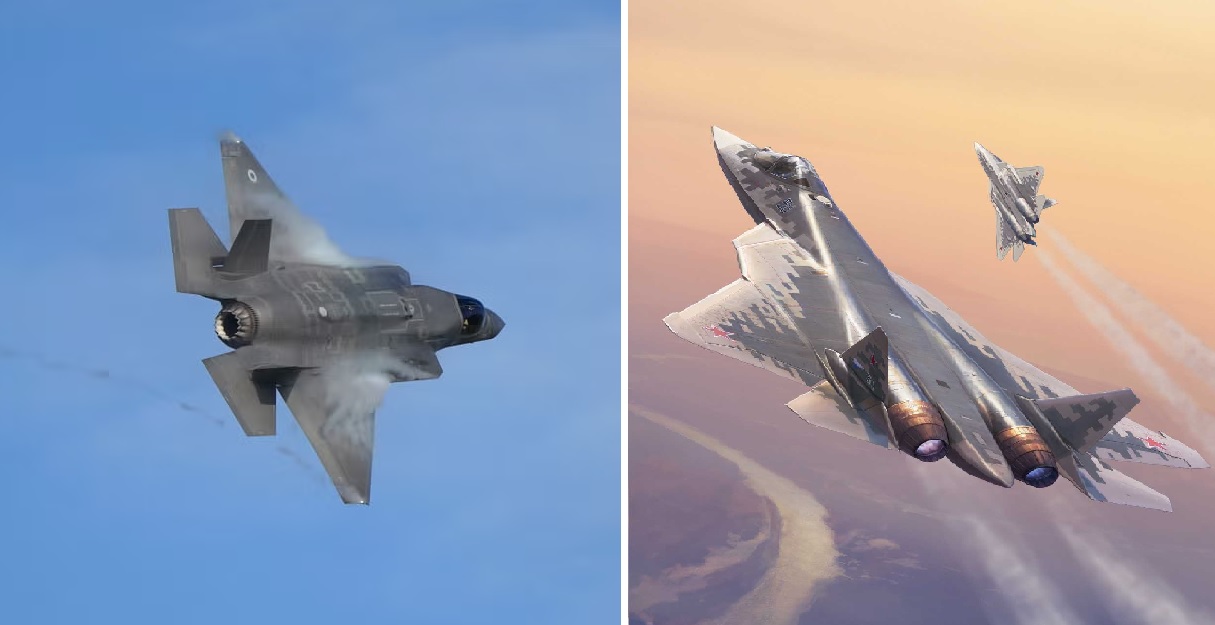
A quiet but intense struggle is unfolding behind the scenes as Washington and Moscow compete to sell their most advanced stealth aircraft to India. What began as standard defense proposals has gradually turned into one of the most significant arms races in recent years — not on the battlefield, but in diplomacy, technology offers, and strategic persuasion.
For Russia, this is a battle it cannot afford to lose. For the United States, this may be the chance to finally break into a market long dominated by Moscow. And for India, the world’s largest democracy and one of the most important military buyers, the emerging competition presents both an opportunity and a dilemma of historic proportions.
Russia’s Extraordinary Offer: A Complete Technology Transfer
In the beginning, Moscow’s proposal to India for the Su-57 fifth-generation fighter was like any conventional export pitch — a package of aircraft with partial industrial involvement. But everything changed the moment former President Donald Trump publicly signaled that Washington was willing to offer the F-35 to India, something U.S. policy had avoided for years.
The Russian response was immediate and unprecedented. Determined not to lose its biggest arms customer, Moscow dramatically enhanced the proposal. Instead of a basic export deal, it offered India complete control and complete access:
-
100% Transfer of Technology for the Su-57 airframe
-
100% ToT for the new AL-51 engine
-
Indian assembly and production rights
-
Freedom to integrate Indian or foreign weapons
-
A joint development roadmap for future upgrades
For India, which has long sought deeper industrial access to fighter production, this offer stood out as something Russia had never offered to any country before. In Moscow’s eyes, losing India — a country that operates 70% to 80% Russian-origin weapons — would not just be a commercial setback but a strategic defeat.
Washington Under Pressure: F-35 Exports Expand Amid Shrinking Markets
On the American side, circumstances were shifting as well. A series of cancellations and delays from European partners had placed new pressure on the F-35 program, forcing Washington to widen its export push. That is why the U.S. took steps that would have been unthinkable a few years ago.
It agreed to sell the F-35 to Saudi Arabia, even at the risk of friction with Israel. Soon after, discussions began on the possibility of extending a similar offer to India. This move came not just from the desire to counter China, but from a deeper ambition: to crack open the Indian market and reduce Russian influence once and for all.
But India’s demands were unlike anything the U.S. has faced in the past. New Delhi made it clear that it would accept the F-35 only under conditions similar to those granted to Israel:
-
Full operational control
-
The ability to install its own weapons
-
Independence from U.S. remote restrictions
-
Complete sovereignty over mission data
Until now, Washington has not signaled whether it would meet these conditions.
The S-400 Dilemma: An Obstacle the U.S. Cannot Ignore
Even if the U.S. eventually agrees to India’s demands, one problem remains — the S-400 air defense system already deployed by India. American officials have repeatedly maintained that the F-35 cannot operate in airspace where Russian radars collect data. The Turkey crisis serves as the most visible example: once Turkey purchased the S-400, its F-35 deal was halted immediately.
For India, this would mean operating the S-400 and the F-35 in completely separate environments, with no shared networks, no common bases, and no integrated operations. Such separation goes directly against India’s long-term integrated command approach. Analysts believe this would remain one of the most difficult barriers for any F-35 deployment in India.
India’s Existing Arsenal Tilts Toward Russia
Another reality complicates the American offer. India’s weapons ecosystem — missiles, radars, datalinks, EW suites, and air-defense networks — is already deeply connected to Russian-origin systems. Any new fighter must fit into this network.
The Su-57, by design, integrates naturally:
-
It can operate comfortably with S-400 batteries.
-
It can carry Indian and Russian weapons with minimal modification.
-
It can link into Indian and Russian command systems.
The F-35, on the other hand, is known for its strict digital ecosystem. It cannot simply plug into India’s existing Russian and indigenous networks. Instead, it would function as a standalone bubble, technologically isolated from most Indian systems.
For many Indian analysts, this is a decisive factor.
Why Washington Is Trying So Hard
Inside American strategic circles, the motivation is clear. India represents three long-term objectives:
-
Build a stronger Asian counterweight to China
-
Reduce the dominance of Russian technology in the Indian military
-
Secure a major new customer for the F-35 program
In each of these, India plays a central role. That is why Washington is pushing harder than ever before. But the U.S. model of tightly controlled weapon ecosystems conflicts with India’s doctrine of strategic autonomy, making negotiations challenging.
Why Moscow’s Proposal Resonates More With India
For India, Russia’s upgraded offer presents an exceptionally comfortable fit. The Su-57 package does not come with operational restrictions. It offers deep industrial access, the ability to integrate any weapon, and compatibility with existing systems like S-400, BrahMos, and Indian EW suites.
Most importantly, it preserves India’s long-standing principle: no foreign power should dictate how Indian military assets operate.
Russian officials have quietly framed their offer as the beginning of a multi-decade partnership where India becomes a co-designer, not just a customer. This vision appeals strongly to India’s aerospace ambitions.
What Comes Next: A Strategic Choice for Decades
India now faces one of its most consequential defense decisions in recent memory. If Washington agrees to full operational control — a major “if” — India gains access to the world’s most advanced stealth fighter. But it comes wrapped in American restrictions and the requirement to separate it from the S-400 ecosystem.
If New Delhi chooses Russia’s Su-57, it gains unmatched industrial freedom, complete compatibility with its existing weapons, and a place as a co-developer in future platforms.
Whichever path India takes, the decision will shape not only the Indian Air Force but also the global balance of military influence for decades. And the world is watching closely, as the U.S. and Russia fight their quiet war — not on the battlefield, but for India’s skies.
About the Author
Aditya Kumar:
Defense & Geopolitics Analyst
Aditya Kumar tracks military developments in South Asia, specializing in Indian missile technology and naval strategy.