U.S. Space Force Expands Golden Dome Missile-Defense Push With New Call for Space-Based Interceptor Prototypes
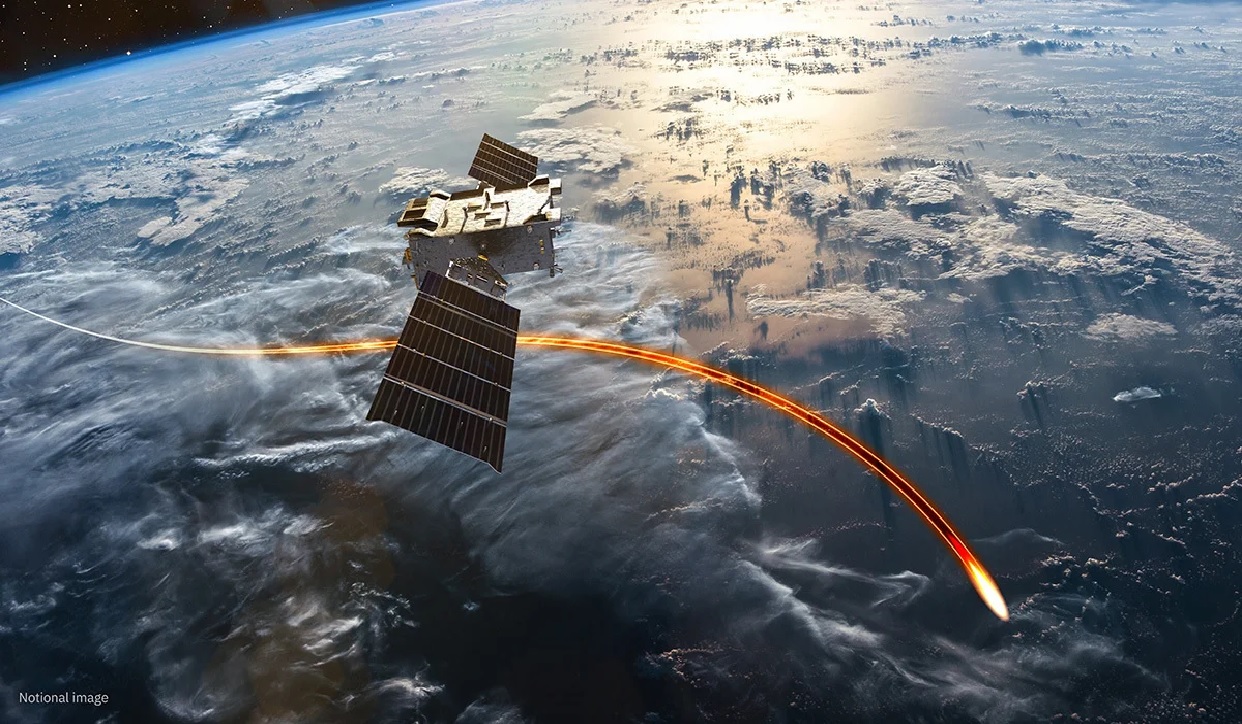
The U.S. Space Force has opened a major new phase in Washington’s effort to build a layered, next-generation missile-defence network, issuing a fresh request for prototype proposals for space-based interceptors capable of destroying hostile missiles during their midcourse phase of flight. The solicitation, released on 7 December, marks the first formal move toward developing a kinetic kill vehicle that would operate from orbit—an idea long debated in U.S. defence circles and widely viewed as one of the most technically complex elements of the Pentagon’s Golden Dome architecture.
Focus on Kinetic Interceptors, Not Directed-Energy Weapons
According to the public notice, the Space Force is seeking kinetic interception solutions only, excluding directed-energy concepts such as lasers or high-power microwaves. Proposals are due by 19 December, and the service has not disclosed performance specifications, interceptor deployment numbers, or targeted orbital regimes, indicating the effort remains in a tightly controlled early stage.
The push follows the agency’s earlier award of 18 prototype contracts for boost-phase interceptors, announced in November under Other Transaction Authority arrangements. Speaking at the Reagan National Defense Forum on 6 December, Golden Dome programme director Gen. Michael Guetlein said space-based midcourse weapons will require a transformational approach to cost, production volume, and reliability.
“When we start talking about things like space-based interceptor, I’ve got to switch that equation on its head,” Guetlein said. “I’ve got to have high magazine depth, low cost per shot. How do I do that? We’re going to have to tap into industry innovation.”
A Revival of Old Ideas—With Modern Scale and Cost Challenges
The Golden Dome concept draws heritage from earlier Strategic Defense Initiative (SDI) experiments, including the “Brilliant Pebbles” programme of the late 1980s. While those efforts demonstrated feasibility for orbital interceptors, they were ultimately halted due to cost, technology maturity, and geopolitical concerns.
Today’s geopolitical landscape—characterised by expanding long-range missile arsenals in China, Russia, North Korea, and Iran—has revived debate over deploying interceptors in orbit. Golden Dome aims to provide the first truly comprehensive U.S. missile shield capable of handling ballistic, hypersonic, and maneuvering glide vehicles in their midcourse trajectories.
Programme officials acknowledge, however, that affordability remains the defining obstacle. Former President Donald Trump recently projected the programme’s budget at $175 billion over three years, but independent estimates are far higher. A September study by the American Enterprise Institute calculated that the 20-year cost could range from $252 billion to as much as $3.6 trillion, depending on interceptor constellation size and launch costs.
Industry Prepares for a Massive Technical Undertaking
Industry leaders say such a system will demand unprecedented cooperation between government, prime contractors, and the commercial space sector. Northrop Grumman CEO Kathy Warden told forum attendees that a successful interceptor architecture must be both technically viable and economically scalable.
“It will take a whole-of-government and industry approach to determine a design that can be deployed aggressively and at scale,” Warden said. “The design has to not only be to develop a system. It has to be to develop a system that can scale and scale affordably.”
Companies expected to participate include major missile-defence primes such as Lockheed Martin, Raytheon, Northrop Grumman, Aerojet Rocketdyne, and rapidly growing commercial-space integrators capable of mass-manufacturing small spacecraft. The Space Force has separately emphasised that responsive launch capability—including rapid replenishment of on-orbit assets—will be essential for any operational architecture.
MDA Opens Competition for SHIELD: Over 1,000 Firms Qualified
In a parallel development, the Missile Defense Agency announced on 2 December that more than 1,000 companies are eligible to compete for task orders under its new SHIELD (Space High-Altitude Interceptor Layer Development) initiative. SHIELD will focus on experimentation, sensor integration, propulsion, and kill-vehicle technologies feeding into Golden Dome’s development pipeline.
MDA officials say the unusually broad industrial base is intentional: the agency aims to draw on capabilities from traditional defence contractors, commercial satellite manufacturers, AI-driven tracking firms, and propulsion startups capable of delivering lightweight, high-ΔV systems suitable for orbital engagements.
Growing Congressional Scrutiny as Costs Rise
Lawmakers have accelerated oversight mechanisms as the programme expands. Senator Deb Fischer, ranking member on the Senate Armed Services Subcommittee on Strategic Forces, said Congress must now prioritise clarity on what elements of Golden Dome are truly essential.
“We have to be able to know what we need and prioritize that,” she said. “Those decisions are becoming clearer when we work with the department and the military and really get the information there.”
The fiscal 2026 National Defense Authorization Act, headed for a House vote on 10 December, includes mandatory annual reporting on Golden Dome’s costs, testing milestones, operational plans, and deployment timelines. Quarterly briefings will continue until the system becomes fully operational.
Technical, Strategic, and Political Tests
Golden Dome’s midcourse interceptor layer is expected to undergo several years of prototyping before any orbital tests occur. Defence officials have privately indicated that on-orbit demonstrations could begin in the early 2030s, depending on funding and technology maturity.
The programme’s supporters argue it is essential for countering the emerging threat of nuclear-armed hypersonic glide vehicles and multi-warhead ballistic missiles. Critics, however, warn that orbital interceptors may escalate strategic tensions, trigger counter-space weapons development by adversaries, and create long-term debris risks.
For now, the Space Force’s new solicitation signals that the United States is moving steadily toward one of the most ambitious missile-defence initiatives in its history—a system that, if successfully deployed, could permanently reshape the global strategic balance.
About the Author
Aditya Kumar:
Defense & Geopolitics Analyst
Aditya Kumar tracks military developments in South Asia, specializing in Indian missile technology and naval strategy.