U.S. Navy Unveils FF(X) Frigate Program, Details And Specifications Revealed
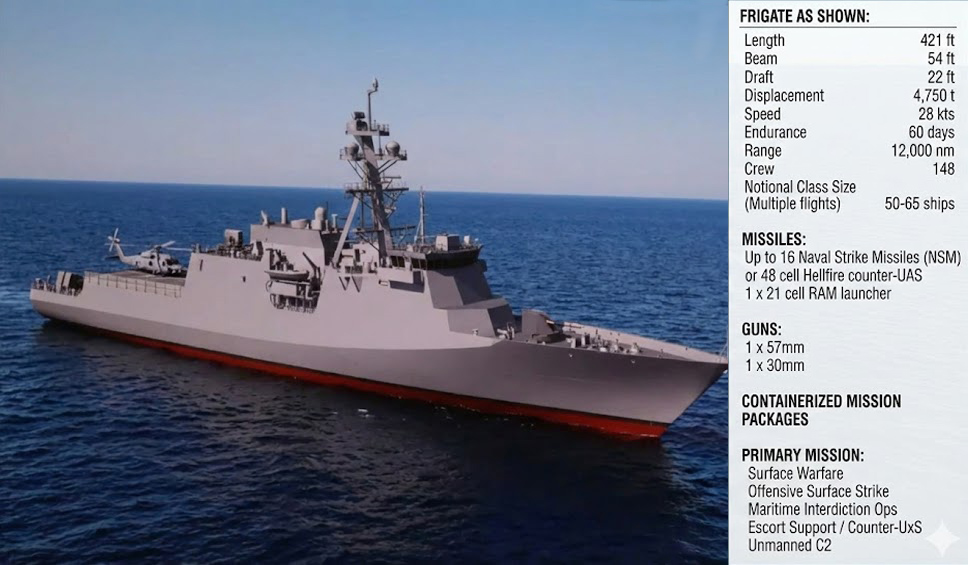
WASHINGTON : The United States Navy has unveiled the clearest picture yet of its Next-Generation Light Surface Combatant, confirming that the forthcoming FF(X) Frigate will mark a decisive shift away from the design and operational philosophy that defined the now-curtailed Constellation-Class Program.
New details emerged during the “Future Fleet” Panel at Surface Navy 2026, hosted by Chris Miller, Executive Director of Naval Sea Systems Command (NAVSEA), alongside Rear Admiral Derek Trinque, the Navy’s Surface Warfare Director (N96). Senior surface warfare leaders used the forum to frame FF(X) not as a replacement for a High-End Frigate, but as a Purpose-Built, Fast, Modular Platform designed to fill the Low End of the Navy’s evolving force mix.
A Deliberate Break From Constellation
According to Navy officials, FF(X) represents a radical departure from the 7,000-Plus-Ton, Aegis-Equipped Constellation-Class Frigates. Instead of pursuing a heavily armed, multi-mission warship, the Navy is prioritizing Speed, Rapid Fielding, and Affordability. The First Hull is targeted to be in the water by 2028, a timeline senior leaders describe as Non-Negotiable.
To meet that schedule, the Navy has selected a derivative of the Legend-Class Coast Guard Cutter as the basis for the new frigate’s hull. Both the Coast Guard cutters and FF(X) will be built by Huntington Ingalls Industries, leveraging an existing, in-service design to reduce Technical Risk and Construction Delays.
Navy leaders acknowledged that the visual and structural similarity to Coast Guard cutters has prompted questions about Survivability and Combat Capability, but stressed that FF(X) must be judged in the context of its Intended Mission Set, rather than against larger surface combatants.
Armament Focused On Modular Strike
As outlined during the panel, FF(X) will carry a lighter but highly flexible Weapons Suite optimized for Lower-End Threats and Distributed Operations. The baseline configuration includes a 57-Millimeter Main Gun, a 30-Millimeter Auxiliary Cannon, and a Mk-49 Launcher loaded with 21 Rolling Airframe Missiles (RAM) for point air defense. Electronic Warfare will be provided by Two SLQ-32(V)6 Systems, complemented by Nulka Soft-Kill Decoy Launchers.
The defining feature of the design, however, is its Modular Payload Space at the stern. This area is designed to accept Containerized Weapon and Mission Packages, including up to 16 Naval Strike Missiles, as many as 48 Hellfire Missiles, or alternative Strike, Surveillance, and Mission Modules. Navy officials repeatedly emphasized that this “Capability In A Box” approach allows the same hull to be rapidly reconfigured for different tasks and potentially shared with Unmanned Surface Vessels (USVs).
Chris Miller described the concept as central to the program’s Risk-Reduction Strategy, allowing capabilities to be developed, upgraded, and integrated independently of the ship’s core design.
Built For The Low End Of The Fight
Senior officers were explicit about where FF(X) fits within the Navy’s future force structure. The ship is intended to serve as the “Low” Component of a Low-Medium-High Mix, operating alongside Flight III Arleigh Burke-Class Destroyers and future Large Surface Combatants. Missions envisioned for the class include Counter-Narcotics Patrols, Maritime Security, Escort Duties, and Presence Operations—roles that currently tie up High-Value Destroyers and Cruisers.
Rear Admiral Derek Trinque drew on his own experience to illustrate the logic behind the requirements, noting that employing Guided-Missile Cruisers or Destroyers for counter-drug missions is an inefficient use of scarce assets. FF(X), he argued, is meant to remove that dilemma from Fleet Commanders.
By focusing on Lower-End Threats, the Navy hopes to free its most capable surface combatants for Deterrence and High-Intensity Conflict Scenarios elsewhere.
Speed, Numbers, And Future Growth
The Navy plans to procure between 50 And 65 FF(X) Hulls across multiple Production Flights. While the initial configuration is deliberately modest, officials said the class is designed with Growth Margin for future upgrades over its production life. Potential enhancements discussed include Upgraded Sensors and the possible addition of Vertical Launch System (VLS) Cells, though no specific upgrades have been approved.
This incremental approach stands in contrast to the Constellation-Class Program, which sought to field a highly capable frigate from the outset and suffered repeated Delays and Cost Growth as requirements evolved.
ASW Questions Remain
One area that drew particular attention during the panel was Anti-Submarine Warfare (ASW). Admirals stressed that the Navy intends to preserve ASW Capacity within the surface fleet despite the effective cancellation of the Constellation-Class. However, questions remain about how much ASW capability FF(X) will ultimately carry.
Observers noted the apparent absence, at least in early design concepts, of a Hull-Mounted Sonar or Towed Array System—key components of traditional frigate ASW operations. Navy officials acknowledged the uncertainty, suggesting that ASW functions could be addressed through Modular Payloads, Aviation Assets, or Manned-Unmanned Teaming, but stopped short of offering definitive answers.
A Pragmatic Recalibration
Taken together, the FF(X) Program reflects a broader Recalibration underway within the U.S. Navy. Rather than pursuing fewer, more complex ships, the service is betting on Speed, Numbers, and Modularity to meet near-term operational demands. By adapting an existing hull, emphasizing Flexible Payloads, and narrowing the mission focus, Navy leaders believe FF(X) can be fielded quickly and at scale—accepting limits in Capability in exchange for Availability and Presence.
Whether that trade-off proves sufficient in an increasingly Contested Maritime Environment remains an open question. For now, however, FF(X) stands as the Navy’s clearest signal yet that the era of the All-Purpose Frigate has given way to a more Specialized, Distributed Vision Of Surface Warfare.
About the Author
Aditya Kumar:
Defense & Geopolitics Analyst
Aditya Kumar tracks military developments in South Asia, specializing in Indian missile technology and naval strategy.