US Navy Fast-Tracks Nex-Gen Medium Landing Ship Program with Bollinger and Damen Designs
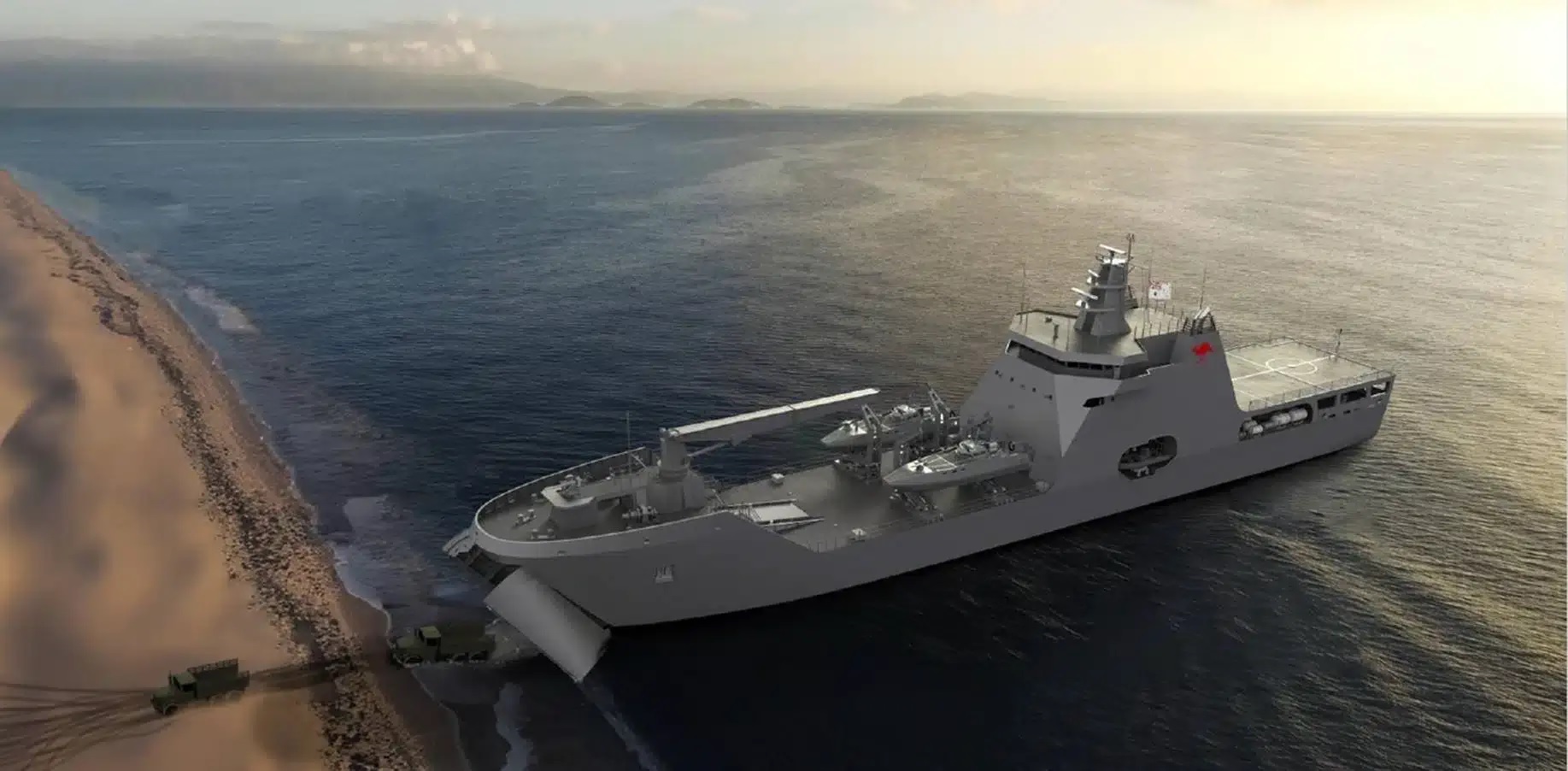
Washington, August 2025 — The US Navy has taken decisive steps to accelerate the development of its new Medium Landing Ship (LSM) fleet, a program vital for the Marine Corps’ operational mobility in contested Indo-Pacific environments. Once known as the Light Amphibious Warship, the LSM will serve as a mid-size beaching vessel to transport and support Marine Littoral Regiments (MLRs) in austere regions where larger amphibious ships face operational risks.
In its latest moves, the Navy’s Naval Sea Systems Command (NAVSEA) confirmed the acquisition of technical data packages (TDPs) from Bollinger Shipyards Lockport and Damen Naval. These TDPs cover the Israeli Logistics Support Vessel (ILSV) and LST-100 designs, chosen as the only viable off-the-shelf platforms capable of meeting top-level Navy requirements after reviewing proposals from 14 shipbuilders.
From Bespoke to Off-the-Shelf
The program originally aimed to develop a new, bespoke landing ship. However, spiraling costs and industry bids far exceeding budget forced the Navy to change course in late 2024. Instead, NAVSEA adopted a commercial/non-developmental item (CNDI) acquisition strategy, relying on mature ship designs to cut costs and accelerate schedules.
The Navy plans to procure 18 to 35 LSMs, with an initial batch of nine ships funded under the Fiscal Year 2026 shipbuilding budget request of $1.96 billion. The new approach reduces engineering risks, shortens build timelines, and ensures operational readiness in line with the Marine Corps’ urgent needs.
Bollinger’s Advantage and the USS McClung (LSM-1)
Bollinger Shipyards, which built two ILSVs for the Israeli Navy in 2023–24, has been sole-sourced for the first LSM Block 1 lead ship, to be named USS McClung (LSM-1). The Navy emphasized that Bollinger’s ability to construct the vessel within the US shipbuilding framework gives it a clear advantage, as the design already conforms to American standards.
NAVSEA noted that building a design already proven in the US provides “time-saving and cost-saving advantages,” lowering performance risk and accelerating delivery schedules.
Damen’s LST-100: Capacity and Global Footprint
While the ILSV design is being prioritized for initial construction, Damen’s LST-100 remains a strong contender for future batches. The design closely aligns with Marine Corps requirements, particularly in troop capacity, ammunition carriage, force protection, and interoperability.
Globally, the LST-100 has already found buyers. Damen delivered NNS Kada to the Nigerian Navy, and a variant was selected by Australia in late 2024 as the basis for its eight-ship Landing Craft Heavy program. NAVSEA has highlighted this international adoption, noting that foreign operators could indirectly bolster US sustainment through shared repair and logistic support facilities overseas.
Construction Management and Industrial Base Expansion
On August 6, NAVSEA and the Medium Landing Ship Program Office (PMS 347) issued a Request for Information (RFI) for firms to provide Vessel Construction Management (VCM) services for the LSM program. The VCM role will be pivotal in coordinating multiple US shipyards, overseeing contract awards, scheduling, budgeting, and quality control.
Each LSM is expected to take 32–36 months to build, with initial contracts covering up to eight ships, all slated for delivery within six years of VCM selection. Future procurement options are expected to expand the fleet beyond this first batch.
Strategic Imperative
The LSM program reflects the Navy and Marine Corps’ shift toward distributed, expeditionary warfare concepts tailored for the Indo-Pacific. Unlike large-deck amphibious ships, LSMs are smaller, cheaper, and capable of beach landings, enabling MLRs to operate from dispersed islands and complicate adversary targeting strategies.
By selecting mature designs and leveraging proven US shipbuilding expertise, the Navy aims to ensure the first ships are delivered on time and within budget, reinforcing its ability to operate effectively in contested maritime zones.
✍️ This article is written by the team of The Defense News.