U.S. Navy Conducts Ship-Launched Precision Strike on ISIS Targets in Nigeria
The United States has carried out a precision military strike against Islamic State (ISIS) positions in northwestern Nigeria, marking one of the most significant maritime-based counterterrorism actions by U.S. forces in West Africa in recent years.
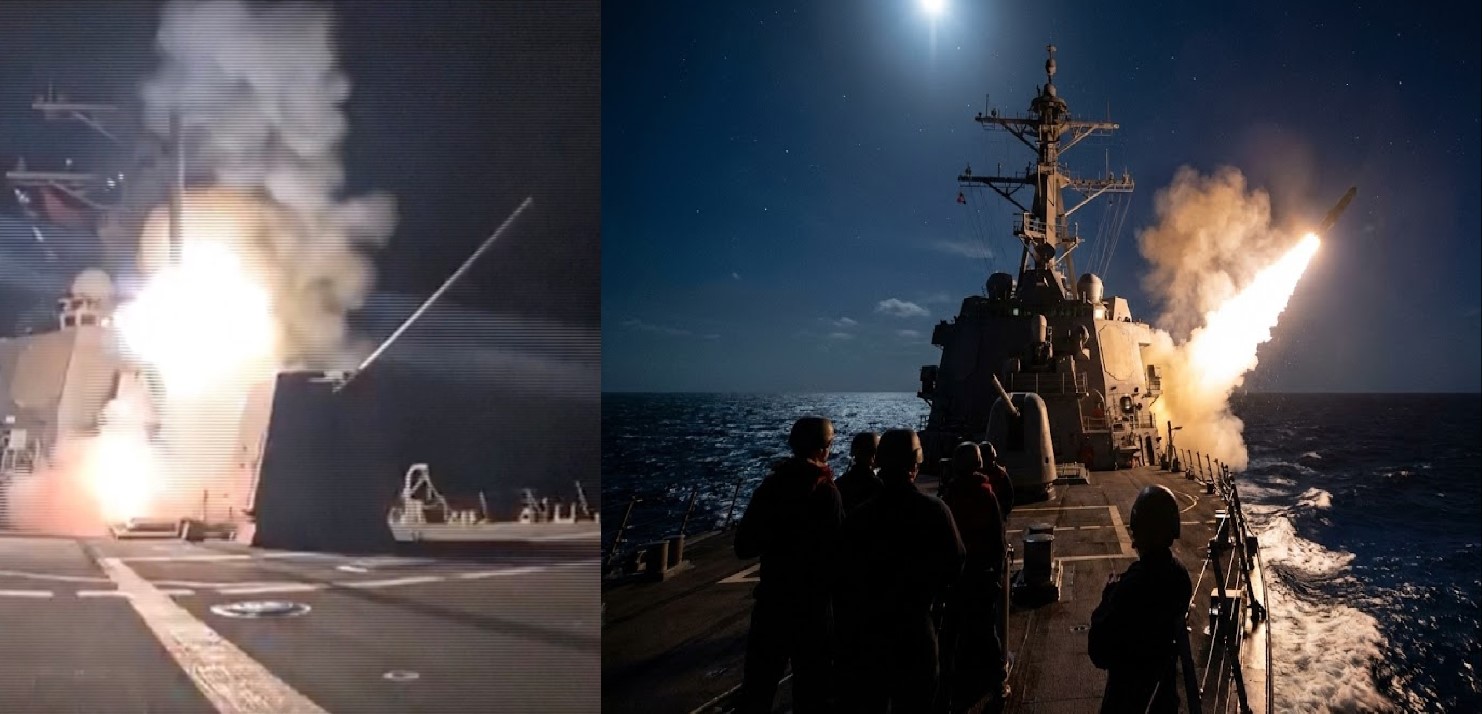
According to information released by the U.S. Department of War, the strike took place on December 25, 2025, targeting ISIS-linked elements operating in Sokoto State, Nigeria. The announcement was accompanied by night-time video footage showing the vertical launch of a missile from a U.S. Navy surface combatant operating offshore, strongly suggesting the use of a long-range cruise missile.
AFRICOM Confirms Coordinated Operation With Nigeria
Shortly after the video release, U.S. Africa Command (AFRICOM) formally confirmed the operation in a public statement.
“At the direction of the President of the United States and the Secretary of War, and in coordination with Nigerian authorities, U.S. Africa Command conducted strikes against ISIS terrorists in Nigeria on December 25, 2025, in Sokoto State,” AFRICOM said.
The statement underscores that the strike was not unilateral, highlighting prior coordination with the Nigerian government and indicating high-level political authorization for the mission.
Video Analysis Points to Tomahawk Missile Launch
Defense analysts reviewing the footage note that the ignition signature, launch angle, and exhaust plume are consistent with a missile fired from the Mk 41 Vertical Launching System (VLS). This system is standard equipment aboard Arleigh Burke-class destroyer warships.
While the U.S. military has not officially confirmed the weapon type or the specific vessel involved, multiple analysts assess that the strike likely involved a BGM-109 Tomahawk Land Attack Missile, a system routinely used for long-range, high-precision strikes against fixed ground targets.
Why the United States Struck ISIS in Nigeria
U.S. officials point to escalating ISIS activity in West Africa as the primary driver behind the operation. Sokoto State lies near regions where Islamic State West Africa Province (ISWAP) has expanded operations, exploiting porous borders, weak local governance, and existing insurgent networks.
According to U.S. defense assessments, ISIS-affiliated groups in Nigeria have:
-
Increased attacks on civilian populations, including religious minorities
-
Targeted security forces and local authorities
-
Sought to establish safe havens capable of supporting regional and transnational operations
The strike is intended to degrade leadership, infrastructure, and operational planning nodes, preventing imminent attacks and limiting ISIS’s ability to project power across Nigeria and the wider Sahel region.
Context: Political Signals From Washington
The operation also follows heightened political attention on Nigeria from Washington. On November 1, 2025, former U.S. President Donald Trump publicly warned that the United States could take direct military action if jihadist violence against Christian communities continued unchecked.
At the time, Nigeria was designated a “country of particular concern” under U.S. religious freedom legislation. While U.S. officials have not explicitly linked the December 25 strike to those remarks, the timing aligns with a sharpened U.S. counterterrorism posture toward West Africa.
The Role of U.S. Navy Destroyers
Arleigh Burke-class destroyers form the backbone of the U.S. Navy’s surface combatant fleet. Equipped with the Aegis Combat System and up to 96 VLS cells, these warships can conduct air defense, anti-submarine warfare, and land-attack missions simultaneously.
Their ability to operate in international waters, including the Gulf of Guinea, allows the United States to strike inland targets without relying on regional air bases or overflight permissions.
Tomahawk: A Proven Long-Range Strike Weapon
The Tomahawk cruise missile is a subsonic, long-range precision weapon with an operational reach exceeding 1,600 kilometers. Using a combination of GPS guidance, inertial navigation, and terrain contour matching, it can strike hardened or high-value targets with high accuracy while flying at low altitude to evade radar detection.
First used operationally during the 1991 Gulf War, the Tomahawk has since been employed in Iraq, Syria, Libya, and Yemen, making it one of the most combat-tested precision weapons in the U.S. arsenal.
A Strategic Shift in U.S. Operations in Africa
Historically, U.S. kinetic operations in Africa have relied heavily on armed drones and manned aircraft operating from land bases in Niger, Djibouti, or allied territories. The December 25 strike signals a notable shift toward maritime-based standoff attacks, offering greater flexibility, lower personnel risk, and reduced political sensitivity.
Naval platforms allow the U.S. military to respond rapidly to emerging threats while maintaining a minimal on-shore footprint, an approach increasingly favored in politically complex regions.
What Comes Next
No post-strike damage assessment or casualty figures have been released, and Nigerian authorities have yet to issue a detailed public statement. However, U.S. officials indicate that the operation is part of ongoing counterterrorism efforts, not a one-off action.
As ISIS-affiliated networks continue to adapt and expand across West Africa and the Sahel, the December 25 strike may mark the beginning of a more prominent role for U.S. naval power in African counterterrorism—one defined by precision, mobility, and strategic distance.
✍️ This article is written by the team of The Defense News.