U.S. Navy Announces Trump-Class 35,000-Ton Battleship With Hypersonic Strike and Directed-Energy Weapons
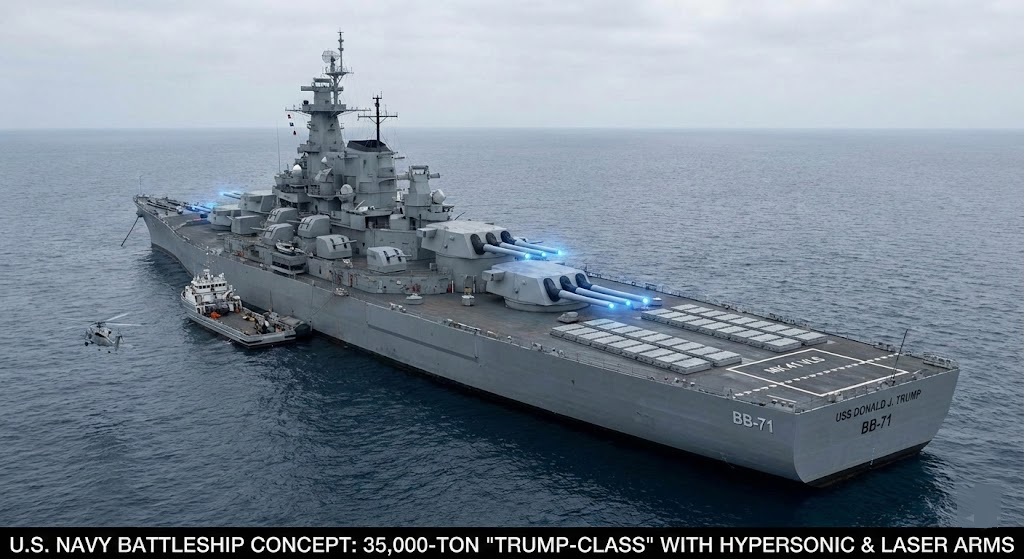
The United States Navy has announced plans for a new class of guided-missile battleships, marking a major shift in surface warfare doctrine and reviving a designation absent from frontline fleets for decades. The proposal was unveiled on December 22, 2025, following a statement by U.S. President Donald Trump, and positions the Trump-class battleship as the centerpiece of a broader naval buildup described as the “Golden Fleet.”
According to Pentagon disclosures, the first ship of the class, the future USS Defiant (BBG-1), is now in the early design phase, with construction of the lead vessel targeted for the early 2030s. Despite the historic name, the Navy’s concept bears little resemblance to the heavily armored gun platforms of the 20th century. Instead, the Trump class is envisioned as a missile-heavy, highly survivable large surface combatant designed to operate inside a saturated anti-ship missile environment, while also serving as a forward fleet command node.
Strategic Rationale
Navy officials describe the program as a response to the realities of peer-level naval conflict. In such scenarios, aircraft carriers may be forced to operate at extended stand-off ranges, while existing destroyers and cruisers risk exhausting their missile magazines within the first days of combat. The Trump-class battleship is intended to offset this vulnerability by combining deep missile capacity, layered defenses, and command-and-control authority into a single platform capable of sustained high-intensity operations.
Official planning outlines an initial build of two ships, followed by an eventual objective of 20 to 25 hulls. The class is framed not as a replacement for escorts, but as a “magazine and presence multiplier,” able to remain combat-effective long after smaller surface combatants have expended their weapons.
Size, Propulsion, and Crew
Concept designs place the Trump class in the 30,000- to 40,000-ton displacement range, making it one of the largest surface combatants proposed since the Cold War. USS Defiant is depicted at roughly 35,000 tons, exceeding 840 feet in length and approaching 880 feet overall. Beam is estimated between 105 and 115 feet, with a draft of 24 to 30 feet.
Propulsion is described as a combined gas turbine and diesel system, delivering speeds in excess of 30 knots while generating substantial electrical power margins to support advanced sensors and weapons. Crew size is projected at 650 to 850 personnel, reflecting both the ship’s scale and its role as a command flagship rather than a conventional escort.
Missile-Centric Main Battery
The Trump class is defined primarily by its missile armament. Navy statements explicitly link the ship to Conventional Prompt Strike (CPS) hypersonic weapons and to the Surface-Launched Cruise Missile–Nuclear (SLCM-N), signaling the integration of both long-range conventional and nuclear-capable strike options on a surface combatant.
Concept material indicates a Mk 41 Vertical Launch System installation of approximately 128 cells, supplemented by a dedicated 12-cell battery for hypersonic missiles. This configuration would allow a single ship to deploy a mixed load of Tomahawk land-attack missiles, SM-2 and SM-6 interceptors for area air defense and surface strike, potential SM-3 missiles for ballistic missile defense, and hypersonic weapons for time-sensitive or heavily defended targets. Navy messaging consistently highlights magazine depth and long-range strike as the class’s defining attributes.
Guns, Lasers, and Layered Engagement
While missiles dominate the design, the Trump class also incorporates advanced gun systems and directed-energy weapons as part of a layered engagement strategy. The Golden Fleet concept references a 32-megajoule electromagnetic railgun firing hypervelocity projectiles, paired with two 5-inch naval guns capable of employing similar ammunition. These systems are intended to provide lower-cost engagement options against drones, fast attack craft, and select missile threats.
Directed-energy weapons feature prominently, with options cited for either two 300-kilowatt or two 600-kilowatt class lasers. These would complement kinetic close-in systems and provide sustained defensive fire limited primarily by power generation and thermal management. Analysts note, however, that both railguns and high-power lasers remain technically challenging, and early ships are expected to rely on mature systems, with advanced weapons introduced through spiral upgrades.
Integrated Air and Missile Defense
Survivability is central to the Trump-class concept. The Navy assigns the ship a formal Integrated Air and Missile Defense (IAMD) role, describing it as capable of operating within a carrier strike group or commanding an independent surface action group. Concept imagery depicts an Aegis-derived combat system architecture, positioning the battleship as a high-value air defense node.
Close-in defenses shown include Rolling Airframe Missile (RAM) launchers, multiple 30-millimeter guns positioned fore and aft, and at least two 20-millimeter class systems to counter threats that penetrate the outer defensive layers. Dedicated counter-unmanned systems modules further emphasize protection against drone swarms in both littoral and open-ocean environments.
Aviation and Command Role
The Trump-class design includes a large flight deck and hangar capable of supporting a tilt-rotor aircraft such as the V-22. This aviation capability is intended to extend the ship’s scouting radius, enable rapid personnel and logistics movement, and support special operations or maritime interdiction missions without immediate reliance on carrier aviation.
From a command perspective, the larger hull enables greater redundancy in power distribution, expanded damage-control margins, and increased space for C4ISR systems. Within the Navy’s distributed maritime operations framework, the battleship is positioned as a forward command hub, coordinating manned and unmanned platforms while sustaining decision-making authority under fire.
Program Outlook and Strategic Impact
Official statements indicate that the Navy would lead development in partnership with the defense industrial base. The Trump class is described as replacing the planned DDG(X) destroyer, with its intended capabilities folded into the larger hull. This approach suggests a focus on proven systems, such as the Mk 41 launcher, while incorporating emerging technologies through incremental modernization.
If built as proposed, the Trump-class battleship would occupy a displacement and missile-capacity category unmatched among Western navies. By concentrating long-range strike, air and missile defense, and fleet command functions into a small number of heavily defended flagships, the program would represent a significant evolution in U.S. surface combat power, aimed at sustaining sea control and power projection well into the 2030s and beyond.
✍️ This article is written by the team of The Defense News.