U.S. Marines Prepare for Modern Air Defense Threats Using Full-Scale Decoys of S-300 and HQ-9 Air Defenses
U.S. Marines from the 1st Radio Battalion have conducted some of their most advanced suppression-of-enemy-air-defense (SEAD) training to date, facing full-scale decoy replicas of Russian S-300 and Chinese HQ-9 long-range surface-to-air missile systems during Exercise Resolute Hunter 26-1 at Naval Air Station Fallon, Nevada. The drills—confirmed by the U.S. Department of War via DVIDS on November 21, 2025—are designed to strengthen joint kill-chain integration and prepare U.S. forces for the next generation of highly networked air defense threats.
Foreign Air Defense Systems in the Nevada Desert
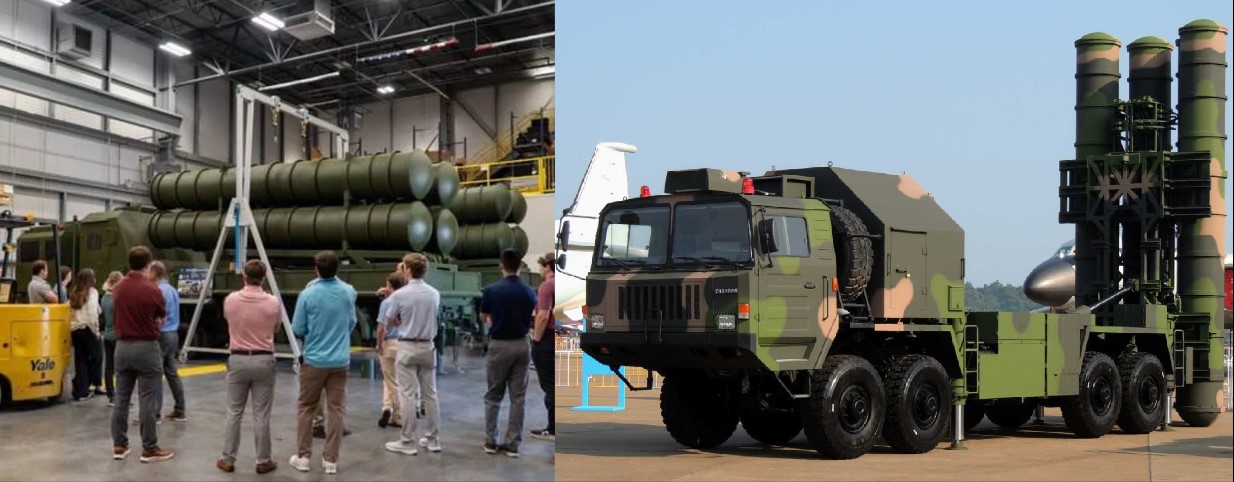
Imagery released from Fallon shows large, foreign-profile missile launchers and radar vehicles painted in desert camouflage, closely resembling the S-300PMU2 and HQ-9/HQ-9B families. These are not simple mock-ups but full-scale, visually and electromagnetically representative decoys, capable of simulating real-world radar emissions, network signatures, and deployment patterns.
The S-300PMU2 “Favourite”, designed by Russia, includes:
-
83M6E2 command post
-
64N6E2 long-range surveillance radar
-
30N6E2 X-band phased-array engagement radar
-
5P85 series launchers carrying long-range missiles
Operationally, a functioning S-300PMU2 battery can threaten aircraft and low-flying cruise missiles up to 150–200 km, while tracking and engaging multiple targets simultaneously. Its architecture forms the backbone of many non-Western integrated air defense networks.
China’s HQ-9 series—mirrored in other range decoys—offers a comparable threat. The HQ-9B variant has a reported engagement range of up to 300 km, tied to the modern HT233 and Type 305 phased-array radars. Export versions, known as FD-2000/FD-2000B, have proliferated across the Middle East, Central Asia, and North Africa.
Why These Systems Matter: The Iran Angle
The selection of S-300 and HQ-9-style targets is not coincidental. Iran received S-300PMU2 batteries from Russia in the mid-2010s and deployed them around its nuclear infrastructure, including Fordow. The semi-arid terrain of Iran’s defense sites closely resembles the Nevada training ranges.
In recent years, reports have suggested that Iran has shown interest in Chinese HQ-9-class systems to complement its indigenous Bavar-373 and Khordad-15 batteries. Several regional neighbors have also evaluated these systems, making HQ-9 derivatives a likely future threat for U.S. forces.
Seen in this light, full-scale decoys at Fallon represent an unmistakable rehearsal for penetrating Iranian-style integrated air defense systems—especially after Israeli strikes on Iranian nuclear and missile sites in 2025, which accelerated Tehran’s efforts to reinforce its air defense network.
Marines Shift From Ground Combat to Multi-Domain SEAD
Historically, disabling enemy air defenses fell to U.S. Air Force platforms such as the F-16CJ “Wild Weasel”, EC-130H Compass Call, and F-35A. But the U.S. Marine Corps is restructuring into a stand-in force, capable of operating deep inside contested zones.
During Resolute Hunter 26-1, Marines practiced:
-
Identifying foreign batteries by radar pulse characteristics
-
Detecting network traffic between SAM components
-
Locating camouflaged launchers via electromagnetic signatures
-
Passing real-time intelligence to Army, Navy, and Air Force shooters
-
Coordinating electronic warfare, cyber intrusion, and long-range missile fires
The goal is to turn Marine units into forward reconnaissance and targeting nodes that help dismantle high-end SAM networks for joint aviation and naval strike forces.
Joint Kill Chain Integration Takes Center Stage
Resolute Hunter is one of the Pentagon’s major multi-domain intelligence and targeting exercises. This year included:
-
U.S. Army long-range fires units
-
Navy aviation and carrier strike elements
-
Air Force electronic attack and ISR aircraft
-
Space Force sensor and tracking teams
The S-300 and HQ-9 surrogates allowed services to rehearse building a complete kill chain: detection, classification, geolocation, jamming, cyber disruption, and kinetic strike.
Officials note the decoys can emit realistic radar waveforms and generate system-specific digital signatures, enabling analysts to work with authentic threat fingerprints.
A Larger Strategic Signal
The deliberate training comes as tensions with Iran remain high. Western intelligence reports warn that Iran is dispersing and upgrading its air defense assets, and accelerating deployment of modern SAMs around nuclear and missile facilities.
In that context, Marines maneuvering around S-300 and HQ-9 look-alikes in Nevada is more than routine—it is a strategic rehearsal. The U.S. is preparing for high-end air defense environments in the very regions where these systems are already deployed.
Fake Targets, Real Kill Chains
Even if the systems on the Fallon ranges are only mock-ups, the work unfolding around them is anything but artificial. The Marines are effectively rehearsing the very data flows, targeting chains, and rapid decision cycles that would unfold in an actual fight. With every run of Resolute Hunter, the United States becomes more adept at navigating the complex world of hostile air defenses—learning how to track foreign SAM batteries, disrupt the networks that bind them, and blind the radars that make them lethal, before finally bringing the full weight of cross-domain firepower against them.
The choice of S-300PMU2 and HQ-9B surrogates is no accident; it reflects the battlefield the Pentagon expects to face in the real world. As one defense official remarked, the launchers may be fake, but the kill chains being refined around them are the very ones the U.S. intends to rely on “when it matters.”
About the Author
Aditya Kumar:
Defense & Geopolitics Analyst
Aditya Kumar tracks military developments in South Asia, specializing in Indian missile technology and naval strategy.