U.S. DoD Awards $311 Million Contract to Maintain Sea-Based X-Band Radar, Key to Missile Defense
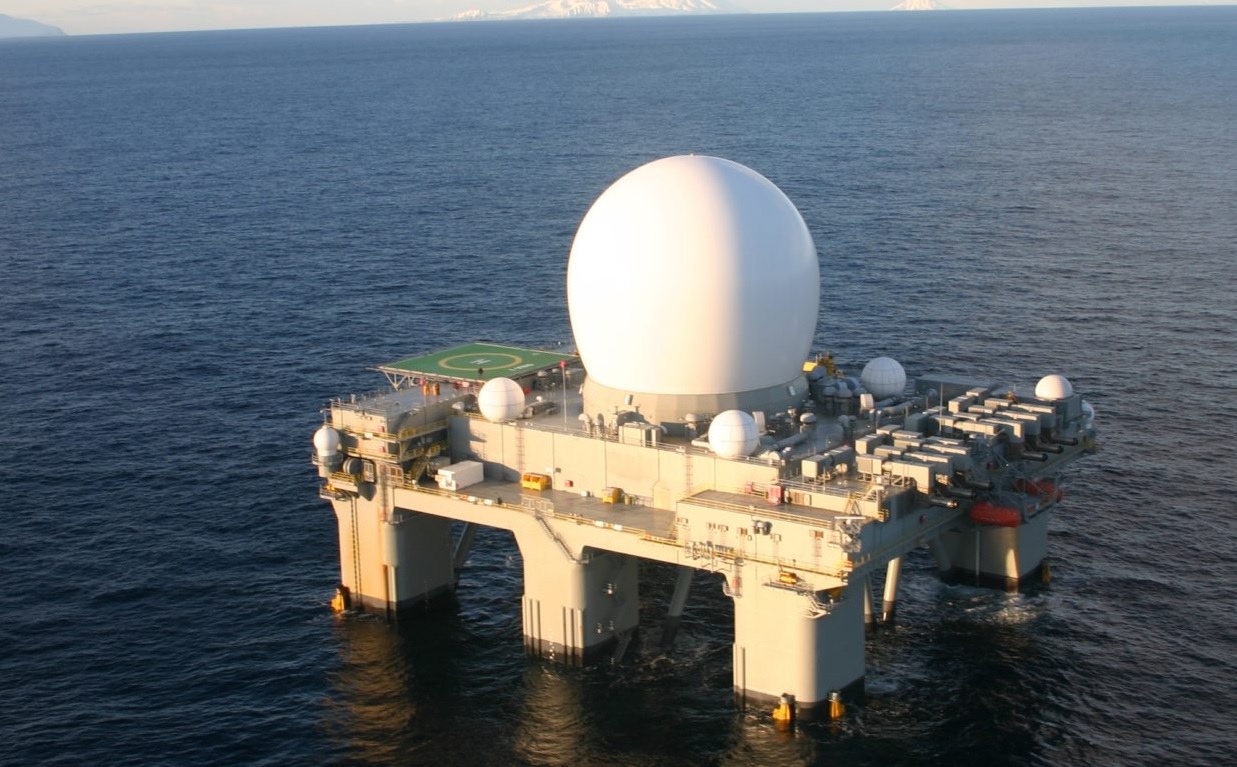
The U.S. Department of Defense has selected TOTE Services Inc. to provide maintenance and operational support for the Sea-Based X-Band Radar (SBX-1), one of the most advanced elements of America’s missile defense network. The contract is valued at $311.4 million, covering an initial 12-month period, with options for four additional years and a possible six-month extension.
The SBX-1, operated by the Missile Defense Agency, is unique within the U.S. military. It is the only operational radar system mounted on a semi-submersible platform, making it mobile yet stable in rough seas. This capability allows the radar to be deployed where needed, providing highly accurate tracking of ballistic missile launches around the globe.
A Giant Eye in the Pacific
Developed by Raytheon, the SBX-1’s X-Band Radar (XBR) is housed inside a massive 31 x 37-meter dome, instantly recognizable by its distinctive white, golf-ball-like appearance. The heart of the radar is an octagonal phased-array antenna with a 384 m² physical aperture and a 248 m² active aperture, made up of more than 45,000 transmit/receive modules. This allows it to detect, track, and differentiate between real warheads and decoys during the midcourse phase of a missile’s flight.
The radar can rotate up to 270° horizontally and 85° vertically, scanning at a rate of 5–8 degrees per second. Its X-band frequency (8–12.5 GHz) makes it one of the most precise tracking systems ever built, able to spot objects the size of a baseball from thousands of kilometers away.
Engineering Marvel
The SBX-1 is as much a floating powerhouse as it is a radar station. Its enormous electronics and antenna require strict temperature control, maintained by a liquid cooling system circulating 3,634 liters of propylene glycol per minute. The platform itself displaces 32,690 tonnes, swelling to over 50,000 tonnes when fully ballasted for stability at sea.
-
Weight of radar dome: ~8,164 kg
-
Total platform weight: ~1,814 tonnes (radar and support systems)
-
Power: Eight Caterpillar C280-16 diesel generators (5,060 kW each)
-
Propulsion: Eight Wärtsilä FS 2150-663 azimuth thrusters, each with 3,300 kW electric motors
-
Maximum speed: 9 knots
-
Crew capacity: 85 personnel
-
Endurance: Up to 60 days without resupply
This engineering behemoth can reposition itself across oceans and remain on station for months at a time, making it a critical asset for monitoring missile threats.
From Oil Rig to Missile Shield
The SBX-1 was built on a Moss CS 50 semi-submersible oil platform, constructed at the Vyborg Shipyard in Russia in 2002. It was later converted for military use at Keppel AmFELS shipyard in Texas, with Boeing Integrated Defense Systems overseeing the design. The radar installation was completed in Corpus Christi, Texas, in 2005, when the massive dome was placed over the antenna.
Although officially homeported at Adak Island, Alaska, the SBX-1 has been based in Pearl Harbor, Hawaii, since 2009 following escalating North Korean missile tests. It has carried out numerous high-profile deployments, including its longest sea mission of 661 days, which ended in 2022.
Strategic Significance
The SBX-1 is a cornerstone of the U.S. Ballistic Missile Defense System (BMDS). Unlike ground-based radars fixed in location, its mobility allows it to be positioned to monitor adversary missile launches in real time, providing data to interceptor systems such as the Ground-Based Midcourse Defense (GMD).
Its strategic value is especially high in the Indo-Pacific region, where missile tests from North Korea and China pose ongoing challenges. Analysts note that the SBX-1’s ability to distinguish between live warheads and decoys makes it a vital link in ensuring that limited interceptor missiles are used effectively in a real conflict.
With the new contract awarded, the Pentagon ensures the SBX-1 will remain operationally ready for at least the next half decade. As the U.S. faces a rapidly evolving missile landscape—ranging from hypersonic threats to swarming decoys—the platform will continue to act as America’s floating radar fortress, combining cutting-edge technology with unmatched mobility.
✍️ This article is written by the team of The Defense News.