U.S. Deploys 11 Warships and 15,000 Troops Near Venezuela, Largest Caribbean Buildup in Decades
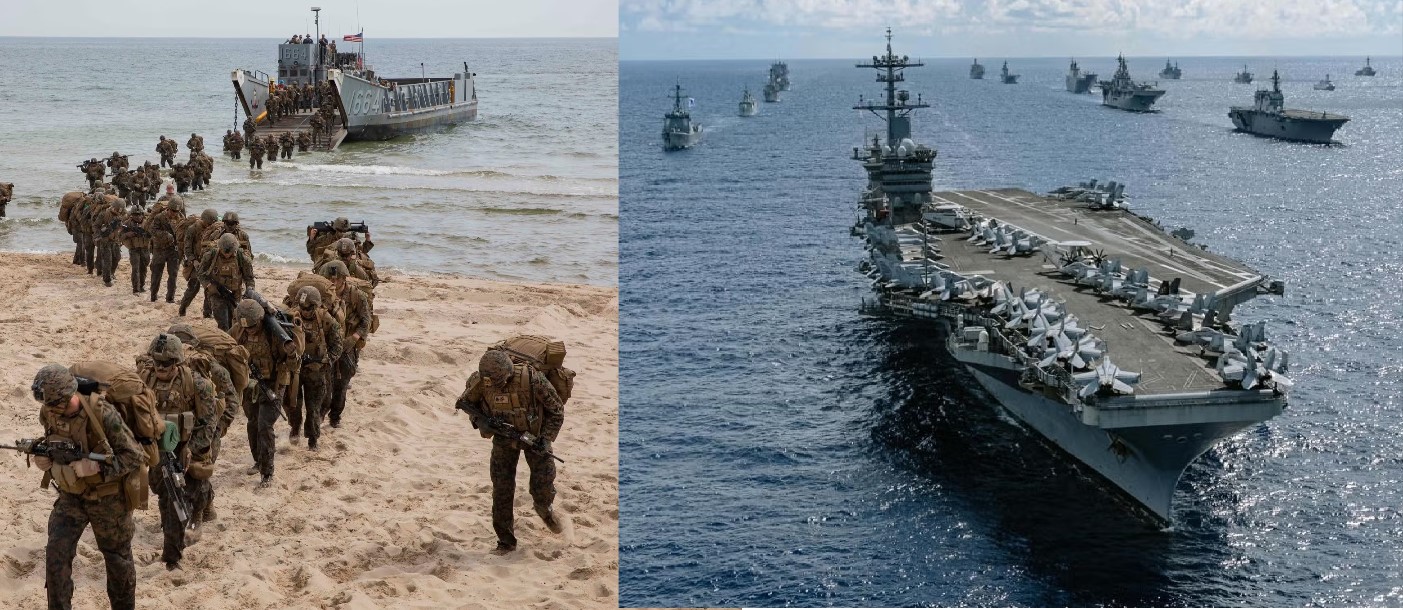
The United States has sent 11 warships, about 15,000 troops, and the aircraft carrier USS Gerald R. Ford to the waters near Venezuela, according to a December 1 Newsmax report. This large movement marks a serious increase in U.S. naval activity in the Caribbean and has raised concern in Venezuela and across the region.
What’s in the Water
The central element of the deployment is the USS Gerald R. Ford, the most advanced and powerful aircraft carrier in the U.S. Navy. According to publicly available details, the Ford strike group includes more than 4,000 sailors and carries a full complement of aircraft — over 100 tactical jets and support planes — giving the U.S. the capacity for rapid air operations.
In addition to the carrier, the broader fleet reportedly includes multiple destroyers, cruisers, amphibious ships, and support vessels, creating a formidable naval presence. Satellite imagery shows the Ford strike group operating in Caribbean waters close to the U.S. Virgin Islands, putting it well within reach of Venezuelan coastlines.
The roughly 15,000 troops include marines embarked on ships, personnel at nearby bases (including a reactivated Roosevelt Roads base in Puerto Rico), and support staff. The U.S. has also reactivated Roosevelt Roads Naval Station in Puerto Rico as part of the logistics backbone for ongoing operations.
Official Justification: Counter-Narcotics, Regional Security
The U.S. government frames this build-up largely as part of a broad campaign to target drug trafficking from Venezuelan waters and “transnational criminal organisations.” The deployment is said to bolster the capacity to monitor maritime traffic, intercept narcotics shipments, and carry out operations against suspected trafficking vessels.
This campaign is officially designated Operation Southern Spear. According to public documents, it aims to “crush the cartels, stop the poison and keep America safe.” As part of the operation, the U.S. Navy, Coast Guard, and other agencies are coordinating surveillance, interdiction, and — when deemed necessary — lethal force against boats suspected of carrying illicit drugs.
Strategic Undertones : A Posture with Broader Implications
Although U.S. officials emphasize counter-narcotics, analysts and critics argue that the scale and proximity of the deployment signal broader strategic aims, potentially including pressure on the Venezuelan government led by Nicolás Maduro. The carrier’s capacity to launch sustained air operations, combined with the support fleet and ground forces, gives the U.S. the option for rapid military strikes.
Observers note that this is the largest U.S. naval presence in the Western Hemisphere in decades — with some comparing it to the scale of Cold War-era deployments.
Moreover, the rapid reactivation of military infrastructure such as Roosevelt Roads in Puerto Rico suggests the U.S. is establishing a semi-permanent staging ground — not simply a temporary mission — hinting at long-term geopolitical intent.
Response from Venezuela and Regional Fallout
The government in Caracas has sharply condemned the deployment, viewing it as a provocation and potential prelude to aggression. Venezuelan officials have accused the U.S. of preparing a “maritime siege” and indicated readiness for retaliation if sovereignty is violated.
Regional actors have also expressed concern. The presence of U.S. warships and marines near islands and nations in the Caribbean has ignited diplomatic unease. Some countries fear being drawn into an escalating confrontation, potentially undermining regional stability.
What’s Next
U.S. military and political authorities have not ruled out further actions. According to recent reporting, the U.S. is “preparing additional operations” in the coming days, possibly including covert actions or strikes should Washington decide to escalate.
Yet the human, political, and legal risks are substantial. Any miscalculation — whether a maritime confrontation, accidental strike, or broader intervention — could trigger a wider conflict in the region, drawing in not only Venezuela but neighboring Caribbean nations.
For now, the world watches as the largest U.S. naval force in decades looms near Venezuela — its intentions proclaimed as anti-narcotics and regional security, but its presence raising fundamental questions about sovereignty, intervention, and the future of American influence in Latin America.
✍️ This article is written by the team of The Defense News.